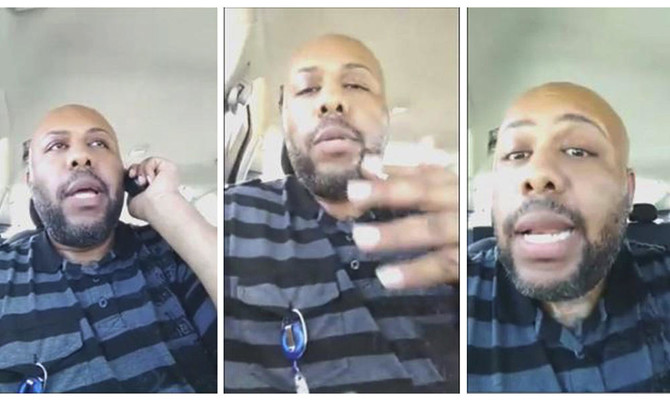
CLEVELAND: Police in Ohio have urged residents in surrounding states to be on alert for a man who they said shot and killed an elderly passerby seemingly at random and then posted a gruesome video of the killing on Facebook.
Steve Stephens, 37, was wanted on a charge of aggravated murder in the death of Robert Godwin Sr. in Cleveland.
In a statement on Monday, police warned residents of Pennsylvania, New York, Indiana and Michigan to be on the lookout for Stephens, who they said may have traveled out of state.
In the video, which appears shaky, Stephens gets out of his car and appears to randomly target Godwin, 74, who is holding a plastic shopping bag. Stephens says the name of a woman, whom Godwin does not seem to recognize.
“She is the reason that this is about to happen to you,” Stephens tells Godwin before pointing a gun at him. Godwin can be seen shielding his face with the shopping bag.
Facebook said the suspect did go live on the social media website at one point during the day, but not during the killing. Police earlier had said that Stephens had broadcast it on Facebook Live.
The video of the killing was on Facebook for about three hours before it was removed. Stephens Facebook page also was eventually removed.
“This is a horrific crime and we do not allow this kind of content on Facebook,” said a company spokesperson.
“We work hard to keep a safe environment on Facebook, and are in touch with law enforcement in emergencies when there are direct threats to physical safety.”
The victim’s son, Robert Godwin Jr., told Cleveland.com that he can’t bring himself to watch the video.
“I have not watched the video. I have not even looked at my cellphone or the news,” Godwin said.
“I don’t really want to see it.”
He said his father, a retired foundry worker, collected aluminum cans and often walked with a plastic shopping bag, picking up can from the ground. The son said he believed his father was looking for cans on Sunday when Stephens approached him.
In a separate video posted on Facebook, Stephens claimed to have killed more than a dozen other people.
“Like I said, I killed 13, so I am working on 14 as we speak,” he said.
Police have not verified any other shootings or deaths, Police Chief Calvin Williams said.
“There are no more victims that we know are tied to him,” he said.
Police said they have been talking with family and friends of Stephens, who is a case manager at Beech Brook, a behavioral health agency headquartered in Pepper Pike, near Cleveland.
“We were shocked and horrified to learn of this news today,” agency spokeswoman Nancy Kortemeyer said in a statement.
“We are hoping that the Cleveland Police will be able to apprehend Mr. Stephens as soon as possible and before anyone else is injured.”
In one of the videos, Stephens can be seen holding up his Beech Brook employee identification badge.
“I am killing with my Beech Brook badge on too,” he says.
Stephens also mentioned his fraternity, Omega Psi Phi, in one of his Facebook posts. The fraternity issued a statement Sunday night.
“On behalf of the Supreme Council and the members of Omega Psi Phi Fraternity, Incorporated, we lift our sincere and heartfelt prayers and condolences of comfort to the families impacted by the recent shooting in Cleveland, Ohio,” it said.
Police said Stephens should be considered armed and dangerous.
The FBI said it was assisting in the investigation.

Search widens for Facebook murder suspect
In Philippine presidential palace, staffers share generations of haunted stories
- Built in 1750, Malacanang has been serving as seat of power since Spanish colonial times
- Ghost tales are so ingrained in the palace that staffers find it difficult to avoid their impact
MANILA: In Malacanang, the presidential palace of the Philippines, residents come and go usually every five years, but some are believed to have lingered for centuries, haunting its historical corridors with their mysterious presence.
Built in 1750 as a summer house for a Spanish aristocrat, the palace was acquired by the Spanish government in 1825 and served as the residence of the colonial governor-general — first of Spain and from 1898, the US. When the Philippines gained full independence in 1946, it remained its seat of power.
The building’s halls and walls have seen centuries of history and remain witnesses not only to politics but also to episodes that those who have worked there say they had to accustom themselves to: from phantom footsteps to a headless figure wearing the barong — the traditional Filipino shirt — complaining voices, or a waiter reporting for work long after his death.
Ignacio Bunye, press secretary during the administration of former President Gloria Macapagal-Arroyo, told Arab News that some officials, including Eduardo Ermita — executive secretary of the Philippines from 2004 to 2010 — took it seriously.
“In Secretary Ermita’s office, you’ll see so many medallions and little images of the Virgin Mary pasted on the windows. He even had his office blessed every now and then. Word is there’s a lot of strange apparitions in his office,” Bunye said.
“There are also stories about the sound of chains — clinking or being dragged. They hear those in other offices.”
Ghost tales are so ingrained in the palace environment that it is difficult to avoid their impact.
One evening, when Bunye stopped by his office after a palace dinner, he heard footsteps outside and then someone tried to turn his room’s doorknob.
“Fortunately, the door had automatically locked when I came in. I felt my hair stand on end. After a while, the footsteps moved away,” he said.
Once everything was quiet, he hurried out of the room and in the hallway saw a white-haired man in a suit, who slowly turned toward him and in a raspy voice, asked: “How do I get out of here?”
The person turned out to be his colleague.
“I sighed in relief. It was Justice Secretary Raul Gonzales,” Bunye said. “He had only been appointed to the Cabinet a week earlier and still didn’t know his way around the palace.”
But others who recall scary sightings have found no rational explanation. A documentary film released by Malacanang for last year’s Halloween had some of them share their stories.
Sgt. Ramson Gordo, a member of the Presidential Security Group, was on night duty when he noticed something odd in the main lobby. He saw three guards wearing the barong, while he knew there could be only two. When he approached the lobby and asked about the third man, he was told there were only two of them.
“There’s also a story of someone who took a photo of the palace’s main lobby. That was also nighttime and there was no one in there,” Gordo said. “When he looked at the picture, there was a person wearing a barong, but with no head.”
Riza Mulet, who usually arrives at work at 6:30 a.m., recounts seeing a man greeting her in the morning.
“He wasn’t familiar to me, but he said, ‘Good morning,’ so I greeted him back … I turned to look at him, but suddenly, he was gone,” she said.
When she told her colleagues that a tall man with a smiling face who looked like a waiter had greeted her and she asked if they knew him, they went silent and told her he had died during the COVID-19 pandemic.
Her second sighting was during a tour of the palace. She saw a man standing beside two antique chairs that had been used by former presidents.
“We were joking, teasing, saying ‘We will sit on them’. Then he got angry, really angry … I made the mistake of looking him in the eyes, so I just bowed my head because he came closer to me. My hands turned cold, and my hair stood on end,” Mulet said.
Her colleagues pulled her away from the place — not all of them aware of what had happened.
“You have to learn to coexist with those who can’t be seen by most people. I can see them, but not everyone can,” she said.
“You have to learn to live with them.”