JEDDAH: The King Salman Center for Relief and Humanitarian Aid (KSRelief) has provided health and medical services to Yemeni civilians in the crisis-hit country.
The KSRelief carried out health and medical projects in Yemen and in Saudi Arabia in cooperation with the Ministry of Health, and in Jordan at the Jordanian Red Crescent Hospital in Amman. It also provided services in Sudan in cooperation with the Sudanese Red Crescent Society.
Center officials say they are committed to treat Yemeni patients and to provide care for their relatives until their return to their country. They are establishing medical clinics in Abkh province in the Republic of Djibouti and running it to provide medical care for Yemeni refugees in the camp that cares for more than 2,550 refugees.
The center also implemented health projects to treat injured civilians in Yemen.
The KSRelief has secured medical supplies in the governorates of Aden, Hadramout, Marib, Saada and Taiz where the number of treated patients reached 22,500.
The KSRelief deployed Sudanese medical staff to provide medical services in Yemen. They provided emergency medical services to Yemen’s women and children in order to reduce morbidity and mortality rates. The project benefited 7.5 million people.
It also provided preventive interventions for saving the lives of girls and boys under 5 years old in addition to pregnant and lactating women. The project benefited 2.7 million people.
The KSRelief supported water and environmental sanitation services, and provided drinking water and sewage in the governorates of Aden, Taiz, Sanaa, Lahj and Ibb. The number of beneficiaries of the project reached 13.3 million people.
The KSRelief established and operated Al-Salam Hospital in Saada governorate where the number of beneficiaries of the project reached 356,322 individuals.
The KSRelief worked to establish and operate the Saudi Hospital in Hajah governorate by providing medical equipment and care. The project benefited 270,000 people.
The center provided the arterial blood gas (ABG) device to the military hospital in Sanaa for patients with heart disease. The project benefited 15,300 individuals.
The KSRelief also set up and operated the Marib General Hospital, providing medical equipment, and comprehensive care and testing for patients in Marib governorate to benefit 74,480 people.
The center, in cooperation with the Saudi National Campaign for the Relief of the Somali People, dug two wells along with a water desalination plant in Yemen refugee camp in Abkh province in the Republic of Djibouti to provide drinking water for Yemeni refugees. The number of beneficiaries reached 3,902 individuals.


KSRelief provides health services to Yemeni people
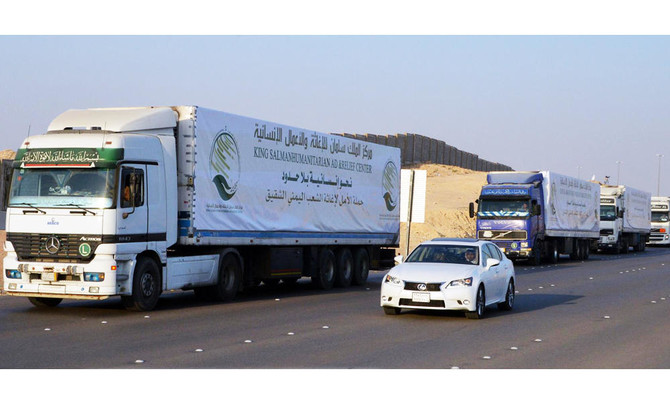
KSRelief provides health services to Yemeni people

Pakistan, Saudi Arabia explore joint investment push in high-growth regions
- Both sides discuss combining Pakistan’s production capacity with Saudi capital and regional market access
- Government says Saudi side expressed interest in corporate farming in Pakistan, particularly in rice sector
KARACHI: Pakistan and Saudi Arabia are looking to jointly tap high-growth regional markets and align production and capital strengths, according to an official statement on Wednesday, following talks between Commerce Minister Jam Kamal Khan and Saudi Investment Assistant Minister Ibrahim Al-Mubarak in the Kingdom.
The two countries have long maintained close bilateral ties that have evolved into a multidimensional strategic partnership.
In October last year, the two countries launched an Economic Cooperation Framework aimed at shifting relations beyond aid toward sustainable trade, investment and development links. The framework followed the signing of a joint security agreement a month earlier, under which aggression against one would be treated as an attack on both.
“A key focus of the discussion was the joint exploration of regional markets, particularly Central Asia, Africa, and ASEAN, identified as high-growth regions offering significant opportunities for collaboration,” according to a statement circulated by Pakistan’s commerce ministry after the meeting.
“The two sides agreed that Pakistan and Saudi Arabia, by leveraging their respective strengths, can position themselves as complementary partners — combining Pakistan’s production capabilities with Saudi Arabia’s capital strength, market access, and regional connectivity,” it added.
The Saudi side expressed interest in corporate farming in Pakistan, particularly in the rice sector, with discussions covering mechanization, storage and logistics to enable consistent, long-term exports under structured arrangements.
Talks also covered broader cooperation in agriculture and food security, including rice, fodder, meat and other agri-products, with the potential involvement of Saudi financing institutions in supporting export-linked agricultural and infrastructure projects.
Corporate farming and mechanization were discussed as long-term solutions to productivity challenges in crops such as cotton, where declining yields and high manual input costs have hurt competitiveness, the statement said.
Human resource development emerged as another area of focus, with both sides noting shortages in mid-tier skills such as nurses, caregivers, technicians and hospitality staff.
The Saudi side expressed openness to replicating vocational “train-to-deploy” models in Pakistan that link training programs directly with overseas employment opportunities.
The meeting also examined opportunities in building materials, pharmaceuticals, sports goods, footwear and light manufacturing, with both sides agreeing to pursue sector-specific workshops and business-to-business engagements to translate policy alignment into tangible trade and investment flows.


