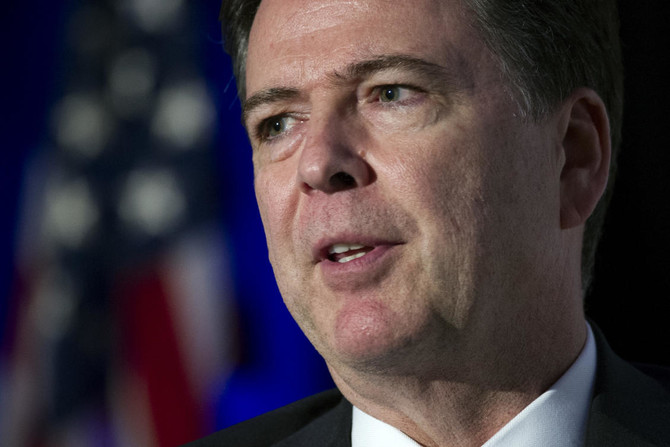
WASHINGTON: FBI Director James Comey said Americans should be aware of foreign efforts to undermine confidence in US elections and mindful of the possibility that what they’re reading might be part of an organized disinformation campaign.
US adversaries, including Russia last year, have “used all kinds of vectors to try and influence and undermine our own faith in our democratic processes” and have relied on increasingly sophisticated tactics, the FBI director warned.
Speaking at a Newseum event Wednesday night, he said the FBI would be transparent in publicly calling out efforts to meddle in American politics and that the public also should take steps to guard against foreign influence.
“The most important thing to be done is people need to be aware of the possibility that what they’re reading has been shaped by troll farms looking to push a message on Twitter to undermine our confidence” about the electoral process, Comey said.
US intelligence agencies said in a January report that Russian efforts to interfere in last year’s American presidential election in favor of Republican Donald Trump included paid social media users, or “trolls.” Part of the goal was to spread information to “denigrate” Democratic presidential nominee Hillary Clinton, who lost the November election, according to the report.
The FBI is investigating, including whether the Kremlin coordinated with Trump campaign associates.
During a question-and-answer session, Comey said the FBI would do everything it could to “identify, investigate and then call out foreign efforts” to influence an election.
“One of the most important things we can do is be transparent about efforts to interfere with our process ‘cause then those interference efforts lose some of their force,” he said.
Comey has drawn criticism for publicly commenting on an investigation about Clinton’s use of a private e-mail server last year while not acknowledging an FBI investigation into potential coordination between the Trump campaign and Russia.
His remarks about the Clinton case at a July news conference came after the FBI had concluded the investigation and determined that charges were not warranted. When Comey wrote Congress in October to say newly discovered e-mails had been found that needed to be reviewed, he said he was following a commitment to lawmakers to update them on new developments.
The FBI does not generally discuss open or ongoing investigations. The FBI has said its counterintelligence investigation began last July.
On Wednesday night, he acknowledged the FBI “did a lot last year that confused people.”
“If you see the world through sides, the FBI doesn’t make a lot of sense to you ‘cause you’re saying, ‘Why did they help this person?’” and hurt someone else, Comey said.
“We don’t see the world that way. We are not on anybody’s side, we really don’t care. We’re trying to figure out what’s true, what’s fair, what’s the right thing to do,” he added.
The question-and-answer session took place following a public showing of an episode of a new USA Network documentary series, “Inside the FBI: New York.”

FBI director: Public should know of agenda-driven fake news
2025 among world’s three hottest years on record, WMO says
- All eight datasets confirmed that the last three years were the planet’s three hottest since records began, the WMO said
- The slight differences in the datasets’ rankings reflect their different methodologies and types of measurements
BRUSSELS: Last year was among the planet’s three warmest on record, the World Meteorological Organization said on Wednesday, as EU scientists also confirmed average temperatures have now exceeded 1.5 degrees Celsius of global warming for the longest since records began.
The WMO, which consolidates eight climate datasets from around the world, said six of them — including the European Union’s European Center for Medium-Range Weather Forecasts (ECMWF) and the British national weather service — had ranked 2025 as the third warmest, while two placed it as the second warmest in the 176-year record.
All eight datasets confirmed that the last three years were the planet’s three hottest since records began, the WMO said. The warmest year on record was 2024.
THREE-YEAR PERIOD ABOVE 1.5 C AVERAGE WARMING LEVEL
The slight differences in the datasets’ rankings reflect their different methodologies and types of measurements — which include satellite data and readings from weather stations.
ECMWF said 2025 also rounded out the first three-year period in which the average global temperature was 1.5 C above the pre-industrial era — the limit beyond which scientists expect global warming will unleash severe impacts, some of them irreversible.
“1.5 C is not a cliff edge. However, we know that every fraction of a degree matters, particularly for worsening extreme weather events,” said Samantha Burgess, strategic lead for climate at ECMWF.
Burgess said she expected 2026 to be among the planet’s five warmest years.
CHOICE OF HOW TO MANAGE TEMPERATURE OVERSHOOT
Governments pledged under the 2015 Paris Agreement to try to avoid exceeding 1.5 C of global warming, measured as a decades-long average temperature compared with pre-industrial temperatures.
But their failure to reduce greenhouse gas emissions means that target could now be breached before 2030 — a decade earlier than had been predicted when the Paris accord was signed in 2015, ECMWF said. “We are bound to pass it,” said Carlo Buontempo, director of the EU’s Copernicus Climate Change Service. “The choice we now have is how to best manage the inevitable overshoot and its consequences on societies and natural systems.”
Currently, the world’s long-term warming level is about 1.4 C above the pre-industrial era, ECMWF said. Measured on a short-term basis, average annual temperatures breached 1.5 C for the first time in 2024.
EXTREME WEATHER
Exceeding the long-term 1.5 C limit would lead to more extreme and widespread impacts, including hotter and longer heatwaves, and more powerful storms and floods. Already in 2025, wildfires in Europe produced the highest total emissions on record, while scientific studies confirmed specific weather events were made worse by climate change, including Hurricane Melissa in the Caribbean and monsoon rains in Pakistan which killed more than 1,000 people in floods.
Despite these worsening impacts, climate science is facing political pushback. US President Donald Trump, who has called climate change “the greatest con job,” last week withdrew from dozens of UN entities including the scientific Intergovernmental Panel on Climate Change.
The long-established consensus among the world’s scientists is that climate change is real, mostly caused by humans, and getting worse. Its main cause is greenhouse gas emissions from burning fossil fuels like coal, oil and gas, which trap heat in the atmosphere.