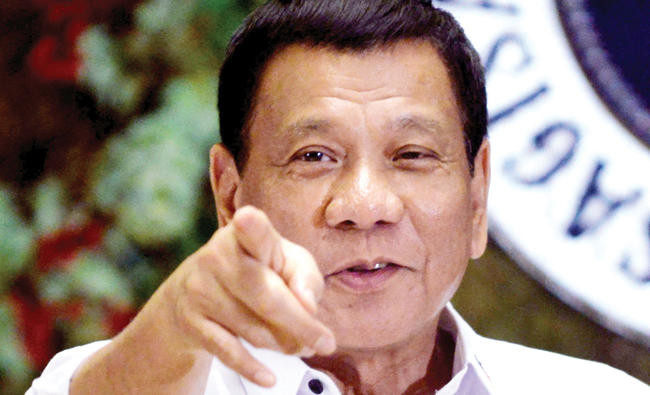
DOHA: With more than a million Filipino workers spread across Saudi Arabia, Bahrain and Qatar, it is small wonder that President Rodrigo Duterte has undertaken a weeklong tour of the Gulf.
The migrants have been drawn to the region by a combination of factors — drug crime and corruption back home, and the job opportunities and wages on offer in the Gulf.
Duterte’s deadly war on drugs may have brought him notoriety in the West, but it has earned him the admiration of many Filipino expatriates anxious for change at home.
“I would happily say I’m a ‘DDS’, a Diehard Duterte Supporter,” Harry Ramos, a senior mechanical engineer based in Doha for 12 years, told AFP. “His platform of government is simple, and he’s got the political will to do it.”
Duterte’s populist agenda went down well with the Filipino diaspora in Qatar, where he received almost 80 percent of the expatriate votes cast in last year’s presidential election.
Ramos, 58, speaks happily about how Filipinos returning home no longer have to bribe officials to get through customs, thanks to Duterte’s crackdown.
Life though has turned sour for some in the Gulf and they will be looking to the president to defend their interests in his talks with the region’s leaders. Duterte held talks with Saudi leaders on Tuesday and was in Bahrain for talks on Thursday. On Friday, he flies into Qatar.
“He will discuss with these leaders matters relevant to the welfare and dignity of the Filipinos living in their countries, as well as explore avenues of economic and political cooperation,” Philippine Assistant Foreign Secretary Hjayceelyn Quintana said.
In the bustling Souq Waqif area of the Qatari capital Doha, Duterte’s trip has prompted an air of expectation.
On a balmy early summer evening, with temperatures touching the low 30 degrees Celsius, conversation outside the busy Manila Supermarket quickly turns to the president’s visit.
Ray, a 38-year-old civil engineer, said he wanted to meet Duterte in person, something he could never achieve back home.
He admitted there was an issue with the poor treatment of some migrants, especially those in domestic service, but said life was generally good for Filipinos in the country.
“All Filipinos come here because they want to earn money,” he said.
“But, if they had to choose the place they will live, of course, they will live in the Philippines, they will choose it. Definitely.”
Ray, who has been in Qatar for six years, said he earns “three or four times more” in Doha than he would back home.
Outside the Damascus International Gents Salon, hair stylist Jim, 27, said he earns around QR4,000 a month ($1,1000).
Back home he would earn the equivalent of $190 at a barbershop, he said.
Twenty-five-year-old Sunshine, who works in promotions, had never left the Philippines before heading to Qatar. Now she has been in Doha for three years.
“It’s better to leave first from the Philippines to earn money and then after a few years... you can go back,” she said.

Filipino expatriates in Gulf look to hardman Rodrigo Duterte
‘A den of bandits’: Rwanda closes thousands of evangelical churches
- A 2018 law introduced new rules on health, safety, and financial disclosures, and requires all preachers to have theological training
- Observers say the real reason for the closures comes down to control, noting that even those who complied with the law had been shut down
- President Kagame has described the church as a relic of the colonial period, a chapter of its history with which the country is still grappling
KIGALI: Grace Room Ministries once filled giant stadiums in Rwanda three times a week before the evangelical organization was shut down in May.
It is one of the 10,000 churches reportedly closed by the government for failing to comply with a 2018 law designed to regulate places of worship.
The law introduced new rules on health, safety, and financial disclosures, and requires all preachers to have theological training.
President Paul Kagame has been vocal in his criticisms of the evangelical churches that have sprouted across the small country in Africa’s Great Lakes region.
“If it were up to me I wouldn’t even reopen a single church,” Kagame told a news briefing last month.
“In all the development challenges we are dealing with, the wars... our country’s survival — what is the role of these churches? Are they also providing jobs? Many are just thieving... some churches are just a den of bandits,” he said.
The vast majority of Rwandans are Christian according to a 2024 census, with many now traveling long and costly distances to find places to pray.
Observers say the real reason for the closures comes down to control.
Kagame’s government is saying “there’s no rival in terms of influence,” Louis Gitinywa, a lawyer and political analyst based in Kigali, told AFP.
The ruling party “bristles when an organization or individual gains influence,” he said, a view also expressed to AFP by an anonymous government official.
‘Deceived’
The 2018 law requires churches to submit annual action plans stating how they align with “national values.” All donations must be channelled through registered accounts.
Pastor Sam Rugira, whose two church branches were shut down last year for failing to meet fire safety regulations, said the rules mostly affected new evangelical churches that have “mushroomed” in recent years.
But Kagame has described the church as a relic of the colonial period, a chapter of its history with which the country is still grappling.
“You have been deceived by the colonizers and you let yourself be deceived,” he said in November.
The closure of Grace Room Ministries came as a shock to many across the country.
Pastor Julienne Kabanda, had been drawing massive crowds to the shiny new BK Arena in Kigali when the church’s license was revoked.
The government had cited unauthorized evangelical activities and a failure to submit “annual activity and financial reports.”
AFP was unable to reach Kabanda for comment.
‘Open disdain, disgust’
A church leader in Kigali, speaking to AFP on condition of anonymity, said the president’s “open disdain and disgust” for churches “spells tough times ahead.”
“It is unfair that even those that fulfilled all requirements are still closed,” he added.
But some say the clampdown on places of worship is linked to the 1994 Rwandan genocide in which around 800,000 people, mostly ethnic Tutsis, were slaughtered.
Ismael Buchanan a political science lecturer at the National University of Rwanda, told AFP the church could sometimes act as “a conduit of recruitment” for the Democratic Forces for the Liberation of Rwanda (FDLR), the Hutu militia formed in exile in DR Congo by those who committed the genocide.
“I agree religion and faith have played a key role in healing Rwandans from the emotional and psychological wounds after the genocide, but it also makes no sense to have a church every two kilometers instead of hospitals and schools,” he said.
Pastor Rugira meanwhile suggested the government is “regulating what it doesn’t understand.”
It should instead work with churches to weed out “bad apples” and help them meet requirements, especially when it comes to the donations they rely on to survive, he said.