DAMASCUS: Syria’s strongman Bashar Assad has accused the West of fabricating a suspected chemical weapons attack that prompted an unprecedented US missile strike, in an exclusive interview with AFP in Damascus.
The embattled leader, whose country has been ravaged by six years of war, said his firepower had not been affected by the attack ordered by US President Donald Trump, but acknowledged that further strikes were possible.
He also insisted his forces had turned over all their chemical weapons stocks in 2013 and would never use the banned arms.
His comments came in an interview conducted at his office Wednesday, his first since a suspected chemical weapons attack that killed dozens of civilians in the rebel-held town of Khan Sheikhun.
“Definitely, a hundred percent for us, it’s fabrication,” he added of the incident which killed 87 people, including 31 children, according to the Britain-based Syrian Observatory for Human Rights monitor.
“Our impression is that the West, mainly the United States, is hand-in-glove with the terrorists. They fabricated the whole story in order to have a pretext for the attack,” said Assad, who has been in power for 17 years.
The suspected attack on Khan Sheikhun, in Syria’s northwestern province of Idlib, comes in the seventh year of the country’s brutal war, which has killed more than 320,000 people and displaced over half the population.
Assad said evidence of the suspected chemical attack came only from “a branch of Al-Qaeda,” referring to a former jihadist affiliate among the groups that control Idlib.
Images of the aftermath, showing victims convulsing and foaming at the mouth as desperate medics working with meagre resources struggled to treat them, caused global shock waves.
But Assad, who appeared relaxed, said it was “not clear whether it happened or not, because how can you verify a video? You have a lot of fake videos now.”
“We don’t know whether those dead children were killed in Khan Sheikhun. Were they dead at all?“
“Who committed the attack if there was an attack?“
Syria’s government signed the Chemical Weapons Convention and agreed to hand over its stockpiles in 2013, under a Russian-brokered deal.
The agreement averted US military action after a sarin attack on a rebel area outside Damascus that killed hundreds of people and was blamed by much of the international community on Assad’s government.
'No strategic value'
Damascus denied responsibility, but agreed to turn over its stockpiles, while continuing to wage war against opposition forces.
In recent months, Assad’s army has clawed back significant territory, including capturing the one-time rebel bastion of eastern Aleppo.
Key to the turnaround has been support from ally Russia, which launched a military intervention to bolster Assad in September 2015.
The Syrian president said his forces had no military reason to hit Khan Sheikhun, describing it as having no strategic value and being far from the current battlefront.
“This story is not convincing by any means,” he said.
The Organization for the Prohibition of Chemical Weapons has begun an investigation into the Khan Sheikhun incident, but Russia on Wednesday blocked a UN Security Council resolution demanding that Syria cooperate with the probe.
And Assad said he could “only allow any investigation when it’s impartial, when we make sure that unbiased countries will participate in this delegation in order to make sure that they won’t use it for politicized purposes.”
He insisted several times that his forces had turned over all chemical weapons stockpiles under the 2013 deal.
Expecting more US attacks
“There was no order to make any attack, we don’t have any chemical weapons, we gave up our arsenal a few years ago,” he said.
“Even if we have them, we wouldn’t use them, and we have never used our chemical arsenal in our history.”
The OPCW has blamed Assad’s government for at least two attacks in 2014 and 2015 involving the use of chlorine.
The Khan Sheikhun incident prompted the first direct US military action against Assad’s government since the war began, with 59 cruise missiles hitting the Shayrat airbase three days after the suspected chemical attack.
Assad said his Russian allies “didn’t warn us... because the Americans called them maybe a few minutes before.”
And he said more US attacks “could happen anytime, anywhere, not only in Syria.”
But he insisted his forces were unaffected by the US strike.
“Our firepower, our ability to attack the terrorists hasn’t been affected by this strike.”
Trump’s administration initially took a hands-off approach to Syria, with Assad raising the possibility the new US president could even be a “natural ally.”
But he said the American strike showed Washington was “not serious in fighting terrorists.”
International efforts to find a political solution to the Syrian crisis have proved fruitless, with successive rounds of talks producing no result.
The conflict has evolved into a complex multi-front war involving the regime, rebels, jihadists and Kurdish forces, as well as the Russian and Turkish militaries, and a US-led coalition fighting the Daesh group.


![]()
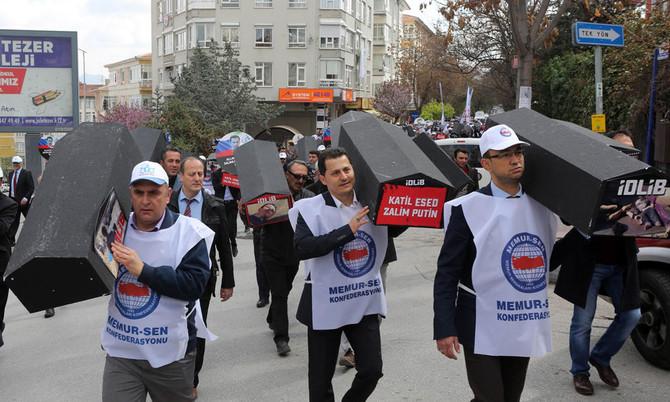
Assad says chemical attack ‘100% fabrication’
Assad says chemical attack ‘100% fabrication’
Latest updates


© 2026 SAUDI RESEARCH & PUBLISHING COMPANY, All Rights Reserved And subject to Terms of Use Agreement.