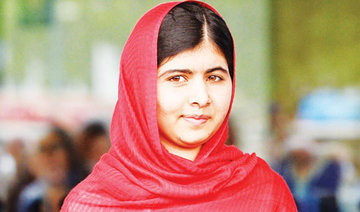
Malala Yousafzai given honorary Canadian citizenship

1 / 7
Pakistani Nobel Peace Laureate Malala Yousafzai leaves Parliament hill after receiving an honorary Canadian citizenship in Ottawa, Ontario, April 12, 2017. (AFP)
2 / 7
Pakistani activist and Nobel Peace Prize winner Malala Yousafzai, right, walks through the hall of honour with Prime Minister Justin Trudeau on Parliament Hill in Ottawa on Wednesday, April 12, 2017. (AP)
3 / 7
Prime Minister Justin Trudeau, right, and his wife Sophie Gregoire Trudeau, left, clap as Pakistani activist and Nobel Peace Prize winner Malala Yousafzai is paid tribute in the House of Commons on Parliament Hill in Ottawa on Wednesday, April 12, 2017. (AP)
4 / 7
Pakistani activist and Nobel Peace Prize winner Malala Yousafzai, left, is presented with an honorary Canadian citizenship by Prime Minister Justin Trudeau in on Parliament Hill in Ottawa on Wednesday, April 12, 2017. (AP)
5 / 7
Prime Minister Justin Trudeau shows Malala Yousafzai the guest book after arriving on Parliament Hill for her Honorary Canadian Citizenship ceremony in Ottawa on Wednesday, April 12, 2017. (AP)
6 / 7
Malala Yousafzai signs a guest book at Parliament Hill in Ottawa, Ontario, April 12, 2017. (AFP)
7 / 7
Malala Yousafzai meets with Canadian Prime Minister Justin Trudeau on Parliament Hill in Ottawa, Ontario on April 12, 2017. (AFP)
Updated 12 April 2017
Follow

Malala Yousafzai given honorary Canadian citizenship

TORONTO: Nobel Peace laureate Malala Yousafzai returned to Canada on Wednesday to receive her honorary citizenship and address the country’s lawmakers after her first visit to Parliament in 2014 was put off because of a terror attack.
Prime Minister Justin Trudeau presented her with a framed certificate of citizenship. She’s only the sixth person to receive the honor and the youngest ever.
The 19-year-old Pakistani activist was 15 when she shot in the head by Taliban militants while returning from school. She was targeted for advocating women’s education.
She won world acclaim for her campaign and was awarded the Nobel Peace Prize in 2014.
Malala originally was scheduled to receive honorary citizenship in October 2014, but the Canadian Parliament was stormed by an armed terrorist that day. The gunman killed a soldier standing guard at Ottawa’s war memorial shortly before storming Parliament in an attack that was stopped cold when he was shot to death.
“The man who attacked Parliament Hill called himself a Muslim — but he did not share my faith. He did not share the faith of one and a half billion Muslims living in peace around the world. He did not share our Islam — a religion of learning, compassion and mercy,” she said to applause.
Malala also praised Canada for welcoming more than 40,000 Syrian refugees, and appeared to add an appeal to the US as well.
“I pray that you continue to open your homes and your hearts to the world’s most defenseless children and families,” she said, “and I hope your neighbors will follow your example.”
And she joked about Trudeau, Canada’s 45-year-old prime minister.
“People are always talking about how young he is. They say he is the second youngest prime minister in Canada’s history. He does yoga, he has tattoos,” she said. “When I was coming here everyone was telling me to shake his hand and let us know how he looks in reality. People were just so excited for me to meet Trudeau. I don’t think anyone cared about the Canadian honorary citizenship.”
The other five honorary citizens are the Dalai Lama, the Aga Khan, Nelson Mandela, Burmese activist Aung San Suu Kyi and Swedish diplomat Raoul Wallenberg.


Journalists in Bangladesh demand protection amid rising attacks

Updated 5 sec ago
Follow

Journalists in Bangladesh demand protection amid rising attacks

  • Media industry in the South Asian country is being systematically targeted
  • Interim government blamed for failing to adequately respond to the incidents
DHAKA: Journalists, editors and owners of media outlets in Bangladesh on Saturday demanded that authorities protect them following recent attacks on two leading national dailies by mobs.
They said the media industry in the South Asian country is being systematically targeted in the interim government headed by Nobel Peace Prize laureate Muhammad Yunus. They said the administration failed to prevent attacks on the Daily Star, the country’s leading English-language daily, and the Prothom Alo, the largest Bengali-language newspaper, both based in Dhaka, the capital.
In December, angry mobs stormed the offices of the two newspapers and set fire to the buildings, trapping journalists and other staff inside, shortly after the death of a prominent Islamist activist.
The newspaper authorities blamed the authorities under the interim government for failing to adequately respond to the incidents despite repeated requests for help to disperse the mobs. Hours later, the trapped journalists who took shelter on the roof of the Daily Star newspaper were rescued. The buildings were looted. A leader of the Editors Council, an independent body of newspaper editors, was manhandled by the attackers when he arrived at the scene.
On the same day, liberal cultural centers were also attacked in Dhaka.
It was not clear why the protesters attacked the newspapers, whose editors are known to be closely connected with Yunus. Protests had been organized in recent months outside the offices of the dailies by Islamists who accused the newspapers of links with India.
On Saturday, the Editors Council and the Newspapers Owners Association of Bangladesh jointly organized a conference where editors, journalist union leaders and journalists from across the country demanded that the authorities uphold the free press amid rising tensions ahead of elections in February.
Nurul Kabir, President of the Editors Council, said attempts to silence media and democratic institutions reflect a dangerous pattern.
Kabir, also the editor of the English-language New Age daily, said unity among journalists should be upheld to fight such a trend.
“Those who want to suppress institutions that act as vehicles of democratic aspirations are doing so through laws, force and intimidation,” he said.
After the attacks on the two dailies in December, an expert of the United Nations said that mob attacks on leading media outlets and cultural centers in Bangladesh were deeply alarming and must be investigated promptly and effectively.
“The weaponization of public anger against journalists and artists is dangerous at any time, and especially now as the country prepares for elections. It could have a chilling effect on media freedom, minority voices and dissenting views with serious consequences for democracy,” Irene Khan said in a statement.
Yunus came to power after former Prime Minister Sheikh Hasina fled the country amid a mass uprising in August, 2024. Yunus had promised stability in the country, but global human rights groups including Human Rights Watch and Amnesty International have blamed the government for its failure to uphold human and other civil rights. The Yunus-led regime has also been blamed for the rise of the radicals and Islamists.
Dozens of journalists are facing murder charges linked to the uprising on the grounds that they encouraged the government of Hasina to use lethal weapons against the protesters. Several journalists who are known to have close links with Hasina have been arrested and jailed under Yunus.