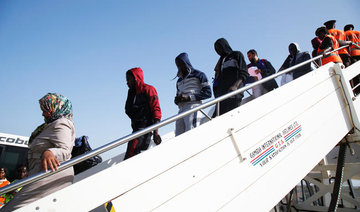
GENEVA: Growing numbers of African migrants passing through Libya are traded in what they call slave markets before being held for ransom, forced labor or sexual exploitation, the UN migration agency said on Tuesday.
West African migrants interviewed by the International Organization for Migration (IOM) have recounted being bought and sold in garages and car parks in the southern city of Sabha, one of Libya’s main migrant-smuggling hubs.
Migrants are traded for between $200 and $500 and are held on average for two or three months, Othman Belbeisi, head of the IOM’s Libya mission, told journalists in Geneva.
“Migrants are being sold in the market as a commodity,” he said. “Selling human beings is becoming a trend among smugglers as the smuggling networks in Libya are becoming stronger and stronger.”
The migrants — many from Nigeria, Senegal and Gambia — are captured as they head north toward Libya’s Mediterranean coast, where some try to catch boats for Italy.
Along the way they are prey to an array of armed groups and smuggling networks that often try to extort extra money in exchange for allowing migrants to continue.
Most migrants are used as day laborers in construction or agriculture. Some are paid and others are forced to work without pay.
“About women, we heard a lot about bad treatment, rape and being forced into prostitution,” Belbeisi said.
The IOM said it had spoken to one Senegalese migrant who was held in a Libyan’s private house in Sabha with about 100 others, who were beaten as they called their families to ask for money for their captors. He was then bought by another Libyan, who set a new price for his release.
Some migrants who cannot pay their captors are reportedly killed or left to starve to death, and when migrants die or are released, others are purchased to replace them, the IOM said.
Migrants are buried without being identified, with families back home uncertain of their fate.
“What we know is that migrants who fall into the hands of smugglers face systematic malnutrition, sexual abuse and even murder,” Mohammed Abdiker, IOM’s director of operations and emergencies, said in a statement. “We are hearing about mass graves in the desert.”
Libya is the main gateway for migrants attempting to reach Europe by sea, with more than 150,000 people making the crossing in each of the past three years.
So far this year an estimated 26,886 migrants have crossed to Italy, over 7,000 more than during the same period in 2016. More than 600 are known to have died at sea, while an unknown number perish during their journey north through the desert.

Migrants traded in ‘slave markets’ in Libya, UN agency says
US allows oil majors to broadly operate in Venezuela, new energy investments
- Treasury Department issues general license allowing Chevron, BP, Eni, Shell and Repsol to operate oil and gas operations in Venezuela
- Move is the most significant relaxation of sanctions on Venezuela since US forces captured and removed President Nicolas Maduro
WASHINGTON: The US eased sanctions on Venezuela’s energy sector on Friday, issuing two general licenses that allow global energy companies to operate oil and gas projects in the OPEC member and for other companies to negotiate contracts to bring in fresh investments. The move was the most significant relaxation of sanctions on Venezuela since US forces captured and removed President Nicolas Maduro last month.
The Treasury Department’s Office of Foreign Assets Control issued a general license allowing Chevron, BP, Eni, Shell and Repsol to operate oil and gas operations in Venezuela. Those companies still have offices in the country and stakes in projects, and are among the main partners of state-run company PDVSA.
The authorization for the oil majors’ operations requires payments for royalties and Venezuelan taxes to go through the US-controlled Foreign Government Deposit Fund.
The other license allows companies around the world to enter contracts with PDVSA for new investments in Venezuelan oil and gas. The contracts are contingent on separate permits from OFAC.
The authorization does not allow transactions with companies in Russia, Iran, or China or entities owned or controlled by joint ventures with people in those countries.
The licenses “invite American and other aligned companies to play a constructive role in supporting economic recovery and responsible investment, ” the US State Department said in a release. Additional authorizations may be issued “as necessary,” it said.
A spokesperson for Chevron, the only US oil firm currently operating in Venezuela, said the company welcomed the new licenses.
“The new General Licenses, coupled with recent changes in Venezuela’s Hydrocarbons Law, are important steps toward enabling the further development of Venezuela’s resources for its people and for advancing regional energy security,” the spokesperson said in a statement.
Eni said it is assessing the opportunities in Venezuela that the authorization opens up.
Oil law reform
The US licenses follow a sweeping reform of Venezuela’s main oil law approved last month, which grants autonomy for foreign oil and gas producers to operate, export and cash sale proceeds under existing joint ventures with PDVSA or through a new production-sharing contract model.
The US has had sanctions on Venezuela since 2019 when President Donald Trump imposed them during his first administration. Trump is now seeking $100 billion in investments by energy companies in Venezuela’s oil and gas sector. US Energy Secretary Chris Wright said on Thursday, during his second day of a trip to Venezuela, that oil sales from the country since Maduro’s capture have hit $1 billion and would hit another $5 billion in months.
Wright said the US will control the proceeds from the sales until Venezuela stands up a “representative government.” Since last month, the Treasury issued several other general licenses to facilitate oil exports, storage, imports and sales from Venezuela. It also authorized the provision of US goods, technology, software or services for the exploration, development or production of oil and gas in Venezuela.
The Venezuelan government expropriated assets of Exxon Mobil and ConocoPhillips in 2007 under then-President Hugo Chavez. The Trump administration is trying to get those companies to invest in Venezuela as well. At a meeting at the White House with Trump last month, Exxon Mobil CEO Darren Woods said Venezuela was “uninvestable” at the moment.
Wright said on Thursday that Exxon, which no longer has an office in Venezuela, is in talks with the government there and gathering data about the oil sector. Exxon did not immediately comment.


