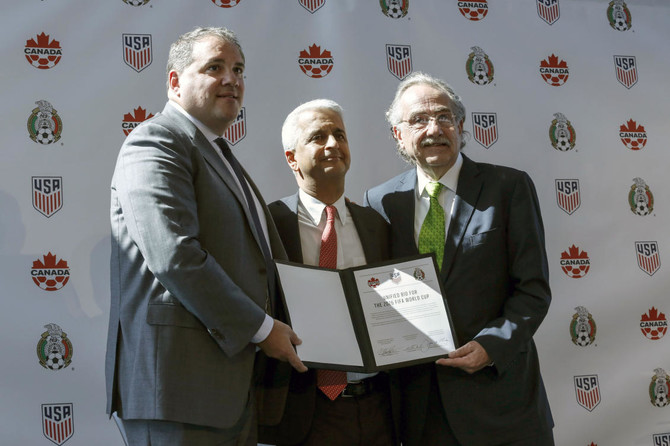
US, Mexico, Canada in joint bid for 2026 World Cup

Sunil Gulati, president of United States Soccer Federation, center, poses for a picture next to Victor Montagliani, CONCACAF president, left, and Decio de Maria, president of the Mexican Football Federation, after announcing the next soccer 2026 World Cup in North America during a press conference on Monday at the One World Trade Center in New York. (AFP)
Updated 11 April 2017
Follow

US, Mexico, Canada in joint bid for 2026 World Cup

NEW YORK: The US, Mexico and Canada on Monday announced a joint bid to stage the 2026 World Cup, aiming to become the first three-way co-hosts in the history of FIFA’s showpiece tournament.
US Soccer Federation chief Sunil Gulati, who announced the bid in New York with his Canadian and Mexican counterparts, insisted they had the full backing of President Donald Trump, despite the US leader’s rocky relations with Mexico.
Gulati said 60 of the tournament’s matches would be staged in the United States, with Canada and Mexico hosting 10 games each. The US would host all knockout games from the quarterfinals onwards, he added.
He played down the possibility that politics could hamper the bid, emphasizing that Trump was “especially pleased” with Mexico’s involvement.
“The president of the US is fully supportive... We are not at all concerned at some of the concerns that some people may raise,” Gulati said.
Trump was elected last year after a campaign marked by rhetoric against Mexico, vowing to build a wall to keep out illegal immigrants he branded “criminals” and “rapists.”
The joint bid will start as the heavy early favorite in the race, despite US prosecutors leading the probe into football corruption which rocked the sport in 2015 and led to the downfall of former FIFA supremo Sepp Blatter.
A bid from the North America region for 2026 had long been regarded as inevitable by FIFA watchers.
That sense of certainty hardened last year, when FIFA’s council ruled that neither Europe nor Asia would be eligible to run for the 2026 tournament on the grounds that the regions are hosting the next two World Cups. Russia is hosting the 2018 finals, followed by Qatar in 2022.
With Europe and Asia ineligible, CONCACAF could in theory face potential competition from the Africa, South America and Oceania regional confederations.
US soccer officials had been publicly coy about the possibility of a future World Cup bid since the country lost out to Qatar in the battle for the 2022 tournament at a corruption-tarnished vote in Zurich in 2010.
However, the prospect of a fresh American bid gathered momentum in 2014 after the World Cup in Brazil.
That campaign captured the imagination of US sports fans, with huge crowds attending public screenings of games at cities across the country.
The country’s club game is also booming, with record numbers attending Major League Soccer games in 2016.
The US also burnished its credentials as a major tournament host with last year’s 16-team Copa America Centenario.
The US first hosted the World Cup in 1994, staging a commercially successful 24-team tournament that played out to packed stadia.
The 1994 tournament remains the most attended World Cup in history, with just over 3.5 million fans flocking to its 52 games, an average of 68,991 per match.
Mexico has hosted the World Cup twice before — the 1970 finals won by a Pele-inspired Brazil and the 1986 tournament won by an Argentina team led by Diego Maradona.
Canada, who have only made one World Cup appearance when they were eliminated in the first round of the 1986 finals, has never hosted the tournament.
However, Canada earned plaudits for its staging of the Womens’ World Cup in 2015, which was won by the US in the final in Vancouver.
Under FIFA plans for its expanded 48-team World Cup, CONCACAF is awarded six berths. Gulati indicated that officials expected all three host nations to be granted places.
“There has never been a World Cup where the host countries have not been qualified,” Gulati said.
A tournament in North America is also likely to be attractive to FIFA for solid public relations reasons.
With dozens of modern, tournament-ready venues to choose from, there is little risk of stadiums being left to rot as white elephants following the event, a problem which has embroiled grounds used at the 2010 and 2014 World Cups.
“We have the luxury of having stadiums that already exist,” Gulati stated. “The thought of building sports facilities that don’t have a long-term use is not particularly inviting for anyone.”


Pakistan-born Australian Khawaja, set to retire from cricket, criticizes racial stereotypes

Updated 02 January 2026
Follow

Pakistan-born Australian Khawaja, set to retire from cricket, criticizes racial stereotypes

  • Usman Khawaja said he felt he was treated ‘a little bit different, even to now,’ because of his Pakistan and Muslim background
  • Khawaja was criticized in the days leading up to the Perth match for golfing twice, not taking part in an optional training session

Veteran Australia batter Usman Khawaja has announced he will retire from international cricket after the fifth Ashes test beginning Sunday at the Sydney Cricket Ground.

He didn’t go quietly.

The Pakistan-born Khawaja, who was the first Muslim to play for Australia, used his retirement announcement Friday to criticize the “racial” stereotyping he experienced during his career.

It will be the 39-year-old Khawaja’s 88th and final test — played at the ground where he began his first-class career. Khawaja scored his first Ashes century at the SCG with 171 against England in 2018.

It was also at that the SCG where he revived his career at age 35, scoring two centuries against England. That prompted one of the great late-career revivals, as Khawaja hit seven centuries in his next two years back in the side.

But Khawaja’s position had come under scrutiny and criticism this season after being unable to open in the first Ashes test in Perth due to back spasms and then missing the Brisbane test with the injury.

He was then initially left out in Adelaide until Steve Smith’s vertigo allowed Khawaja to return, before an 82 in the first innings there ensured he would stay in the side for the fourth test in Melbourne. Australia, with a 3-1 lead going into the fifth test, has retained the Ashes.

Khawaja said he felt he was treated “a little bit different, even to now,” because of his Pakistan and Muslim background.

“Different in the way I’ve been treated, different in how things have happened,” he said at a media conference in Sydney. “I had back spasms, it was something I couldn’t control. The way the media and the past players came out and attacked me . . . I copped it for about five days straight. Everyone was piling in.

“Once the racial stereotypes came in, of me being lazy, it was things I’ve dealt with my whole life. Pakistani, West Indian, colored players...we’re selfish, we only care about ourselves, we don’t care about the team, we don’t train hard enough.”

Khawaja was criticized in the days leading up to the Perth match for golfing twice and not taking part in an optional training session. Some commentators suggested the golf might have been responsible for his back issues.

“I can give you countless number of guys who have played golf the day before a match and have been injured, but you guys haven’t said a thing,” Khawaja told the assembled media.

“I can give you even more examples of guys who have had 15 schooners (large glasses of beer) the night before a game and have then been injured, but no one said a word because they were just being ‘Aussie larrikins,’ they were just being lads. But when I get injured, everyone went at my credibility and who I am as a person.”

Khawaja said he knew the end of his career was imminent.

“I guess moving into this series, I had an inkling this would be the last series,” he said. “I’m glad I can go out on my own terms.”

Khawaja has scored 6,206 runs at an average of 43.49 in his 87 tests with 16 centuries and 28 half-centuries.

“Usman has made a huge contribution to Australian cricket both through his outstanding achievements as one of our most stylish and resilient batters . . . and off field, particularly through the Usman Khawaja Foundation,” Cricket Australia chief executive Todd Greenberg said in a statement.

“Usman has been one of Australia’s most reliable opening batters and testament to his success was him being named ICC test cricketer of the year the same season that Australia won the World Test Championship (in 2023).”

Khawaja said his No. 1 emotion on announcing his retirement was “contentment.”

“I’m very lucky to have played so many games for Australia the way I have,” Khawaja said. “I hope I have inspired people along the way.”