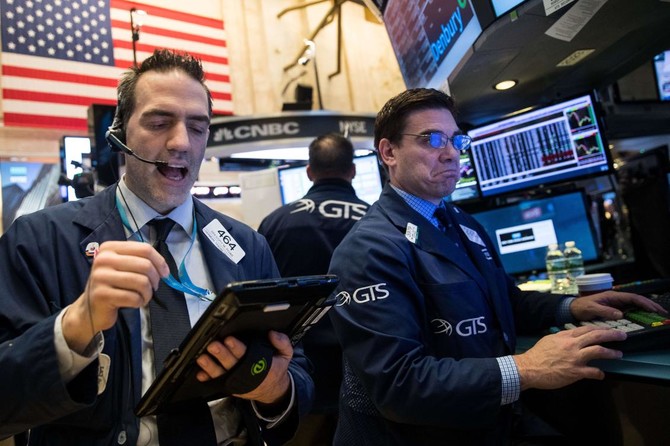
NEW YORK: Wall Street stock indexes rose on Monday as higher oil futures boosted the energy sector and investors placed their bets ahead of the US quarterly corporate earnings season.
However, US Treasury yields dipped in advance of the government’s $24 billion debt auction later in the day, part of its $56 billion sale of notes and bonds this week.
In commodities, oil prices rose around 1 percent, supported by strong demand and uncertainty over the conflict in Syria and another shutdown at Libya’s largest oilfield.
Brent crude futures, the international benchmark for oil prices, were up 57 cents at $55.81 per barrel. US West Texas Intermediate (WTI) crude futures were up 65 cents at $52.89 a barrel.
“Markets are taking some comfort in that,” said Jeffrey Kleintop, Chief Global Investment Strategist at Charles Schwab in Boston. “When we go below $50 investors worry about global weakness and concerns about the solvency and economies of oil producers like Russia and Saudi Arabia.”
The S&P’s energy sector was the biggest percentage gainer and strongest positive influence out of the benchmark’s 11 major sectors.
The Dow Jones Industrial Average rose 70.65 points, or 0.34 percent, to 20,726.75, the S&P 500 gained 6.67 points, or 0.28 percent, to 2,362.21 and the Nasdaq Composite added 14.71 points, or 0.25 percent, to 5,892.52.
Investors will also have their eye on the US earnings season, which kicks off this week with reports from some of the biggest banks.
“There’s some optimism among investors that the earnings reports are going to validate the rise in valuations we’ve seen over the last six months,” said Kleintop.
“The news on earnings will be good but I don’t know that it’ll be good enough to sustain all the gains we’ve seen over the last six months.”
In the currency market the dollar index, which tracks the greenback against six major currencies, was down slightly after touching its highest point in three weeks earlier in the day. The dollar had risen 0.5 percent Friday.
Benchmark 10-year Treasury yields were 2.364 percent, down 1 basis point from late on Friday, while the 30-year yield was 1 basis point lower at 2.988 percent.
The MSCI all world stock index was up 0.1 percent. The index has risen as much as 12.4 percent since early November to an intraday peak on March 21. It trades at 16 times forward earnings, compared to a 15-year average of about 14 times.
European stocks clung to a tiny 0.01 percent gain as investors there focused on geopolitical risks.
Top aides to US President Donald Trump differed on Sunday on where US policy on Syria was headed after last week’s attack on a Syrian air base, while US Secretary of State Rex Tillerson warned the strikes were a warning to other nations, including North Korea.
Ahead of this month’s French presidential vote, investors eyed the rise of far-left candidate Jean Luc Melenchon in polls as this raises the possibility he will square off against far-right leader Marine Le Pen.
“The market is focusing a bit too much on the extreme possibilities, but I guess with the elections coming up so soon some nerves are inevitable,” said DZ Bank strategist Christian Lenk.

US stocks rise with oil futures, investors await earnings
Saudi-French cooperation to localize veterinary vaccine manufacturing
RIYADH: In the presence of sector leaders, the National Livestock and Fisheries Development Program signed a memorandum of understanding with French company Ceva under the patronage of Minister of Environment, Water and Agriculture Abdulrahman bin Abdulmohsen Al-Fadhli, who also chairs the program’s board.
The agreement aims to localize vaccine manufacturing, transfer technology and technical expertise, and expand the industrial and commercial production of veterinary vaccines across the Kingdom.
According to the MoU, the two parties will work to achieve high efficiency in mass production scale-up and establish a clear path for sustainable commercial operation that meets the needs of the local and national market, as well as strengthen the biosecurity and food security system.
The MoU also includes the development and modernization of messenger RNA vaccine technologies, along with joint research and development of a Middle East Respiratory Syndrome vaccine for camels. This involves designing, evaluating, and developing vaccines specifically tailored to combat the virus.
The agreement also covers the development of a rabies vaccine and related solutions, as well as supporting national efforts to control the disease through vaccine provision, capacity building, and the implementation of integrated prevention strategies.
The collaboration between the program and Ceva aims to meet the needs of the poultry vaccine market in the Kingdom, currently estimated at around SR750 million ($199 million).
The company will work to cover approximately 30 percent of this market with an initial investment of around SR250 million.
With continued government support for poultry projects and increased production in the sector, the market is expected to grow at a rate exceeding 10 percent annually, reaching approximately SR1.25 billion by 2030.
The addition of the world’s leading poultry vaccine manufacturer to Biotech Park highlights the program’s key role in developing new industries within the livestock and fisheries sector.
It also highlights the program’s commitment to building international partnerships with global companies, organizations, research centers, and universities to support advanced biotechnology industries and attract high-quality investments. It also seeks to create new economic sectors based on biotechnology, enhance veterinary health security, and support the sustainable economic development of the livestock sector, as well as empower national and emerging companies and provide advanced research and industrial infrastructure.
This will solidify the Kingdom’s position as a global hub for biotechnology industries and the development of national capabilities.
Ceva is the first international partner to join Biotech Park, the future veterinary biotechnology city launched by the program in Dhurma Governorate. The city is the world’s first specialized and fully integrated hub for veterinary biotechnology, serving as a benchmark for sector development and a platform supporting markets across the Kingdom, the Gulf, the Middle East, Africa and beyond.
The signing of Ceva is a significant step, given its position as the world’s leading manufacturer of poultry vaccines and medicines, and one of the most prominent international companies in the field of biotechnology.
The MoU aims to localize the veterinary vaccine industry, ensuring its compatibility with the strains of poultry diseases prevalent in Saudi Arabia. This includes the transfer of technology and technical expertise from Ceva, along with the implementation of specialized training programs to guarantee that manufacturing facilities comply with international Good Manufacturing Practice standards.