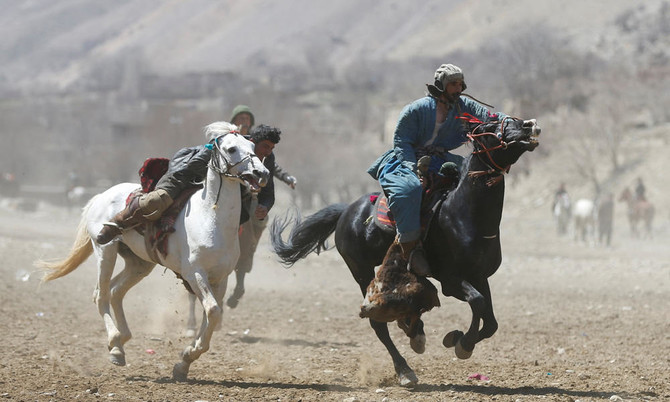
PANJSHIR, Afghanistan: A crash of horses and men deep in a mountain pass signals the start of another game of buzkashi, Afghanistan’s national sport.
Buzkashi, which translates roughly as “goat pulling,” has been played for centuries across Central Asia and is one of the most enduring and iconic symbols of Afghanistan.
It is a sport which is often violent, but designed to showcase the riders’ horsemanship and warrior spirit.
Amid foreign invasions, civil wars, and insurgent attacks, Afghans have gathered to cheer on their favorite “chapandaz,” as the riders are known.
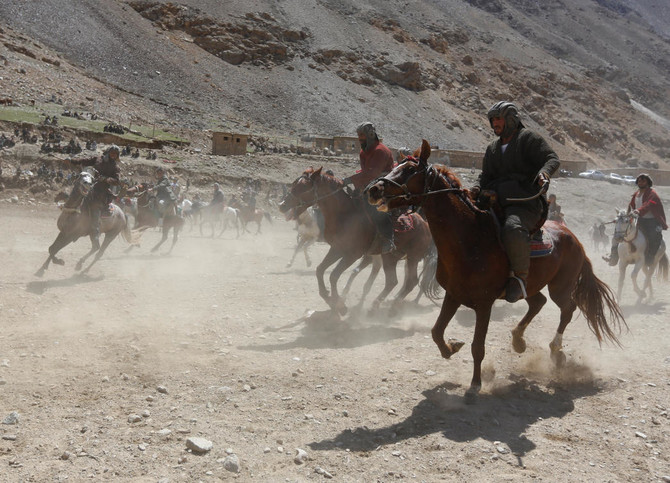
On Friday, a typical community match played out under the soaring, snow-capped peaks that surround the Panjshir Valley, north of Kabul.
Rusting hulks of Russian-made tanks and guns litter the Panjshir, testifying to the years of war when famed guerilla commander Ahmad Shah Massoud used the mountains to hold off first the Soviets, then the Taliban.
“It’s been almost fifty to sixty years that buzkashi matches have been happening on this site,” said Abdul Anaan, a spectator.
“I myself was a horseman and usually played buzkashi, and today many youth are interested in this game and playing it.”
The game typically involves riders on horses wrestling over half of a calf carcass, which is usually able to withstand the pounding better than goats.
Matches may involve individual players competing, or teams, often owned or sponsored by powerful warlords or other leaders.
In both cases, the goal is to carry the carcass and drop it on a target on the ground, all while dozens of other riders and horses grab, hit, kick, and struggle to tear the carcass away.
“If we fall down on the ground or get hurt it doesn’t mean that we are angry with each other,” said horseman Mohammed Hafiz. “This is just the rule of the game.”
Horses and riders regularly career into the crowds on the sidelines, sending spectators scrambling out of the way.
Occasionally a rider would escape the crush with a bleeding gash to their head or hands, only to wrap it up and return to the game.
Buzkashi matches can attract thousands of spectators and even some times make news, as was the case when Afghanistan’s First Vice President Abdul Rashid Dostum was accused of ordering his men to assault and abduct a political rival on the sidelines of a buzkashi game late last year.
For fans, however, the game’s significance will outlast the country’s current politics, just as it has outlasted previous wars.
“This sport is for the entertainment of our village, our people and our country,” said Anaan.

Traditional 'goat pulling' sport outlasts Afghan wars, politics
Arts festival’s decision to exclude Palestinian author spurs boycott
- A Macquarie University academic who researches Islamophobia and Palestine, Abdel-Fattah responded saying it was “a blatant and shameless act of anti-Palestinian racism and censorship,” with her lawyers issuing a letter to the festival
SYDENY: A top Australian arts festival has seen the withdrawal of dozens of writers in a backlash against its decision to bar an Australian Palestinian author after the Bondi Beach mass shooting, as moves to curb antisemitism spur free speech concerns.
The shooting which killed 15 people at a Jewish Hanukkah celebration at Sydney’s Bondi Beach on Dec. 14 sparked nationwide calls to tackle antisemitism. Police say the alleged gunmen were inspired by Daesh.
The Adelaide Festival board said last Thursday it would disinvite Randa Abdel-Fattah from February’s Writers Week in the state of South Australia because “it would not be culturally sensitive to continue to program her at this unprecedented time so soon after Bondi.”
FASTFACTS
• Abdel-Fattah responded, saying it was ‘a blatant and shameless act of anti-Palestinian racism and censorship.’
• Around 50 authors have since withdrawn from the festival in protest, leaving it in doubt, local media reported.
A Macquarie University academic who researches Islamophobia and Palestine, Abdel-Fattah responded saying it was “a blatant and shameless act of anti-Palestinian racism and censorship,” with her lawyers issuing a letter to the festival.
Around 50 authors have since withdrawn from the festival in protest, leaving it in doubt, local media reported.
Among the boycotting authors, Kathy Lette wrote on social media the decision to bar Abdel-Fattah “sends a divisive and plainly discriminatory message that platforming Australian Palestinians is ‘culturally insensitive.'”
The Adelaide Festival said in a statement on Monday that three board members and the chairperson had resigned. The festival’s executive director, Julian Hobba, said the arts body was “navigating a complex moment.”
a complex and unprecedented moment” after the “significant community response” to the board decision.
In the days after the Bondi Beach attack, Jewish community groups and the Israeli government criticized Prime Minister Anthony Albanese for failing to act on a rise in antisemitic attacks and criticized protest marches against Israel’s war in Gaza held since 2023.
Albanese said last week a Royal Commission will consider the events of the shooting as well as antisemitism and social cohesion in Australia. Albanese said on Monday he would recall parliament next week to pass tougher hate speech laws.
On Monday, New South Wales state premier Chris Minns announced new rules that would allow local councils to cut off power and water to illegally operating prayer halls.
Minns said the new rules were prompted by the difficulty in closing a prayer hall in Sydney linked to a cleric found by a court to have made statements intimidating Jewish Australians.
The mayor of the western Sydney suburb of Fairfield said the rules were ill-considered and councils should not be responsible for determining hate speech.
“Freedom of speech is something that should always be allowed, as long as it is done in a peaceful way,” Mayor Frank Carbone told Reuters.