Saudi-UK talks focus on security, trade

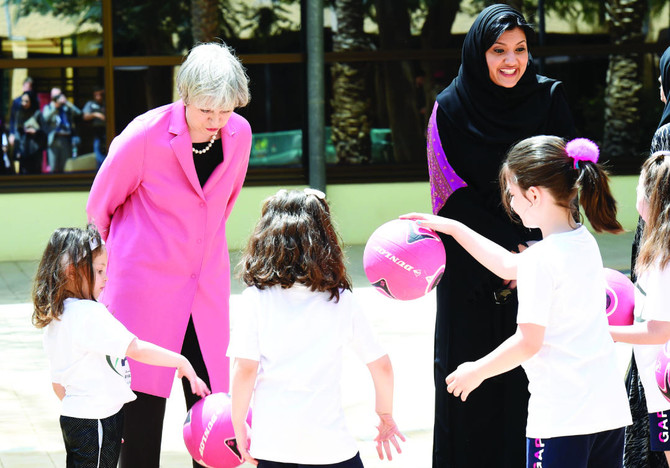
British Prime Minister Theresa May and Princess Reema bint Bandar, vice president for women’s affairs at the General Sports Authority, chat with Saudi girls during a basketball class at the Olympic Headquarters in Riyadh on Wednesday. (AFP)
Updated 06 April 2017
Follow

Saudi-UK talks focus on security, trade

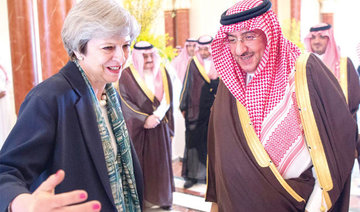
RIYADH: The Saudi-UK talks held in the capital Wednesday focused on security and strengthening business relationships between the two countries, said the Saudi Press Agency (SPA) in a statement following the meeting between King Salman and British Prime Minister Theresa May at Al-Yamamah Palace.
The two leaders discussed cooperation in bilateral relations.
The talks also focused on recent developments in regional and international situations.
During the meeting, King Salman awarded May the Order of King Abdulaziz.
The honor has in the past been awarded to other G-7 heads of state, including former US President Obama, Japan’s Prime Minister Shinzo Abe and Indian Prime Minister Narendra Modi.
According to a Downing Street spokesperson, May and King Salman held talks on a wide range of subjects, including security. “They also discussed working together to address the humanitarian situation in Yemen,” the spokesperson said.


From Riyadh to orbit: Saudi health tech firm pioneers AI medical care

Selwa Al-Hazzaa, Saudi ophthalmologist. (Supplied)
Updated 8 sec ago
Follow

From Riyadh to orbit: Saudi health tech firm pioneers AI medical care

  • Al-Obaidallah emphasized the early challenges of building a healthtech startup, but praised the ever-improving climate in Saudi Arabia

DAVOS: A Saudi health technology startup is breaking new ground in ophthalmology and artificial intelligence by studying eye diseases both on Earth and in space, start-up co-founders told Arab News on Tuesday.

Selwa Al-Hazzaa, an ophthalmologist with 35 years of experience, and Naif Al-Obaidallah, her son and co-founder from a tech and investment background, announced at the World Economic Forum in Davos a partnership with Cornell University to study the eye microbiome in space.

“Being an ophthalmologist for the last 35 years, there are many diseases, unfortunately, that there is no treatment for,” Al-Hazzaa said.

“We got this idea: why don’t we take samples of the eye, the microbiome, take them to space, and see how they mutate. Whatever solution we find in space will help astronauts — and it can also help patients here on Earth,” she added.

The project, entirely Saudi-led with support from the King Abdulaziz City for Science and Technology and the Saudi Space Agency, leverages simulation labs to test findings before deployment in orbit.

“We looked at many entities and found that Cornell University are very, very on top when it comes to space technology and the microbiome,” Al-Hazzaa added.

For the pair, this latest collaboration builds on years of innovation in AI healthcare solutions.

SDM’s SAARIA system automates retinal image analysis, enabling non-specialists to detect eye diseases. Other AI-driven tools it is pioneering streamline diagnostics for ophthalmology and mammography, among others.

“It’s going to augment physicians, not replace them,” Al-Hazzaa said. “We can now give doctors the patients who need surgery on a silver platter.”

Al-Obaidallah emphasized the early challenges of building a healthtech startup, but praised the ever-improving climate in Saudi Arabia.

“Being a startup in healthcare, it’s very hard to integrate AI due to regulations, patient data rules, and ethical frameworks,” he said. “We faced challenges, but every solution we create helps shape the industry for everyone.”

He continued: “If you go back a few years, there were very few startups. Now, thousands of companies are incubated across ministries, and Saudi Arabia ranks first in investment and unicorn creation in the region.”

Al-Hazzaa noted that the founders’ expertise, spanning medicine, cloud technology, security, and investment, has been pivotal.

“What brought us together was passion. We look at it as a service first, business second,” she said.

Their solutions are already reaching tens of thousands of underprivileged patients in Saudi Arabia.

“We started with diabetes because it’s a global pandemic,” Al-Hazzaa said. “Globally, only 55 percent of diabetics are examined; in the Gulf, only 24 percent. Using SAARIA, we’ve saved the sight of 40,000 patients — free of charge.”

Beyond diagnostics, SDM is moving into predictive healthcare, with plans to forecast conditions such as hypertension, stroke, Alzheimer’s, and 20 other diseases based on retinal scans.

The startup recently secured a grant from the Research Development Innovation Authority to expand this work.

The partnership with Cornell, combined with Saudi support for women in tech, is a source of pride for the pair.

“Despite all the obstacles, people in the beginning thought I was crazy,” Al-Hazzaa said.

“Today, as a Saudi woman in tech, I can say we’ve surpassed the G20 and Silicon Valley in female involvement, with 36 percent of our team women.”

Al-Obaidallah added that SDM’s success demonstrated the strength of the Kingdom’s digital transformation.

“We’re able to take technology, AI, and healthcare and make it accessible for everyone. Healthcare is not a privilege; it’s a right,” he said.