

Arab League: Syria chemical attack a 'major crime'; UK says all evidence point to Assad

Updated 07 April 2017
Follow

Arab League: Syria chemical attack a 'major crime'; UK says all evidence point to Assad

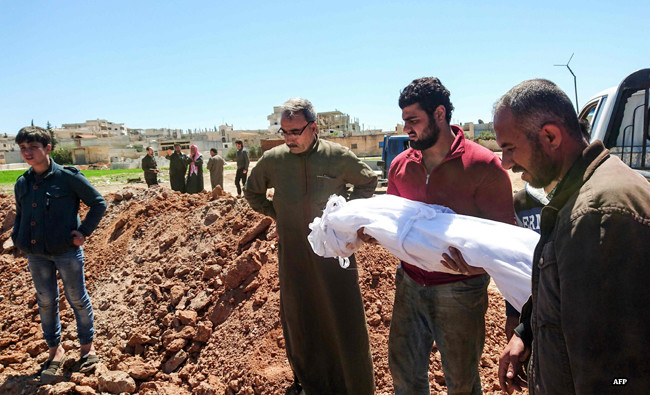
CAIRO/VATICAN/BEIRUT: International outcry grew louder on Wednesday against a suspected chemical weapons attack in Syria, with Pope Francis describing it as an “unacceptable massacre” and the Arab League calling it a “major crime”.
NATO and UN Secretary-General Antonio Guterres also weighed in, calling for an investigation to hold to account those responsible for the attack that left more than 70 dead in Syria’s Idlib province on Tuesday.
Lebanese Prime Minister Saad Hariri said the international community is itself to blame for allowing such acts to happen.
“The world should not be shocked because it’s letting such a regime do what it is doing. What should shock us is the increase of children dying and that the whole world is watching,” he told reporters at a Syria donor conference in Belgium.
Hariri also said that Lebanon has been overwhelmed by the arrival of some 1.5 million Syrian refugees and “cannot sustain this issue anymore. The international community has to do something.”
At his midweek public audience in St. Peter’s Square in Vatican City, Pope Francis said: “I completely deplore the unacceptable massacre that took place in Idlib province yesterday, where dozens of defenseless people, including many children, were killed.”
The 80-year-old pontiff spoke out as Russia and Western powers disputed what happened at Khan Sheikhun, where at least 20 children were among those who have died.
The Syrian Observatory for Human Rights said Tuesday’s air strike on the opposition-held town of Khan Sheikhun in Idlib province was likely carried out by regime warplanes, a charge the regime denied.
Turkey’s health minister says some 30 Syrians have been brought to the Turkish city of Gaziantep, bordering Syria, for treatment following the suspected chemical weapons attack in Syria.
Recep Akdag said Wednesday that initial symptoms and findings confirm that the wounded were the victims of a chemical attack. His comments were reported by the Haber Turk news channel.

‘Evidence point to Assad’
Russia, which has provided military and diplomatic backing for Syrian President Bashar Assad in his fight against the opposition fighters, said the deaths occurred after regime forces bombarded a “terrorist warehouse” containing “toxic substances.”
British Foreign Secretary Boris Johnson, however, insisted that “all the evidence” pointed to Assad’s regime “using illegal weapons on their own people.”
Johnson also says that he does “not see how a government like that can continue to have any kind of legitimate administration over the people of Syria.”
He added that he “would like to see those culpable pay a price for this.”
In Cairo, Arab League chief Ahmed Aboul Gheit said “targeting and killing civilians with these prohibited methods is considered a major crime and a barbaric act.” A
“Whoever carried it out will not escape from justice, and must be punished by the international community according to international law and international humanitarian law,” hesaid, without specifying who he held responsible.
The Arab League suspended Syria’s membership at the end of 2011 following months of brutal repression of anti-regime demonstrations and an opposition movement supported by Gulf monarchies.

Investigation pushed
UN’s Guterres said the global body would seek to establish who was to blame for a deadly episode, which he said had “demonstrated that war crimes are going on in Syria.”
Guterres told reporters at a Syria donor conference in Brussels on Wednesday that he hopes “this moment will be able to mobilize the capacity of all those that have responsibilities in this situation.”
He said “the horrific events of yesterday demonstrate that unfortunately war crimes are going on in Syria, that international humanitarian law remains being violated frequently.”
He added he is “confident that the Security Council will live up to its responsibilities,” with major powers set to convene there later in the day.
NATO Secretary-General Jens Stoltenberg said in a statement Wednesday that “this is the third report of the use of these barbaric weapons in the last month alone.”
He said Syria “is responsible to ensure its full compliance with these obligations.”
German Foreign Minister Sigmar Gabriel has called on Russia to endorse a planned United Nations Security Council resolution condemning a suspected chemical weapons attack in Syria.
Gabriel said Wednesday in Brussels before the opening of the international conference on the Syria conflict that, “We appeal to Russia to approve this resolution, to investigate this case and to bring to justice those who are responsible.”
The UN Security Council is to convene for an emergency meeting over a suspected deadly chemical attack in a town in northern Syria earlier this week, where at least 72 people were reported killed, including 11 children.
Nearly 400,000 people have been killed and half of Syria’s population has been displaced by the six-year conflict.
Palestinians in the West Bank struggle to get by as Israel severely limits work permits

Updated 6 sec ago
Follow

Palestinians in the West Bank struggle to get by as Israel severely limits work permits

  • Many Palestinians in the occupied West Bank are struggling to get by after losing their permits to work inside Israel
  • Israel revoked around 100,000 permits after Hamas’ Oct. 7, 2023, attack ignited the war in the Gaza Strip
TULKAREM, West Bank: Hanadi Abu Zant hasn’t been able to pay rent on her apartment in the occupied West Bank for nearly a year after losing her permit to work inside Israel. When her landlord calls the police on her, she hides in a mosque.
“My biggest fear is being kicked out of my home. Where will we sleep, on the street?” she said, wiping tears from her cheeks.
She is among some 100,000 Palestinians whose work permits were revoked after Hamas’ Oct. 7, 2023, attack ignited the war in the Gaza Strip. Confined to the occupied territory, where jobs are scarce and wages far lower, they face dwindling and dangerous options as the economic crisis deepens.
Some have sold their belongings or gone into debt as they try to pay for food, electricity and school expenses for their children. Others have paid steep fees for black-market permits or tried to sneak into Israel, risking arrest or worse if they are mistaken for militants.
Israel, which has controlled the West Bank for nearly six decades, says it is under no obligation to allow Palestinians to enter for work and makes such decisions based on security considerations. Thousands of Palestinians are still allowed to work in scores of Jewish settlements across the West Bank, built on land they want for a future state.
Risk of collapse
The World Bank has warned that the West Bank economy is at risk of collapse because of Israel’s restrictions. By the end of last year, unemployment had surged to nearly 30 percent compared with around 12 percent before the war, according to the Palestinian Central Bureau of Statistics.
Before the war, tens of thousands of Palestinians worked inside Israel, mainly in construction and service jobs. Wages can be more than double those in the landlocked West Bank, where decades of Israeli checkpoints, land seizures and other restrictions have weighed heavily on the economy. Palestinians also blame the Palestinian Authority, which exercises limited self-rule in parts of the territory, for not doing enough to create jobs.
About 100,000 Palestinians had work permits that were revoked after the outbreak of the war. Israel has since reinstated fewer than 10,000, according to Gisha, an Israeli group advocating for Palestinian freedom of movement.
Wages earned in Israel injected some $4 billion into the Palestinian economy in 2022, according to the Institute for National Security Studies, an Israeli think tank. That’s equivalent to about two-thirds of the Palestinian Authority’s budget that year.
An Israeli official said Palestinians do not have an inherent right to enter Israel, and that permits are subject to security considerations. The official spoke on condition of anonymity in line with regulations.
Israel seized the West Bank, Gaza and east Jerusalem in the 1967 Mideast war, territories the Palestinians want for a future state. Some 3 million Palestinians live in the West Bank, along with over 500,000 Israeli settlers who can come and go freely.
The war in Gaza has brought a spike in Palestinian attacks on Israelis as well as settler violence. Military operations that Israel says are aimed at dismantling militant groups have caused heavy damage in the West Bank and displaced tens of thousands of Palestinians.
‘My refrigerator, it’s empty’
After her husband left her five years ago, Abu Zant secured a job at a food-packing plant in Israel that paid around $1,400 a month, enough to support her four children. When the war erupted, she thought the ban would only last a few months. She baked pastries for friends to scrape by.
Hasan Joma, who ran a business in Tulkarem before the war helping people find work in Israel, said Palestinian brokers are charging more than triple the price for a permit.
While there are no definite figures, tens of thousands of Palestinians are believed to be working illegally in Israel, according to Esteban Klor, professor of economics at Israel’s Hebrew University and a senior researcher at the INSS. Some risk their lives trying to cross Israel’s separation barrier, which consists of 9-meter high (30-foot) concrete walls, fences and closed military roads.
Shuhrat Barghouthi’s husband has spent five months in prison for trying to climb the barrier to enter Israel for work, she said. Before the war, the couple worked in Israel earning a combined $5,700 a month. Now they are both unemployed and around $14,000 in debt.
“Come and see my refrigerator, it’s empty, there’s nothing to feed my children,” she said. She can’t afford to heat her apartment, where she hasn’t paid rent in two years. She says her children are often sick and frequently go to bed hungry.
Sometimes she returns home to see her belongings strewn in the street by the landlord, who has been trying to evict them.
Forced to work in settlements
Of the roughly 48,000 Palestinians who worked in Israeli settlements before the war, more than 65 percent have kept their permits, according to Gisha. The Palestinians and most of the international community view the settlements, which have rapidly expanded in recent years, as illegal.
Israeli officials did not respond to questions about why more Palestinians are permitted to work in the settlements.
Palestinians employed in the settlements, speaking on condition of anonymity for fear of retribution, say their employers have beefed up security since the start of the war and are far more willing to fire anyone stepping out of line, knowing there are plenty more desperate for work.
Two Palestinians working in the Mishor Adumim settlement said security guards look through workers’ phones and revoke their permits arbitrarily.
Israelis have turned to foreign workers to fill jobs held by Palestinians, but some say it’s a poor substitute because they cost more and do not know the language. Palestinians speak Arabic, but those who work in Israel are often fluent in Hebrew.
Raphael Dadush, an Israeli developer, said the permit crackdown has resulted in costly delays.
Before the war, Palestinians made up more than half his workforce. He’s tried to replace them with Chinese workers but says it’s not exactly the same. He understands the government’s decision, but says it’s time to find a way for Palestinians to return that ensures Israel’s security.
Assaf Adiv, the executive director of an Israeli group advocating for Palestinian labor rights, says there has to be some economic integration or there will be “chaos.”
“The alternative to work in Israel is starvation and desperation,” he said.