

US-backed forces repel Daesh assault near Syrian dam

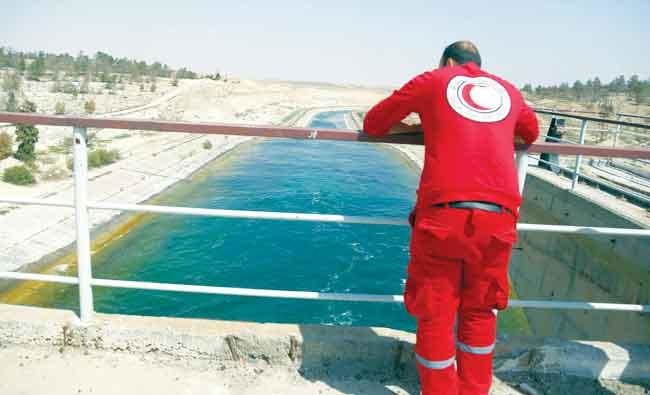
A Syrian Arab Red Crescent member is seen examining water levels at the Tabqa dam on Tuesday. (AFP)
Updated 03 April 2017
Follow

US-backed forces repel Daesh assault near Syrian dam

AMMAN: US-backed Syrian forces repelled a major counter-attack by Daesh militants holding out at the country’s largest dam and in the nearby town of Tabqa, the group and activists said on Sunday.
The dam is a key strategic target in the military campaign to isolate and capture the Syrian city of Raqqa, 40 km to the east and Daesh’s biggest urban stronghold.
The US-backed group said militants attacked its positions north-east of Tabqa and at an airbase to the south of the town where dozens of its fighters were killed; but the coalition of Kurdish and Arab militias was making slower advances in a village east of the town.
Jehan Sheikh Ahmad, a spokeswoman for the Syrian Democratic Forces (SDF), spearheaded by the powerful Kurdish YPG militia, said the militants were stepping up their resistance as SDF forces got closer to encircling the town and the dam.
“Our forces are advancing...(Daesh) are facing large difficulties and so they are starting counter-attacks,” said the official whose forces have US special forces with them.
The SDF began an assault to capture the dam and the nearby town almost two weeks ago after the coalition landed some of its fighters on the southern side of the Euphrates near Tabqa, leading to its capture of an air base.
The SDF has been waging a multi-phased offensive since November to isolate Raqqa, with backing from the US-led coalition taking territory to the north and east of the province.
Hundreds of families with their cattle, property, motor bikes and vans continued on Sunday to flee from villages under Daesh control.
The US-backed forces say at least 7,000 people have taken shelter in their areas since the campaign to capture Tabqa.
Many are also fleeing airstrikes on civilian areas in Raqqa province that have left dozens dead according to activists and the Britain-based Syrian Observatory for Human Rights.
Last month strikes believed to be conducted by the US-led coalition hit a bakery and a local market in Tabqa town with dozens of civilians killed. Another raid that hit a school sheltering displaced people near Raqqa also killed scores. The SDF denies civilians are targeted.
Daesh and the Syrian government have both said the hydroelectric dam is vulnerable to collapse after strikes by the US-led coalition.
Syrian officials say that would lead to catastrophic flooding in the cities and towns in the Euphrates valley downstream.
The SDF and the coalition have denied the dam is in danger.
Residents, however, say an SDF attempt last week to relieve the dam’s water levels by opening a canal from the Balikh River that flows into the Euphrates had flooded cultivated agricultural land in several villages. 


Second US aircraft carrier is being sent to the Middle East, AP source says

Updated 3 sec ago
Follow

Second US aircraft carrier is being sent to the Middle East, AP source says

  • Move by the USS Gerald R. Ford, first reported by The New York Times, will put two carriers and their accompanying warships in the region
  • Trump told Axios earlier this week that he was considering sending a second carrier strike group to the Middle East
WASHINGTON: The world’s largest aircraft carrier has been ordered to sail from the Caribbean Sea to the Middle East, a person familiar with the plans said Thursday, as US President Donald Trump considers whether to take possible military action against Iran.
The move by the USS Gerald R. Ford, first reported by The New York Times, will put two carriers and their accompanying warships in the region as Trump increases pressure on Iran to make a deal over its nuclear program. The person spoke on condition of anonymity to discuss military movements.
The USS Abraham Lincoln aircraft carrier and three guided-missile destroyers arrived in the Middle East more than two weeks ago.
It marks a quick turnaround for the USS Ford, which Trump sent from the Mediterranean Sea to the Caribbean last October as the administration build up a huge military presence in the leadup to the surprise raid last month that captured then-Venezuelan President Nicolas Maduro.
It also appears to be at odds with Trump’s national security strategy, which put an emphasis on the Western Hemisphere over other parts of the world.
Trump on Thursday warned Iran that failure to reach a deal with his administration would be “very traumatic.” Iran and the United States held indirect talks in Oman last week.
“I guess over the next month, something like that,” Trump said in response to a question about his timeline for striking a deal with Iran on its nuclear program. “It should happen quickly. They should agree very quickly.”
Trump told Axios earlier this week that he was considering sending a second carrier strike group to the Middle East.
Trump held lengthy talks with Israeli Prime Minister Benjamin Netanyahu on Wednesday and said he insisted to Israel’s leader that negotiations with Iran needed to continue. Netanyahu is urging the administration to press Tehran to scale back its ballistic missile program and end its support for militant groups such as Hamas and Hezbollah as part of any deal.
The USS Ford set out on deployment in late June 2025, which means the crew will have been deployed for eight months in two weeks time. While it is unclear how long the ship will remain in the Middle East, the move sets the crew up for an usually long deployment.
The White House didn’t immediately respond to a request for comment.