Iran continues to sponsor terror: US defense chief

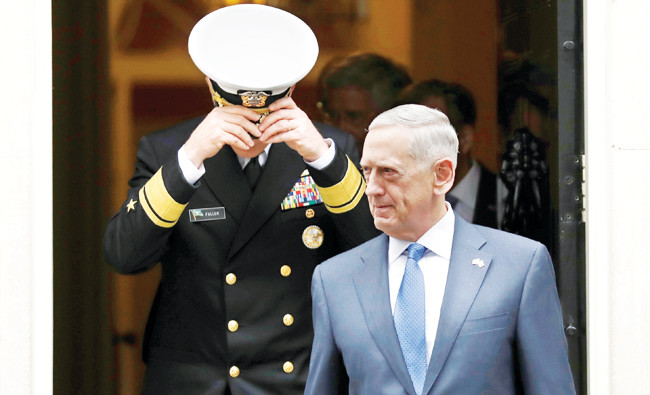
US Defense Secretary James Mattis leaves after visiting British Prime Minister Theresa May at 10 Downing Street in London, Friday. (AP)
Updated 01 April 2017
Follow

Iran continues to sponsor terror: US defense chief

LONDON: Iran is continuing to behave as an exporter of terrorism and still sponsors militant activity, US Defense Secretary James Mattis said in London on Friday. 

Asked about comments he made in 2012 that the three primary threats the US faced were “Iran, Iran, Iran,” Mattis told reporters that Iran’s behavior had not changed in the years since.

“At the time when I spoke about Iran I was a commander of US Central Command and that (Iran) was the primary exporter of terrorism, frankly, it was the primary state sponsor of terrorism and it continues that kind of behavior today,” Mattis said. 

International experts agreed with Mattis’ assertion that Tehran is a key global supporter of terror.

“Iran single-handedly trains, finances, arms and supports a quarter of world-designated terrorist groups. Iran’s Revolutionary Guard Corps (IRGC) has also given birth to many powerful militia groups in the region,” Dr. Majid Rafizadeh, Harvard scholar and US-based expert on Iranian affairs, told Arab News.

“Many believe that Iran is more dangerous than groups such as (Daesh) because the Islamic Republic is the disease and these groups are the symptoms… To address the underlying issue, the disease should be tackled.”

Despite the recent nuclear deal reached between Tehran and the US and other world powers, the “core pillars” of Iran’s foreign policy have not changed since 1979, Rafizadeh added.

“These pillars are mainly anchored in revolutionary principles, such as exporting its religion or anti-Americanism, and geopolitical landscapes such as pursuing regional hegemonic ambitions, pre-eminence, and superiority,” he said.

On his first visit to Britain as Pentagon chief, Mattis made clear he still worries about Iran’s involvement in what the US sees as destabilizing activities across the Middle East.

He also said North Korea must be stopped on its path toward being able to threaten the US with nuclear attack, emphasizing diplomatic means of changing Pyongyang’s “reckless” agenda.


— With Reuters


Syria welcomes Canada’s decision to amend sanctions

Syria’s Central Bank governor, Abdulkader Husarieh. (SANA)
Updated 4 sec ago
Follow

Syria welcomes Canada’s decision to amend sanctions

  • Husarieh said the decision could pave the way for Canadian participation in Syria’s reconstruction and infrastructure development

DAMSCUS: Syria’s Central Bank governor, Abdulkader Husarieh, commended the Canadian government’s decision to amend the sanctions imposed on Damascus under the Special Economic Measures Regulations, including the lifting of the comprehensive economic embargo in place since May 2011.
In a post published on his personal Facebook page, Husarieh described the move as an important milestone that reinforces the implementation of understandings reached during his recent visit to Canada.
He added that the amendment provides an opportunity to boost economic relations and activate cooperation between Canadian and Syrian banks and financial institutions.
Husarieh said the decision could pave the way for Canadian participation in Syria’s reconstruction and infrastructure development.
Meanwhile, the Syrian Arab Red Crescent and the Turkish Red Crescent signed cooperation agreements on Friday to strengthen humanitarian efforts in Syria amid ongoing crises and economic hardship.
Syrian Arab Red Crescent President Hazem Bakleh met in Damascus with Alper Kucuk, the Turkish Red Crescent’s director general for international affairs and migration services, to discuss rising humanitarian needs and ways to enhance coordination in support of vulnerable communities.
According to a statement released by the Syrian organization, the agreement provides for expanding relief and service activities.
It includes support for the construction of a new Red Crescent branch headquarters in Idlib province and the launch of a project to distribute hot meals and bread in Damascus and Aleppo during the holy month of Ramadan.
The Syrian Arab Red Crescent has sought to broaden partnerships with regional and international organizations in recent years to strengthen its operational capacity across multiple provinces, as the country continues to face economic strain and humanitarian challenges affecting large segments of the population.