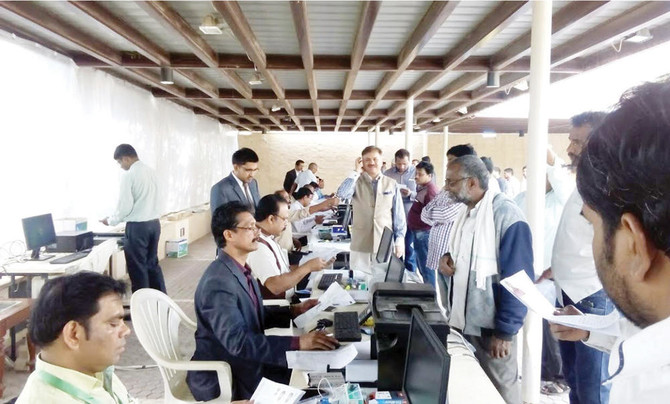
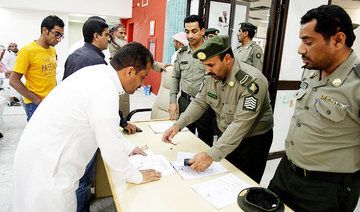
RIYADH: Hundreds of illegal Indian expats queued up at the Indian Embassy Wednesday and Thursday at the start of the 90-day amnesty period that offers those who are illegally staying to leave the Kingdom without penalty.
Anil Nautiyal, first secretary of community welfare at the Indian Embassy told Arab News on Thursday the embassy will serve Indian nationals during the three-month long amnesty period.
“On (Wednesday), 820 people queued up at the embassy, out of which 615 people applied for the emergency certificate or out-pass,” he said. “The queue is long on Thursday too, and we are expecting almost the same number taking benefit of it.”
Indian Ambassador Ahmad Javed monitored the process and interacted with applicants, officials and volunteers coordinating with them in order to ensure a hassle-free service, said Nautiyal.
The ambassador appealed to all the overstaying Indians to take advantage of the 2017 amnesty, which is not only limited to the Riyadh and Jeddah facilities, but is also available at 21 other locations spread across the Kingdom.
Application centers to handle departures include facilities in Dammam, Jubail, Hail, Buraida, Wadi Al-Dwaser, Al-Khafji, Al-Jouf, Hafr Al-Batin, Arar and Hofuf. The embassy has set up a 24/7 control room with a toll free number 8002471234 and a helpline +966 11 4884697 for the amnesty period.
The out-pass and exit visa will be issued at no charge. The embassy and the consulate will provide the travel documents. Saudi authorities will facilitate with the exit visa, while the return ticket is to be arranged by the applicant.
The out-pass beneficiary should complete a 2-page application form; provide a passport copy (first and last page), one photo, and an iqama copy, border number or visa page of the passport. The out-pass will be issued in five to seven days.

Hundreds queue up at Indian Embassy to benefit from amnesty
Pakistan, Saudi Arabia explore joint investment push in high-growth regions
- Both sides discuss combining Pakistan’s production capacity with Saudi capital and regional market access
- Government says Saudi side expressed interest in corporate farming in Pakistan, particularly in rice sector
KARACHI: Pakistan and Saudi Arabia are looking to jointly tap high-growth regional markets and align production and capital strengths, according to an official statement on Wednesday, following talks between Commerce Minister Jam Kamal Khan and Saudi Investment Assistant Minister Ibrahim Al-Mubarak in the Kingdom.
The two countries have long maintained close bilateral ties that have evolved into a multidimensional strategic partnership.
In October last year, the two countries launched an Economic Cooperation Framework aimed at shifting relations beyond aid toward sustainable trade, investment and development links. The framework followed the signing of a joint security agreement a month earlier, under which aggression against one would be treated as an attack on both.
“A key focus of the discussion was the joint exploration of regional markets, particularly Central Asia, Africa, and ASEAN, identified as high-growth regions offering significant opportunities for collaboration,” according to a statement circulated by Pakistan’s commerce ministry after the meeting.
“The two sides agreed that Pakistan and Saudi Arabia, by leveraging their respective strengths, can position themselves as complementary partners — combining Pakistan’s production capabilities with Saudi Arabia’s capital strength, market access, and regional connectivity,” it added.
The Saudi side expressed interest in corporate farming in Pakistan, particularly in the rice sector, with discussions covering mechanization, storage and logistics to enable consistent, long-term exports under structured arrangements.
Talks also covered broader cooperation in agriculture and food security, including rice, fodder, meat and other agri-products, with the potential involvement of Saudi financing institutions in supporting export-linked agricultural and infrastructure projects.
Corporate farming and mechanization were discussed as long-term solutions to productivity challenges in crops such as cotton, where declining yields and high manual input costs have hurt competitiveness, the statement said.
Human resource development emerged as another area of focus, with both sides noting shortages in mid-tier skills such as nurses, caregivers, technicians and hospitality staff.
The Saudi side expressed openness to replicating vocational “train-to-deploy” models in Pakistan that link training programs directly with overseas employment opportunities.
The meeting also examined opportunities in building materials, pharmaceuticals, sports goods, footwear and light manufacturing, with both sides agreeing to pursue sector-specific workshops and business-to-business engagements to translate policy alignment into tangible trade and investment flows.