ADDIS ABABA: Ethiopia’s parliament on Thursday approved a four month extension of a state of emergency that was first imposed in October to quell nearly a year of anti-government protests.
“The House unanimously voted to extend the state of emergency,” said a report carried by state media.
Defense Minister Siraj Fegessa said the “extension is needed so as to take the prevailing relatively good peace and security situations to the point of no return,” the Fana Broadcasting Corporate (FBC) reported.
Prime Minister Hailemariam Desalegn declared a six-month state of emergency in October after months of protests in different parts of the country that were met with a strong security response that killed hundreds, according to human rights groups.
The protesters also targeted foreign farms and businesses, especially in the Oromia region close to the capital where unrest began in November 2015.
A key complaint of the protesters is the domination of the ruling Ethiopian People’s Revolutionary Democratic Front (EPRDF) party, in power since 1991, and which holds all 546 seats in parliament.
Anteneh Terefe, an opposition Blue Party official was dismayed by the government’s decision.
“This is a bad signal to all of us as political parties, as Ethiopians as individuals and for the state of country,” he said.
“Extension of the state of emergency means things have not gone back to normal. I really wonder how it will possible for us to do any kind of politics.”
More than 11,000 people were arrested under the state of emergency but most were released after receiving “renewal training” on the country’s constitution and other topics, FBC reported last month.
As part of a crackdown on dissent some opposition leaders in the country have been arrested, while others in exile are facing trial in absentia.
Olympic silver medallist Feyisa Lilesa drew attention to the protests at last year’s Rio games by crossing his wrists above his head — a gesture that has become a symbol of the protest movement. He now lives in exile in the US.
The current state of emergency is the first in Ethiopia nationwide since the fall of communist dictator Mengistu Haile Mariam in 1991.


Ethiopia state of emergency extended by four months
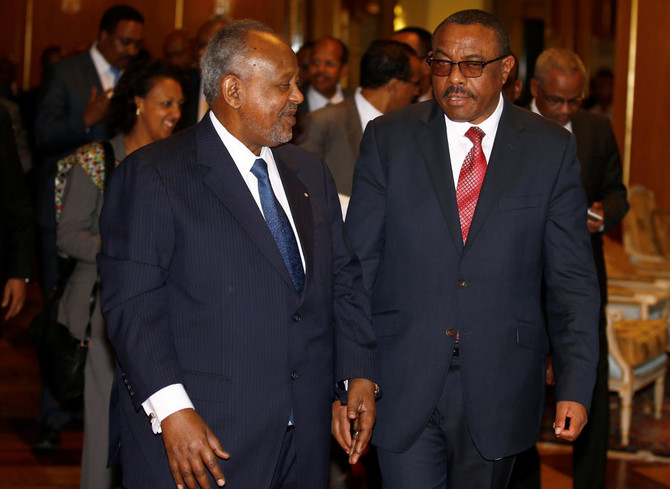
Ethiopia state of emergency extended by four months

Philippines eyes closer cooperation on advanced defense tech with UAE
- Philippine-UAE defense agreement is Manila’s first with a Gulf country
- Philippines says new deal will also help modernize the Philippine military
MANILA: The Philippines is seeking stronger cooperation with the UAE on advanced defense technologies under their new defense pact — its first such deal with a Gulf country — the Department of National Defense said on Friday.
The Memorandum of Understanding on Defense Cooperation was signed during President Ferdinand Marcos Jr.’s visit to Abu Dhabi earlier this week, which also saw the Philippines and the UAE signing a comprehensive economic partnership agreement, marking Manila’s first free trade pact with a Middle Eastern nation.
The Philippines-UAE defense agreement “seeks to deepen cooperation on advanced defense technologies and strengthen the security relations” between the two countries, DND spokesperson Assistant Secretary Arsenio Andolong said in a statement.
The MoU “will serve as a platform for collaboration on unmanned aerial systems, electronic warfare, and naval systems, in line with the ongoing capability development and modernization of the Armed Forces of the Philippines,” he added.
It is also expected to further military relations through education and training, intelligence and security sharing, and cooperation in the fields of anti-terrorism, maritime security, and peacekeeping operations.
The UAE’s Ministry of Foreign Affairs has described security and defense as “very promising fields” in Philippine-UAE ties, pointing to Abu Dhabi being the location of Manila’s first defense attache office in the Middle East.
The UAE is the latest in a growing list of countries with defense and security deals with the Philippines, which also signed a new defense pact with Japan this week.
“I would argue that this is more significant than it looks on first read, precisely because it’s the Philippines’ first formal defense cooperation agreement with a Gulf state. It signals diversification,” Rikard Jalkebro, associate professor at the Anwar Gargash Diplomatic Academy in Abu Dhabi, told Arab News.
“Manila is widening its security partnerships beyond its traditional circles at a time when strategic pressure is rising in the South China Sea, and the global security environment is (volatile) across regions.”
Though the MoU is not an alliance and does not create mutual defense obligations, it provides a “framework for the practical stuff that matters,” including access, training pathways, procurement discussions and structured channels” for security cooperation, he added.
“For the UAE, the timing also makes sense, seeing that Abu Dhabi is no longer only a defense buyer; it’s increasingly a producer and exporter, particularly in areas like UAS (unmanned aerial systems) and enabling technologies. That opens a new lane for Manila to explore capability-building, technology transfer, and industry-to-industry links,” Jalkebro said.
The defense deal also matters geopolitically, as events in the Middle East and the Indo-Pacific region have ripple effects on global stability and commerce.
“So, a Philippines–UAE defense framework can be read as a pragmatic hedge, strengthening resilience and options without formally taking sides,” Jalkebro said.


