LONDON: The mother of Westminster attacker Khalid Masood says she is “deeply shocked, saddened and numbed” by his murderous actions.
In a statement released through the police, Janet Ajao says that “since discovering that it was my son that was responsible, I have shed many tears for the people caught up in this horrendous incident.”
Ajao says she wants to make it “absolutely clear” that she does not condone his actions or support the beliefs that led him to carry out the attack.
Masood was born in southern England in 1964 as Adrian Elms, and took the name Adrian Ajao after his stepfather, whom his mother married when he was a small child. Police say he changed his name to Khalid Masood in 2005.
Janet Ajao lives in rural Wales.
A senior British counterterrorism officer says police have found “no evidence” Westminster attacker Khalid Masood was associated with the Daesh group or Al-Qaeda.
Deputy Assistant Commissioner Neil Basu says Masood clearly had “an interest in jihad,” but police have no evidence he discussed his attack with others.
Basu says in a statement that the attack in which Masood used an SUV and knives to kill four people in London “appears to be based on low sophistication, low tech, low cost techniques copied from other attacks.”
He says Masood was not a “subject of interest” for counterterror police or the intelligence services before last week’s attack.


The Latest: London attacker’s mother ‘saddened and numbed’
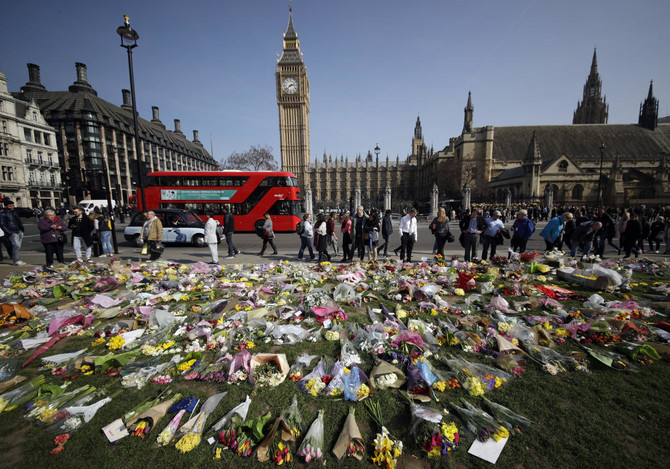
The Latest: London attacker’s mother ‘saddened and numbed’




February fifth warmest on record, extreme rain in Europe: EU monitor
- Global temperatures last month were 1.49C above preindustrial times
- Temperatures and precipitation varied widely in Europe
PARIS: The world logged its fifth hottest February on record, with western Europe drenched by extreme rainfall and widespread flooding, the European Union’s climate monitor said on Tuesday.
Global temperatures last month were 1.49C above preindustrial times, defined as the 1850-1900 period before large-scale fossil fuel use drove climate change.
Temperatures and precipitation varied widely in Europe.
The average temperature in Europe was among the three coldest in the past 14 years at -0.07C.
But western, southern and southeast Europe experienced above-average temperatures, according to the Copernicus Climate Change Service.
Colder conditions were experienced in northwest Russia, Baltic countries, Finland and its Scandinavian neighbors.
“Wet and dry conditions across the continent showed a pronounced contrast: much of western and southern Europe was wetter than average, whereas the rest of the continent... was mostly drier than average,” the service said in its monthly report.
The United States, northeast Canada, the Middle East, Central Asia and east Antarctica had warmer-than-average temperatures.
- Need for global action -
Sea surface temperatures were the second highest for the month of February.
In the Arctic, the average sea ice extent was at its third lowest level for the month at five percent below average.
In the Antarctic, the monthly sea ice extent was close to average for February — a “sharp contrast to the much below-average” levels observed over the past four years, Copernicus said.
“The extreme events of February 2026 highlight the growing impacts of climate change and the pressing need for global action,” said Samantha Burgess, strategic lead for climate at the European Center for Medium-Range Weather Forecasts, which operates Copernicus.
“Europe experienced stark temperature contrasts,” Burgess said.
“Exceptional atmospheric rivers — narrow bands of very moist air — brought record rainfall and widespread flooding to western and southern Europe,” she said.
Human-driven climate change intensified torrential downpours that killed dozens and forced thousands of people from their homes across Spain, Portugal and Morocco between January and February, according to the World Weather Attribution (WWA) network of climate scientists.