LONDON: Brexit challenges Britain’s global image of openness and tolerance, but Cool Britannia has what it takes to avoid being suddenly rebranded as uncool just because it quits the EU, advertising professionals say.
From music to film and fashion, Britain has for decades enhanced its image as a modern and dynamic culture. The ease of immigrating and working in Britain helped it build a reputation as a welcoming and hospitable society.
But the vote to leave the EU last June sent a troubling message of tighter border controls and an exit from the EU’s single market.
“Brexit is a self-inflicted wound because you are putting the image of openness at risk, that is dangerous,” said Matt Scheckner, founder and executive director of Advertising Week.
“So to send the message that Britain is open for business is vitally important.”
The effusive New Yorker organized this week the fifth London version of Advertising Week, which attracted 40,000 industry professionals to four days of seminars and events in the capital’s trendy neighborhood of Soho.
“The things that make British culture unique remain. Music, fashion, British content, creative content, television (and) film. I would say all those things are not at risk because they are driven by creative people,” said Scheckner.
“But when you look at things like tourism, which is a very big industry when you look at businesses, it has to employ young talent, the risk is being viewed as an unfriendly place for talent, for young people,” he added.
At Advertising Week, dominated by young professionals with an international outlook, there were few supporters of Brexit.
Brexit “is an inward-looking and insular process by itself,” said Melanie Read of the Aesop agency.
But most advertising executives still think it is possible to save Britain’s brand by emphasizing the positive.
“People will have to reassert the strengths of the country, the cultural strengths, in their creation,” said Matt Donegan, managing director at Social Circle marketing agency.
Similarly, advertising professionals thought Britain could emphasize other, intangible advantages such as its stable political and legal system, a qualified English-speaking workforce and even the capacity of the British people to take the best from foreign cultural influences.
Adept marketers could even turn divided public opinion into a positive — presenting a diversity of views as a counterpoint to a uniform, inward-looking bloc.
Richard Staplehurst, a partnerships manager at the Latimer agency, said he remains optimistic about the ability of young people, who mostly voted to remain in the EU, to keep good vibes flowing.
“There will be enough social media activism to show the country is open,” he said. “Many people will say ‘it is not fair, we want you to come.’”
Private activism could act as a counterweight to the often divisive public political debate.
“We are naturally outward-looking and naturally innovative,” Secretary of State for International Trade Liam Fox told AFP.
“It is not because we are leaving the EU that our great culture will disappear,” added Latimer’s Staplehurst.


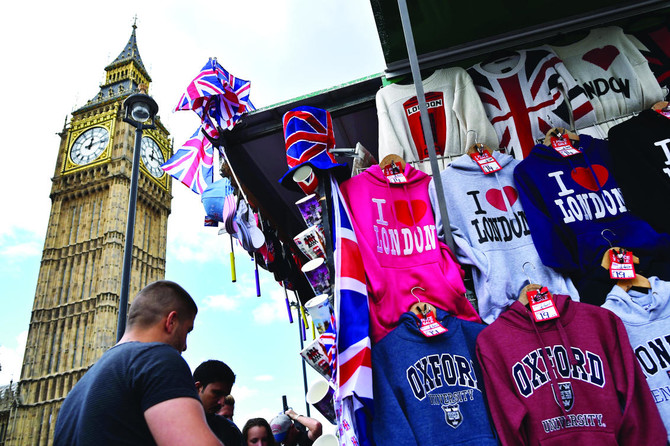
Saving Cool Britannia image from Brexit bruise
Saving Cool Britannia image from Brexit bruise

Jordan’s industry fuels 39% of Q2 GDP growth
JEDDAH: Jordan’s industrial sector emerged as a major contributor to economic performance in 2025, accounting for 39 percent of gross domestic product growth in the second quarter and 92 percent of national exports.
Manufactured exports increased 8.9 percent year on year during the first nine months of 2025, reaching 6.4 billion Jordanian dinars ($9 billion), driven by stronger external demand. The expansion aligns with the country’s Economic Modernization Vision, which aims to position the country as a regional hub for high-value industrial exports, the Jordan News Agency, known as Petra, quoted the Jordan Chamber of Industry President Fathi Jaghbir as saying.
Export growth was broad-based, with eight of 10 industrial subsectors posting gains. Food manufacturing, construction materials, packaging, and engineering industries led performance, supported by expanded market access across Europe, Arab countries, and Africa.
In 2025, Jordanian industrial products reached more than 144 export destinations, including emerging Asian and African markets such as Ethiopia, Djibouti, Thailand, the Philippines, and Pakistan. Arab countries accounted for 42 percent of industrial exports, with Saudi Arabia remaining the largest market at 955 million dinars.
Exports to Syria rose sharply to nearly 174 million dinars, while shipments to Iraq and Lebanon totaled approximately 745 million dinars. Demand from advanced markets also strengthened, with exports to India reaching 859 million dinars and Italy about 141 million dinars.
Industrial output also showed steady improvement. The industrial production index rose 1.47 percent during the first nine months of 2025, led by construction industries at 2.7 percent, packaging at 2.3 percent, and food and livestock-related industries at 1.7 percent.
Employment gains accompanied the sector’s expansion, with more than 6,000 net new manufacturing jobs created during the period, lifting total industrial employment to approximately 270,000 workers. Nearly half of the new jobs were generated in food manufacturing, reflecting export-driven growth.
Jaghbir said industrial exports remain among the economy’s highest value-added activities, noting that every dinar invested generates an estimated 2.17 dinars through employment, logistics, finance, and supply-chain linkages. The sector also plays a critical role in narrowing the trade deficit and supporting macroeconomic stability.
Investment activity accelerated across several subsectors in 2025, including food processing, chemicals, pharmaceuticals, mining, textiles, and leather, as manufacturers expanded capacity and upgraded production lines to meet rising demand.
Jaghbir attributed part of the sector’s momentum to government measures aimed at strengthening competitiveness and improving the business environment. Key steps included freezing reductions in customs duties for selected industries, maintaining exemptions for production inputs, reinstating tariffs on goods with local alternatives, and imposing a 16 percent customs duty on postal parcels to support domestic producers.
Additional incentives in industrial cities and broader structural reforms were also cited as improving the investment climate, reducing operational burdens, and balancing consumer needs with protection of local industries.


