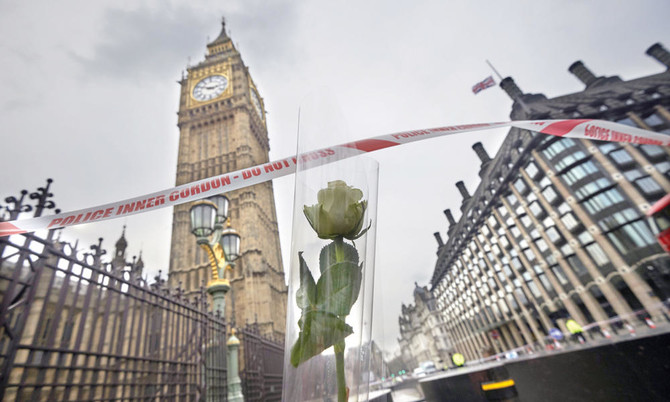
LONDON: Experts have warned of the threat posed by “low-tech” terror attacks, following Wednesday’s deadly rampage outside the UK Parliament and questions over another incident in Antwerp.
The London attacker — who mowed down two civilians with his car and stabbed a policeman before being shot dead — was on Thursday named as British-born Khalid Masood.
Daesh claimed responsibility for the attack in a statement issued by its Amaq news agency, but did not name Masood and gave no details.
“Masood was not the subject of any current investigations and there was no prior intelligence about his intent to mount a terrorist attack,” London’s Metropolitan Police said in a statement.
“However, he was known to police and has a range of previous convictions for assaults, including GBH (grievous bodily harm), possession of offensive weapons and public order offenses.”
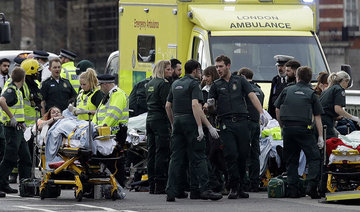
Prime Minister Theresa May told Parliament the attacker had once been investigated by the MI5 intelligence agency over concerns about violent extremism, but was a peripheral figure. About 40 people were injured in the attack, of whom 29 remain in hospital, seven in critical condition.
Britain’s Foreign Secretary Boris Johnson said the fact that victims from the London attack came from 11 countries shows that “an attack on London is an attack on the world.”
Police arrested eight people at six locations in London and Birmingham in the investigation into the attack.
The bloodshed in London took place on the first anniversary of attacks that killed 32 people in Brussels, and resembled Daesh-inspired attacks in France and Germany where vehicles were driven into crowds.
Many have been shocked that the attacker was able to cause such mayhem in the heart of the UK capital equipped with nothing more than a hired car and a knife.
“This kind of attack, this lone-wolf attack, using things from daily life, a vehicle, a knife, are much more difficult to forestall,” Defense Minister Michael Fallon told the BBC.
Professor Lee Marsden, head of the School of Politics, Philosophy, Language and Communication Studies at the University of East Anglia, said there is a pattern of terror attacks launched with “whatever weapons are to hand.”
Marsden told Arab News: “It is the low-tech nature of this which is the concern — that there doesn’t need to be the level of sophistication that previous terror groups were able to employ.
“In one sense it’s less alarming because it was less sophisticated; on the other hand it does send out a message that individuals can inflict maximum damage with very limited resources.
“It’s the random nature of it which is an effective tool in terms of creating fear, and as a direct challenge to governments in the West about their ability to be able to protect their own citizens.”
Marsden said that Daesh’s claim that it was behind the London attack should be treated with caution.
“It’s really (a question of) whether Islamic State is orchestrating this or whether it’s just inspiring the attack,” he said.
“Daesh are masters of publicity and very media-savvy. And it costs them very little to claim (such attacks). This gives them publicity, notoriety, particularly at a time when they’re clearly on the back-foot and losing significant amounts of territory in Iraq. This deflects from that; it sends out a message… that they’re still very much in business.”
It emerged on Thursday that a man had been arrested after a car was driven at speed into a pedestrianized street in Antwerp, Belgium, forcing people to jump out of its path.
The car sped away in the Belgian port leaving no one injured, but prosecutors said police later arrested a man suspected of being the driver, naming him as Mohammed R., a 39-year-old French national of North African origin.
Antwerp police found knives in the vehicle and a canister containing an unknown substance that bomb disposal officers were checking, Belgian federal prosecutors’ office said in a statement.
The Belgian federal prosecutors did not give details of any motive but said they had been called in “based on all these elements and the events in London yesterday.”
A French source later told Reuters that authorities there believed the suspect had not been trying to hit anyone, but was probably drunk and trying to escape a police check.
— With Reuters


![]()
‘Low-tech’ terror threat in spotlight as Daesh claims London attack
‘Low-tech’ terror threat in spotlight as Daesh claims London attack

Latest updates


Recommended


© 2026 SAUDI RESEARCH & PUBLISHING COMPANY, All Rights Reserved And subject to Terms of Use Agreement.