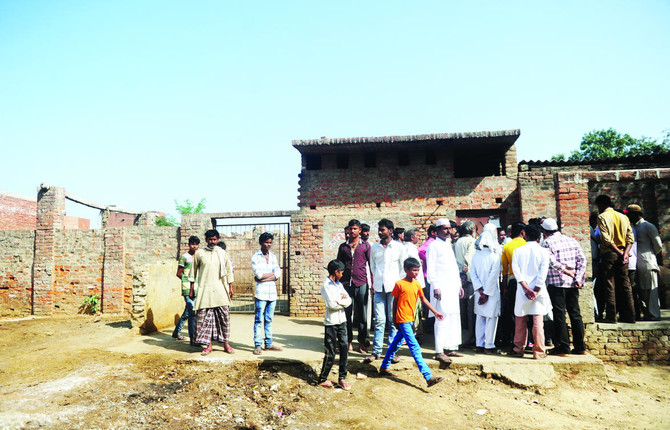
Butcher shops razed amid crackdown on beef in India

Indian Muslim butchers and traders gather outside a closed slaughter house in Allahabad on Tuesday. (AFP)
Updated 22 March 2017
Follow

Butcher shops razed amid crackdown on beef in India

NEW DELHI: Indian police said Wednesday they were not ruling out arson after fire gutted three butcher shops in Uttar Pradesh state, where a firebrand Hindu leader has taken office promising a crackdown on slaughterhouses.
The meat industry is a magnet for religious violence in India, where Hindus consider cows sacred and accusations of beef being sold by Muslims can trigger violent mob reprisals.
Police were investigating the “mysterious” overnight blaze that reduced the three butcher shops to ashes in Hathras district, local police chief Dilip Kumar told AFP.
“We are not ruling out anything,” he said.
The fire comes just days after a hard-line Hindu priest-turned-politician took control of Uttar Pradesh, India’s largest state with a bloody history of violence between Hindus and Muslims.
Yogi Adityanath is known for his polarizing and inflammatory speeches against Muslims, and has railed for harsher penalties for the slaughter of cows, which is already illegal in most Indian states.
He was chosen to lead Uttar Pradesh after Prime Minister Narendra Modi’s right-wing Bharatiya Janata Party swept state polls earlier this month, in part on a pledge to clamp down on slaughterhouses.
Since the thumping election victory, dozens of butcher shops deemed illegal by the government have been sealed off across the state in what authorities say is a crackdown on unlicensed traders.
Most butcher shops are run by Muslims and cow slaughter is a flashpoint issue. A 50-year-old Muslim man was dragged from his home in 2015 and beaten to death by roughly 100 people over rumors he ate beef. Police later said it was mutton.
India has witnessed a rise in vigilantism by Hindu extremists since Modi — whose right-wing party is strongly aligned to Hindu nationalist groups — was voted to power in 2014.


Bangladesh halts controversial relocation of Rohingya refugees to remote island

Updated 13 sec ago
Follow

Bangladesh halts controversial relocation of Rohingya refugees to remote island

  • Administration of ousted PM Sheikh Hasina spent about $350m on the project
  • Rohingya refuse to move to island and 10,000 have fled, top refugee official says

DHAKA: When Bangladesh launched a multi-million-dollar project to relocate Rohingya refugees to a remote island, it promised a better life. Five years on, the controversial plan has stalled, as authorities find it is unsustainable and refugees flee back to overcrowded mainland camps.

The Bhasan Char island emerged naturally from river sediments some 20 years ago. It lies in the Bay of Bengal, over 60 km from Bangladesh’s mainland.

Never inhabited, the 40 sq. km area was developed to accommodate 100,000 Rohingya refugees from the cramped camps of the coastal Cox’s Bazar district.

Relocation to the island started in early December 2020, despite protests from the UN and humanitarian organizations, which warned that it was vulnerable to cyclones and flooding, and that its isolation restricted access to emergency services.

Over 1,600 people were then moved to Bhasan Char by the Bangladesh Navy, followed by another 1,800 the same month. During 25 such transfers, more than 38,000 refugees were resettled on the island by October 2024.

The relocation project was spearheaded by the government of former Prime Minister Sheikh Hasina, who was ousted last year. The new administration has since suspended it indefinitely.

“The Bangladesh government will not conduct any further relocation of the Rohingya to Bhasan Char island. The main reason is that the country’s present government considers the project not viable,” Mizanur Rahman, refugee relief and repatriation commissioner in Cox’s Bazar, told Arab News on Sunday.

The government’s decision was prompted by data from UN agencies, which showed that operations on Bhasan Char involved 30 percent higher costs compared with the mainland camps in Cox’s Bazar, Rahman said.

“On the other hand, the Rohingya are not voluntarily coming forward for relocation to the island. Many of those previously relocated have fled ... Around 29,000 are currently living on the island, while about 10,000 have returned to Cox’s Bazar on their own.”

A mostly Muslim ethnic minority, the Rohingya have lived for centuries in Myanmar’s western Rakhine state but were stripped of their citizenship in the 1980s and have faced systemic persecution ever since.

In 2017 alone, some 750,000 of them crossed to neighboring Bangladesh, fleeing a deadly crackdown by Myanmar’s military. Today, about 1.3 million of them shelter in 33 camps in the coastal Cox’s Bazar district, making it the world’s largest refugee settlement.

Bhasan Char, where the Bangladeshi government spent an estimated $350 million to construct concrete residential buildings, cyclone shelters, roads, freshwater systems, and other infrastructure, offered better living conditions than the squalid camps.

But there was no regular transport service to the island, its inhabitants were not allowed to travel freely, and livelihood opportunities were few and dependent on aid coming from the mainland.

Rahman said: “Considering all aspects, we can say that Rohingya relocation to Bhasan Char is currently halted. Following the fall of Sheikh Hasina’s regime, only one batch of Rohingya was relocated to the island.

“The relocation was conducted with government funding, but the government is no longer allowing any funds for this purpose.”

“The Bangladeshi government has spent around $350 million on it from its own funds ... It seems the project has not turned out to be successful.”