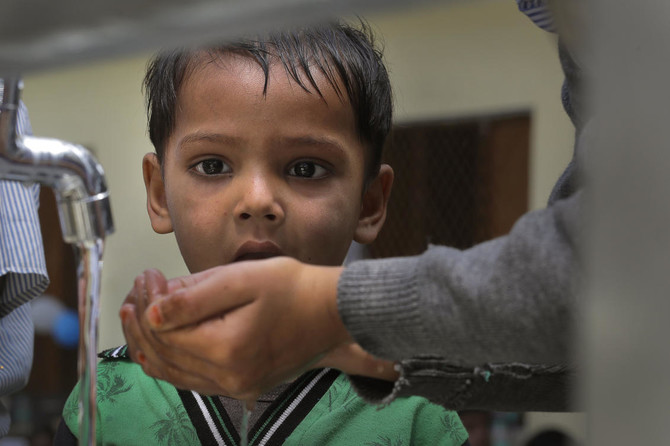
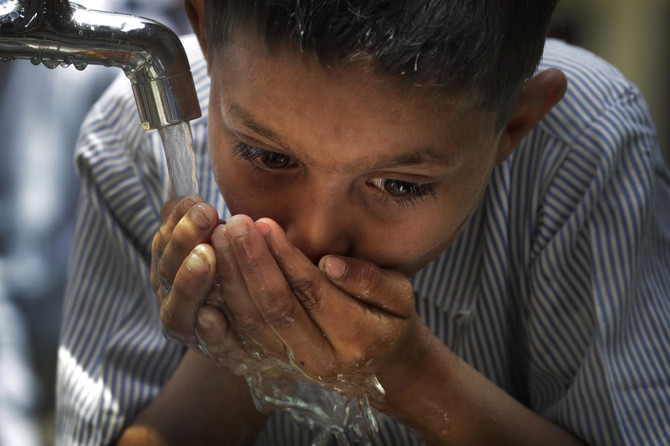
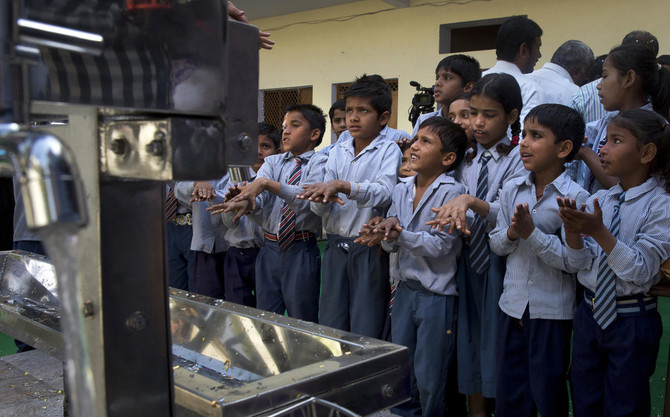
INDIA: Schoolchildren cheered and village women clapped as a gush of clean water flowed through a set of gleaming steel taps connected to a newly installed water filtration plant in a dusty north Indian village.
Nai Basti is a mere 55 kilometers (35 miles) east of the capital, New Delhi, but access to clean drinking water was a dream for the villagers until Wednesday, when the filtration plant began functioning at a village elementary school.
India has the world’s highest number of people without access to clean water. According to UNICEF, the UN’s children’s agency, nearly 78 million Indians — or about 5 percent of the country’s 1.3 billion population — must make do with contaminated water sources or buy water at high rates.
The lack of clean water contributes to increases in stomach ailments, diarrheal diseases and deaths from waterborne diseases. Around 140,000 children die of diarrheal disease in India each year, a third of the 315,000 such deaths of children worldwide.
The US-based non-governmental organization, Planet Water Foundation, which has built the filtration system in Nai Basti, chose to activate it March 22, marked globally as World Water Day. The nonprofit plans to give access to clean drinking water to 24,000 people through 24 projects in five countries on this day.
School staff and villagers in Nai Basti said access to clean water would transform their lives. Apart from ending the effort of pumping every bucket they need for their use, it would also bring down waterborne diseases sharply.
“Earlier, the children used to drink dirty water. This was groundwater drawn from a bore-well by using a hand pump. They used to fall sick frequently and would not attend school,” said Vinod Sharma, principal of the Brahmaved Inter College in Nai Basti. “We expect attendance to reach 100 percent. And the residents of the village will have access to this water as well,” he said.
Installing the filtration system in the school serves the dual purpose of teaching children basic hygiene such as washing their hands before meals and after using the toilet.
In many ways Nai Basti’s water woes reflect the severe water shortages faced across the country. As rivers and streams run dry, villagers are forced to dig bore-wells and pump up increasingly polluted groundwater. But decades of extracting groundwater for their daily needs has led to a precipitous drop in the groundwater table levels across the country, threatening environmental and human disaster.
India faces chronic water shortages. With climate change, the country’s annual monsoon rains have become more erratic, and traditional water reservoirs have shrunk.
The situation is worse in the cities, where water tables have plunged hundreds of feet, leaving people entirely dependent on tankers which supply water at prohibitive prices. In major cities this has led to the creation of powerful water “mafias,” which control water supplies to neighborhoods.
Nai Basti residents foresee a healthier future with their new access to clean water.
“My worries were for my children who would often fall ill from drinking unfiltered water. They were falling behind in their studies from missing school,” said Jyoti, a housewife, who uses one name.
“That won’t be a problem anymore,” she smiled.


Clean water plant brings hope to village in north India
Clean water plant brings hope to village in north India



‘No to the war’: Spain digs in as rift with US deepens
- Pedro Sanchez: ‘We will not be complicit in something that is harmful to the world and contrary to our values and interests’
- US forces use the Rota naval base and Moron air base in southern Spain under an agreement signed in 1953 under the dictatorship of General Francisco Franco
MADRID: Spain’s prime minister defiantly posted “No to the war” on Wednesday, deepening a rift with the United States after Madrid refused the use of its bases to attack Iran and Washington threatened trade reprisals.
Spain’s Socialist Prime Minister Pedro Sanchez had already angered US President Donald Trump with a series of other policies.
Sanchez has refused to join NATO allies in a pledge to boost defense spending to five percent of GDP as demanded by Trump, and has fiercely criticized Israel’s war in Gaza.
Trump lashed out at Sanchez’s government on Tuesday, calling Spain a “terrible” ally and threatening to sever all trade with Spain.
Sanchez defended his position on Wednesday, saying his government’s position “can be summed up in four words: no to the war.”
“We will not be complicit in something that is harmful to the world and contrary to our values and interests, simply out of fear of retaliation,” he added in a televised address.
Spain is part of the European Union, which allows goods to move freely between its 27 countries. This would complicate any bid to impose trade restrictions on a single member state.
“Trump’s words don’t always become policy. We will have to see if he follows through, and how,” said Angel Saz Carranza, director of the Esade Center for Global Economy and Geopolitics, a Spanish think tank.
European Council chief Antonio Costa wrote on X that he had called Sanchez to “express the EU’s full solidarity with Spain.”
“The EU will always ensure that the interests of its member states are fully protected,” Costa said.
French President Emmanuel Macron also called to “express France’s European solidarity in response to the recent threats of economic coercion targeting Spain,” his office said.
‘Oppose this disaster’
US forces use the Rota naval base and Moron air base in southern Spain under an agreement signed in 1953 under the dictatorship of General Francisco Franco.
During the 2003 invasion of Iraq, Spain, then led by conservative prime minister Jose Maria Aznar, staunchly backed the United States by sending troops.
Spain’s participation in the Iraq war sparked huge street demonstrations and many Spaniards blame it for the March 11, 2004 Madrid train bombings that killed nearly 200 people.
A branch of Al-Qaeda claimed responsibility for the attacks and called for the withdrawal of Spanish forces from Iraq.
Sanchez on Wednesday compared the Iran attacks to the Iraq war, which he said increased terrorism, increased energy prices and led to a less secure world.
“We oppose this disaster,” he said in reference to the Iran war.
In contrast, neighboring Portugal authorized the United States to “conditionally” use an air base on the Azores archipelago in the Atlantic Ocean for the Iran strikes, Prime Minister Luis Montenegro told parliament on Wednesday.
The authorization was granted as long as “these operations are defensive or retaliatory, are necessary and proportionate, and exclusively target military objectives,” Montenegro said.
The conservative leader said those conditions were “aligned with international law,” but he declined to openly support Sanchez or take a stance on the US-Israeli strikes on Iran.
Rally his base
The Spanish prime minister has emerged as a prominent figure for Europe’s disillusioned progressives, who see him as one of the few remaining openly leftist voices in a continent increasingly dominated by right-wing politics.
His opposition to the use of the bases is seen by some analysts as an attempt to rally his supporters around an issue that unites the Spanish left.
Sanchez, in power since 2018, heads a minority coalition government that struggles to pass legislation.
The popularity of his Socialist party has taken a hit from a string of sexual harassment and graft scandals ahead of the next general election due in 2027.
Many on Spain’s right consider Sanchez’s opposition to Trump as motivated more by domestic politics than by a moral compass.
The head of the main opposition conservative Popular Party which tops opinion polls, Alberto Nunez Feijoo, accused Sanchez on X of using foreign policy for “partisan” purposes.
Left-leaning daily newspaper El Pais urged Sanchez in an editorial on Wednesday to “resist the temptation” to “exploit widespread hostility toward Trump in Spanish society to boost his popularity.”


