BRASILIA: Brazil tried to reassure the world Sunday that its huge meat industry poses no threat — with President Michel Temer even inviting ambassadors to a steak dinner — despite allegations that corrupt exporters sold tainted products.
Temer smiled as he invited diplomats to a traditional Brazilian meat restaurant called a churrascaria, saying “if you accept the invitation we will be very happy.” Nineteen of the 33 envoys who met with him accepted the offer. But Temer had the serious mission of calming a scandal threatening the reputation of the world’s biggest beef and poultry exporting nation.
The scare started Friday when police said a two-year probe had found major meat producers bribed health inspectors to certify tainted food as fit for consumption.
At least 30 people have been arrested, with police raiding more than a dozen processing plants and issuing 27 arrest warrants.
A poultry-processing plant run by the multinational BRF group and two meat-processing plants operated by the local Peccin company were shut down, the Agriculture Ministry said.
Brazilian meat is exported to more than 150 countries, with principal markets as far apart as Saudi Arabia, China, Singapore, Japan, Russia, the Netherlands and Italy. Sales in 2016 reached $5.9 billion in poultry and $4.3 billion in beef, according to Brazilian government data.
In his address to the ambassadors, Temer acknowledged that the scandal had generated “major concern.”
But he insisted that the bad meat and faked certificates occurred in only “a very few businesses” and did not represent a wider problem.
Calling Brazil’s inspection system “one of the most respected” in the world, Temer said: “I want to reiterate our confidence in the quality of our products.”
In 2016, 853,000 consignments of animal products were exported, Temer said, yet “just 184 of them were deemed by importers to be in violation.”
Earlier, Luis Eduardo Pacifici Rangel, secretary of agricultural protection, told reporters that there was “no risk for population, neither for exports.”
Brazil is worried the scandal will hurt attempts to negotiate a trade deal between South America’s Mercosur group with the EU.
The EU ambassador to Brazil, Joao Cravinho, tweeted on Sunday that he wanted “complete, urgent clarifications from the agriculture ministry.”
The authorities have not yet detailed where tainted products were found, but say that in some cases carcinogenic substances were used to mask the smell of bad meat.
In addition to the giant BRF firm, which owns the Sadia and Perdigao brands, companies under investigation include JBS, a world leader in meat sales and owner of the Big Frango, Seara Alimentos and Swift brands.
JBS took out a full-page ad in the newspaper O Globo to say that the federal office conducting the investigation had made no mention of health problems stemming from JBS products. The BRF group is running similar ads, saying its products pose no health risk “whatsoever.”


![]()
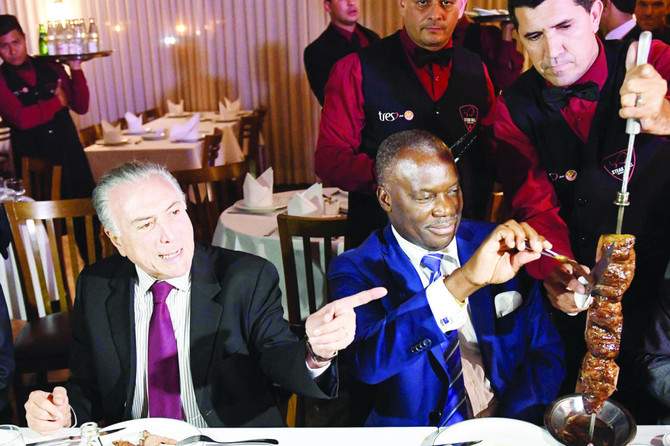
Brazil president seeks to calm fears over meat sales, exports
Brazil president seeks to calm fears over meat sales, exports
Latest updates


Recommended


© 2026 SAUDI RESEARCH & PUBLISHING COMPANY, All Rights Reserved And subject to Terms of Use Agreement.