

Vogue Arabia looks to build bridges for ‘misunderstood’ Middle East

The first printed edition of Vogue Arabia hit newsstands on March 5. (Condé Nast/Nervora)
Updated 21 March 2017
Follow

Vogue Arabia looks to build bridges for ‘misunderstood’ Middle East

DUBAI: Forget the UN and endless rounds of Middle East peace talks — there is a new player on the global diplomatic scene: Vogue Arabia.
That was, at least, the somewhat outlandish suggestion made by Tommy Hilfiger as the long-awaited regional edition of the fashion glossy hit the shelves on March 5.
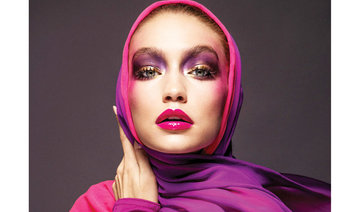
The inaugural print edition of Vogue Arabia featured supermodel Gigi Hadid on the front cover, wearing what appeared to be a veil. The appearance of the half-Palestinian model on the magazine’s cover, Hilfiger told TMZ, could “increase the love” between the US and Middle East, with Gigi as a “conduit” to better relations.
It is somewhat unlikely that a fashion photo shoot could help solve knotty diplomatic disputes over issues like, say, the Iran nuclear deal or Israeli-Palestinian conflict.
Shashi Menon — founder of Nervora, which publishes Vogue Arabia in partnership with US media giant Condé Nast — is the first to admit this.
But the launch of the title does have a scope that is broader than the latest haute couture creations or fleeting fashions.
Speaking to Arab News in the swish Vogue Arabia offices in the Dubai Design District, Menon spelled out a wider aim of the title.
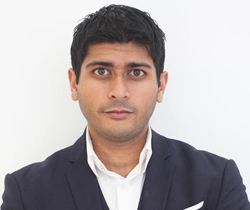
“The Middle East is very clearly one of the more, if not the most misunderstood regions in the world. Part of what we hope to do is build bridges through conversation and dialogue,” he said.
Menon acknowledged that Hilfiger’s statement was “grandiose” and a little “over-the-top” — but said that the sentiment he expressed was a genuine one.


                      Shashi Menon


“There is frankly no more important time for a publication like Vogue to launch in this region, and help to elevate authentic, original and positive stories about what’s happening here… and take it to a global level,” he said.
“That is a cultural cause and a mission that we feel that we want to participate in. We want to help create conversation and participate in that, which we think will be good for everyone.”
The launch of Vogue Arabia has been a long time coming.
Ten years ago Condé Nast had strongly ruled out licensing an edition of its flagship fashion title in this region.
Jonathan Newhouse, head of Condé Nast International, reportedly wrote in an email that the Middle East is too violent, claiming that it is incompatible with the Vogue brand given a “powerful fundamentalist, religious element, which rejects Western values.”
But such objections appear to have faded, with Condé Nast striking up a deal with Nervora to launch a Vogue Arabia website last year — through a rebrand of Style.com/Arabia — followed by the print version this month. Saudi royal Deena Aljuhani Abdulaziz is the editor-in-chief, with both the website and magazine being published in English and Arabic.
Menon said it was an “unprecedented” move to launch a Vogue title online first. But while digital will be important to the title — it has commissioned special online video shoots, for example — the media executive sees a firm future for the print title in the Internet age.
“We see a robust future for Vogue in print,” he said. “There is nothing that can really rival the premium, luxury, fully controlled reader experience that you get with print.”
The magazine is available in major cities of the Gulf, as well as further afield in Cairo and Beirut. It is available through private distribution and partners in Saudi Arabia, which Menon said was a key market for the publisher.
“For us Saudi Arabia is very important,” he said. “It is an ongoing goal of ours to be more and more present in Saudi Arabia, not just through the magazine but also from the website and possibly through events.”
Menon said it is possible to combine what Vogue stands for with the Middle Eastern outlook in a “tasteful and culturally appropriate” way.
“We don’t want to come in and feel like just a Western-only brand that is coming in here and trying to project a Western identity. We really want to participate in that conversation organically,” he said.
And this conversation will hopefully give a boost to how the rest of the world sees the Middle East — although that is not something that will happen overnight, Menon said.
“It is not about making giant political statements… We want to just help create more conversation and dialogue,” he said. “Ultimately the goal would be to promote more cultural understanding.”

‘Not just another regional magazine’

Vogue Arabia, the 22nd international edition of the fashion title, is edited by Deena Aljuhani Abdulaziz; a fashion-forward mother of three and Saudi royal who describes herself as “ambitious.”
“I don’t want Vogue Arabia to just be another regional magazine. I definitely want it to be a global one as well, especially in this political climate. I think it’s very important,” she said.
Through its range of features and shoots, the magazine attempts to cater to a wide and diverse audience of Arab women, whose varying takes on personal style and modesty cannot be defined by one trope or fashion statement.
While not intentionally provocative, there are images of women in backless gowns and skirts that end above the knee. There are also artful shots of women in headscarves.

‘AI is here, now what?’ Arab News unveils report on future of media ahead of Bridge Summit

Updated 07 December 2025
Follow

‘AI is here, now what?’ Arab News unveils report on future of media ahead of Bridge Summit

  • As the Bridge Summit opens in Abu Dhabi, Arab News releases a landmark report on how AI is transforming media in the MENA region
  • Based on a high-level roundtable at the Dubai Future Forum, the new report highlights both the opportunities and risks facing Arab media

DUBAI: As the Bridge Summit kicks off in Abu Dhabi on Monday, bringing together global leaders to explore the future of media, entertainment, and the creative economy, Arab News has launched a timely report on how artificial intelligence is transforming the media industry in the Middle East and beyond.

The report, produced by the Arab News Research and Studies Unit following a high-level roundtable at the Dubai Future Forum, captures the urgency and complexity of AI adoption in the media industry of the Middle East and North Africa region.

It explores how AI is transforming newsroom operations, redefining journalistic roles, and raising critical questions around credibility, accuracy, and trust amid rapid technological disruption.

AI is no longer an emerging trend in the Middle East — it is a central force reshaping economies, governance and public communication.

Journalists watch an introductory video by the 'artificial intelligence' anchor Fedha on the twitter account of Kuwait News service, in Kuwait City on April 9, 2023. (AFP file photo)

With AI projected to contribute $320 billion to the regional economy by 2030, including more than $135 billion to Saudi Arabia’s gross domestic product and nearly $96 billion to the UAE’s, governments and industries are racing to integrate it.

But, for the region’s news media, AI represents something deeper than economic potential: a direct challenge to the foundations of credibility, trust and fact-based reporting.

Such were the questions that set the stage for the roundtable hosted and moderated by Arab News’ Deputy Editor-in-Chief Noor Nugali in collaboration with the Dubai Future Foundation, where editors, media executives and tech specialists convened to confront an industry experiencing one of the most dramatic transformations in its history.

Arab News held a roundtable on the sidelines of the Dubai Future Forum. (AN photo)

The result is an exhaustive and insightful report, which offers both optimism and unease as AI’s looming presence weaves into daily newsroom operations, just as the guardrails needed to protect journalism from misinformation, bias and opacity remain dangerously underdeveloped.

“AI is here and it’s transforming our newsroom,” said Mina Al-Oraibi, editor in chief of the UAE’s leading daily The National, as she described how her team recently held a full-newsroom AI workshop to generate internal use cases.

“We got 26 ideas that we’re working through so people don’t feel this is something imposed,” she said. “They need to feel they’re ahead of the curve rather than being eaten up by it.”

Across the region, that curve is moving quickly. Globally, 81 percent of journalists now use AI tools during their general work, while nearly half do so daily.

However, reporters admit they rely on it mostly to handle mundane, time-consuming tasks such as transcribing interviews, summarizing reports, and translating documents.

Nabeel Al-Khatib, general manager of Asharq News, explained how the shift has already redefined newsroom economics.

“A newsroom of 50 can now publish the equivalent of what 500 once could,” he said. However, although “machines will take over the production line,” he argued that “human oversight must remain to ensure accuracy, context and editorial standards.”

For many newsrooms, the advent of generative AI — machines creating new original content — has created valuable efficiencies, freeing journalists to spend more time verifying and reporting, which are tasks no machine can yet replace.

US President Donald Trump is shown praying in this AI-generated image. Media experts worry that differentiating between true and fake pictures is becoming difficult. 

However, several speakers stressed that the value of AI depends entirely on how intentionally it is used.

“We believe it’s human first, human last,” said Nayla Tueni, editor in chief of Lebanese daily An-Nahar. “We need to always fact-check everything. But at the same time, we need to use all the tools.”

For Tueni, transformation is not optional. “I don’t think journalism will end,” she said. However, if outlets “don’t transform, they cannot continue because the world is transforming every second.”

Accessing revenue streams is also a concern. Elda Choucair, CEO of Omnicom Media Group MENA, said “the biggest danger is … if you don’t have content that you advertise around.”

The region’s audiences appear more comfortable with AI-enhanced content than those in Western markets. But even as opportunities expand, risks multiply. AI-generated misinformation has surged so dramatically that the World Economic Forum ranked it the top global short-term threat for the second year in a row.

A BBC-led audit of four major AI systems found that nearly half of AI-generated answers contained significant errors, fabricated details or incorrect sourcing.

This AI-generated image shows US President Donald Trump being arrested by the police. Media experts worry that differentiating between true and fake pictures is becoming difficult. 

“It’s already very difficult to differentiate between the (true) and the fake,” said Choucair. “We need to create awareness that sometimes, if you really want the truth, you’ve got to wait.”

At a time when 70 percent of global audiences say they struggle to trust online content, speakers warned that the misuse or undisclosed use of AI could deepen a crisis of confidence.

“The machine should be a slave to human beings,” advertising media mogul Pierre Choueiri said, adding: “This is where governments, or regulations, should come in.”

However, regulation in the region remains elusive. While Saudi Arabia has taken major steps, including the establishment of the Saudi Data & AI Authority and the Kingdom’s Generative AI Guidelines, efforts remain far from the comprehensive frameworks seen in Europe.

“It’s inconceivable that Arab consumers are left to face significant risks with no regulatory shield,” said media strategist and legal expert Mazen Hayek. He argued that the region needs its own protections, like the EU’s General Data Protection Regulation, to ensure transparency, safeguard data and hold AI providers accountable.

For Hayek and others, the deeper problem involves technological sovereignty. Nearly all of the AI platforms used in the Middle East today — from search engines to large language models — are built and controlled abroad, often trained on datasets that do not reflect the region’s linguistic, cultural or political realities.

“We live in a region that has zero control over the platforms and the technology that we consume,” Hayek said. “Someone needs to create a platform that empowers the region to create and distribute its own content.”

Julien Hawari, CEO of the emerging social media platform Million, said the main issue is integrity. “That has been a problem for as long as we can think of.”

Rashid Al-Marri, CEO of the Media Regulation Sector at the Dubai Media Council, explained that “there has to be that human element understanding (the content) and what’s happening and being able to come out and speak and get the truth out there.”

Saudi Arabia’s push toward sovereign AI infrastructure, including Public Investment Fund-backed HUMAIN and the $100 billion Project Transcendence, was cited as a step in the right direction. However, roundtable participants warned that unless the region accelerates these efforts, it risks ceding its information future to external algorithms and foreign companies.

The human-capital gap is equally pressing. Despite widespread adoption, most journalists using AI have received little or no training. Many rely on self-learning or online tutorials, and nearly eight in 10 work in newsrooms without formal AI policies.

This lack of structure has created an environment where AI is widely deployed but rarely governed.

For CAMB.AI co-founder Avneesh Prakash, the solution requires both precaution and empowerment. “Like any innovation, AI needs to be regulated,” he said. “Just as a car has an accelerator and a brake, AI must include a kill switch because it requires human judgment, human creativity and human resilience.”

Despite the risks, the discussion ended on a note of guarded optimism. Participants agreed that AI can help rebuild journalism for a digital era — but only if newsrooms combine innovation with rigorous editorial oversight, transparency and a renewed commitment to verification.

Mamoon Sbeih, regional president of advertising firm APCO, offered a clear warning of what lies ahead. AI, he said, “might help the journalism industry progress and redefine itself, or it might expedite its demise.”

For now, the region’s media leaders remain determined to pursue the first path — ensuring that even as machines play a growing role in production, the values that define journalism remain firmly, unmistakably human.