

Vogue Arabia looks to build bridges for ‘misunderstood’ Middle East

The first printed edition of Vogue Arabia hit newsstands on March 5. (Condé Nast/Nervora)
Updated 21 March 2017
Follow

Vogue Arabia looks to build bridges for ‘misunderstood’ Middle East

DUBAI: Forget the UN and endless rounds of Middle East peace talks — there is a new player on the global diplomatic scene: Vogue Arabia.
That was, at least, the somewhat outlandish suggestion made by Tommy Hilfiger as the long-awaited regional edition of the fashion glossy hit the shelves on March 5.
The inaugural print edition of Vogue Arabia featured supermodel Gigi Hadid on the front cover, wearing what appeared to be a veil. The appearance of the half-Palestinian model on the magazine’s cover, Hilfiger told TMZ, could “increase the love” between the US and Middle East, with Gigi as a “conduit” to better relations.
It is somewhat unlikely that a fashion photo shoot could help solve knotty diplomatic disputes over issues like, say, the Iran nuclear deal or Israeli-Palestinian conflict.
Shashi Menon — founder of Nervora, which publishes Vogue Arabia in partnership with US media giant Condé Nast — is the first to admit this.
But the launch of the title does have a scope that is broader than the latest haute couture creations or fleeting fashions.
Speaking to Arab News in the swish Vogue Arabia offices in the Dubai Design District, Menon spelled out a wider aim of the title.
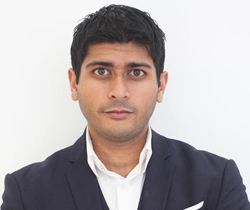
“The Middle East is very clearly one of the more, if not the most misunderstood regions in the world. Part of what we hope to do is build bridges through conversation and dialogue,” he said.
Menon acknowledged that Hilfiger’s statement was “grandiose” and a little “over-the-top” — but said that the sentiment he expressed was a genuine one.


                      Shashi Menon


“There is frankly no more important time for a publication like Vogue to launch in this region, and help to elevate authentic, original and positive stories about what’s happening here… and take it to a global level,” he said.
“That is a cultural cause and a mission that we feel that we want to participate in. We want to help create conversation and participate in that, which we think will be good for everyone.”
The launch of Vogue Arabia has been a long time coming.
Ten years ago Condé Nast had strongly ruled out licensing an edition of its flagship fashion title in this region.
Jonathan Newhouse, head of Condé Nast International, reportedly wrote in an email that the Middle East is too violent, claiming that it is incompatible with the Vogue brand given a “powerful fundamentalist, religious element, which rejects Western values.”
But such objections appear to have faded, with Condé Nast striking up a deal with Nervora to launch a Vogue Arabia website last year — through a rebrand of Style.com/Arabia — followed by the print version this month. Saudi royal Deena Aljuhani Abdulaziz is the editor-in-chief, with both the website and magazine being published in English and Arabic.
Menon said it was an “unprecedented” move to launch a Vogue title online first. But while digital will be important to the title — it has commissioned special online video shoots, for example — the media executive sees a firm future for the print title in the Internet age.
“We see a robust future for Vogue in print,” he said. “There is nothing that can really rival the premium, luxury, fully controlled reader experience that you get with print.”
The magazine is available in major cities of the Gulf, as well as further afield in Cairo and Beirut. It is available through private distribution and partners in Saudi Arabia, which Menon said was a key market for the publisher.
“For us Saudi Arabia is very important,” he said. “It is an ongoing goal of ours to be more and more present in Saudi Arabia, not just through the magazine but also from the website and possibly through events.”
Menon said it is possible to combine what Vogue stands for with the Middle Eastern outlook in a “tasteful and culturally appropriate” way.
“We don’t want to come in and feel like just a Western-only brand that is coming in here and trying to project a Western identity. We really want to participate in that conversation organically,” he said.
And this conversation will hopefully give a boost to how the rest of the world sees the Middle East — although that is not something that will happen overnight, Menon said.
“It is not about making giant political statements… We want to just help create more conversation and dialogue,” he said. “Ultimately the goal would be to promote more cultural understanding.”

‘Not just another regional magazine’

Vogue Arabia, the 22nd international edition of the fashion title, is edited by Deena Aljuhani Abdulaziz; a fashion-forward mother of three and Saudi royal who describes herself as “ambitious.”
“I don’t want Vogue Arabia to just be another regional magazine. I definitely want it to be a global one as well, especially in this political climate. I think it’s very important,” she said.
Through its range of features and shoots, the magazine attempts to cater to a wide and diverse audience of Arab women, whose varying takes on personal style and modesty cannot be defined by one trope or fashion statement.
While not intentionally provocative, there are images of women in backless gowns and skirts that end above the knee. There are also artful shots of women in headscarves.


Keep it real: Tech giants urged to lead on safeguarding online privacy

Updated 10 December 2025
Follow

Keep it real: Tech giants urged to lead on safeguarding online privacy

  • AI, deepfakes, misinformation under scrutiny at Bridge Summit
  • Media, tech professionals discuss how to keep users safe

ABU DHABI: As AI-generated deepfakes and bots grow more sophisticated, online privacy and identity protection have become urgent global concerns, especially for journalists, influencers and media professionals, whose lives unfold in the digital spotlight.

The growing threats of impersonation, character assassination and coordinated online abuse was at the center of a high-stakes conversation on the second day of the Bridge Summit in Abu Dhabi, where regional and international leaders from the technology and media fields tackled the complex risks surrounding digital safety, security and trust in an AI-powered world.

Adeline Hulin, chief of unit, media and information literacy at UNESCO, highlighted the risks that many people, in particular children and women, are facing online. 

Although her work has long centered on promoting safe internet practices, she said that the onus of safeguarding online privacy and security rested primarily with technology companies — the only actors, she argued, capable of keeping pace with the rapid evolution of AI.

“It is going to be really important that instead of people constantly having to adapt to the technology, if the technology itself is more user-centric,” she told the summit.

“We can train people to recognize deepfakes, but technology can do that quicker.”

Major tech companies have come under fire in recent years for failing to tackle harassment and misinformation. This has led to a litany of legislation as governments try to gain control of a growing problem.

But some companies appear to be heeding the call. Erin Relford, senior privacy engineer at Google, said her company was working to embed privacy protections in the infrastructure level beneath the platform.

“We want to give consumers the choice of how much they can share data-wise,” she said.

“The biggest challenge is making sure you have the right people in the room to create these privacy protection platforms.”

Privacy enhancement technology would see several tools released that empowered users to understand how their data was being monetized and aggregated, Relford said.

Google had been working to change the parental controls and make it easier for users to understand their protection, she said, but admitted it was still difficult and more education was needed.

“Most of the power lies within the user. Consumers drive what is popular. In terms of organizations that protect your privacy, we want to encourage them and use their services rather than empowering websites that don’t,” she said.

Education is key 

Still, Relford argued that education was fundamental in rolling out privacy tools. Tech companies could only do so much if people did not increase their awareness online, she said.

“The better we educate people about privacy tools, the less harm we have from the ground up.”

Echoing similar sentiments, Hulin promoted the idea of including online literacy in school curricula. Even high-profile moves, like Australia’s recent headline-grabbing ban on under-16s using social media, would do little to reduce the risks without more education.

“Even if there is banning, it’s not going to change misinformation and disinformation. You still need to teach these kids about the information ecosystem,” she said.

“Parents need to be really interested in the news information that your children are consuming.”

Assel Mussagaliyeva-Tang, founder of Singapore-based startup EDUTech Future, said that the AI revolution demanded close collaboration between schools, universities and families to equip children with the skills to navigate new technologies safely and responsibly.

“We need to set up the guardrails and protection of the kids because they are not aware how the model will respond to their needs,” she said.

A UNESCO survey found that 62 percent of digital creators skip rigorous fact-checking, while a 2024 YouGov study showed only 27 percent of young adults feel confident about AI in education.

Mussagaliyeva-Tang said educators needed to focus on preparing and nurturing adults who were “ready for the world,” by integrating ethics, data literacy and critical thinking into curricula.

But she said that universities and the broader education system remained behind the curve in adapting to emerging technologies and equipping students with the skills needed for responsible digital engagement.

Likewise, tech companies needed to be transparent and inclusive in training their data in a way that represented different cultures, she said.

While global regulations on AI remain fragmented, Dr. Luca Iando, dean and distinguished chair at the Collins College of Professional Studies at St. John’s University, called on educational institutions to actively collaborate with technology platforms to help shape educational content and mitigate the potential harm of AI on children, especially as technologies continue to grow.

He warned of young people’s overreliance on AI and said that educators in the long term needed to focus on developing “durable, human skills” in students and transform the type of assignments and coursework to meet the new age of AI.

There needed to be guidelines for students on using AI responsibly, to prepare them for the workplace, he said.

Highlighting the skills gap between educational institutions and the modern workplace, Mussagaliyeva-Tang said: “Employers want professionals. They don’t have time and the budgets to retrain after the outdated curriculum of the university.”

The rise of AI demanded a rethinking of the true purpose of education to nurture individuals who strove to make a positive impact on a rapidly evolving world, she said.