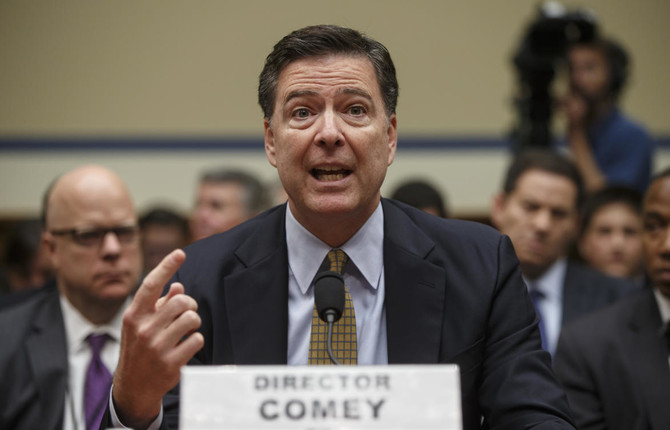
WASHINGTON: The directors of the FBI and NSA are to give keenly awaited testimony before Congress Monday on what ties President Donald Trump may have with Russia and his explosive allegation that he was wiretapped by his predecessor Barack Obama.
Federal Bureau of Investigation Director James Comey and Mike Rogers of the National Security Agency will speak publicly for the first time about two issues that have riveted the American public for weeks and further divided the country’s two ever-at-odds political parties.
The stakes for the tycoon-turned-world-leader could hardly be higher.
Comey will testify before the House Intelligence Committee at a hearing aimed at probing Russia’s interference in the 2016 election campaign. Rogers is also scheduled to testify.
Trump and his entourage’s possible ties with the Russia of President Vladimir Putin have been the subject of much speculation since before he was elected on November 8.
US intelligence agencies in January took the extraordinary step of stating publicly that they had concluded that hackers working for Russia broke into the e-mail accounts of senior Democrats and released embarrassing ones with the aim of helping Trump defeat Hillary Clinton.
Even since then, the question of whether Trump and company were or are somehow in cahoots with Russia has dominated the national conversation.
A congressional panel so far has found no evidence that Trump’s campaign colluded with Russia, its chairman said Sunday.
Based on “everything I have up to this morning — no evidence of collusion,” by Trump’s team and Moscow, Representative Devin Nunes, chairman of the House Intelligence Committee, told Fox News.
“Was there a physical wiretap of Trump Tower? No, but there never was, and the information we got on Friday continues to lead us in that direction,” Nunes stressed.
Moscow has denied involvement in the hacks, and Trump has denounced the tumult over alleged Russia connections as a “total witch hunt.”
Monday’s hearing was also expected to address a second explosive issue: Trump’s unsubstantiated accusations that the Obama administration wiretapped his phone at Trump Tower in New York during the campaign.
Trump on March 4 tweeted that Obama had “tapped” his phone — a charge that has consumed political debate in the US capital.
Several congressional panels have launched investigations into Russia’s alleged interference, including the House and Senate intelligence committees, which have jurisdiction over the nation’s 17 intelligence agencies, and the House and Senate judiciary committees.
The FBI is also probing Russian interference in the election.
The question remains whether the agency has opened a criminal investigation into possible ties between Trump campaign aides and Russian officials.
Monday’s hearing promises to be a very public showdown between the FBI and lawmakers, with the national security world certain to watch whether Comey drops a political bombshell.
Members of Congress have expressed frustration over what they call the lack of cooperation from the FBI about Russia and Trump’s wiretap claim, which Obama and an array of other officials have flatly denied.
The issue of wiretapping first surfaced last month, when Trump’s national security adviser Michael Flynn was forced to resign after it was revealed he had misled top officials over his contacts with the Russian ambassador to Washington to discuss sanctions Obama had just announced against Russia over the election hacking.
Around the same time, The New York Times reported that US intelligence had intercepted calls showing that members of Trump’s campaign had repeated contacts with top Russian intelligence officials in the year preceding the election.
Nunes has said that the intelligence committee probe focuses in part on who revealed that Flynn had unreported private contacts with the Russians over the sanctions issue.
Adding to the intrigue, Trump’s attorney general Jeff Sessions recused himself from any Russia-related inquiries after it was learned that he had met twice with the Russian ambassador in the months before Trump took office, and had failed to disclose this during his confirmation hearing when asked a question about such contacts and speaking under oath.
Domestically, the controversy over the wiretapping claim has pulled attention away from Trump’s effort to push through other key items on his agenda, including the planned repeal of Obama’s health care law, tax reform and his controversial travel ban.
Critics say it has also debased the already coarse tone of political debate in Washington and eroded the president’s credibility at home and abroad.
Some of the fallout has been international in scope: The White House was forced to retract a charge repeated last week by its spokesman Sean Spicer suggesting that Britain’s intelligence services aided the Obama administration in the alleged wiretap. That claim has strained relations with America’s closest ally.
Still, as recently as Friday, Trump repeated the claim in an aside during a White House press conference with Angela Merkel.
“As far as wiretapping, I guess, by this past administration, at least we have something in common, perhaps,” Trump told the German chancellor, referring to a WikiLeaks report in 2015 that the US had monitored calls involving Merkel and her top aides for years.

FBI director to testify on Russia ties, alleged wiretap
Backlash as Australia kills dingoes after backpacker death
- The euthanization program has stirred debate about how to manage the local population of dingoes
- Wildlife experts said killing the animals was the wrong response and may threaten the island’s dingo population
SYDNEY: Australian authorities have sparked a backlash by killing a group of dingoes linked to the death of a young Canadian woman on an island in the country’s east.
The Queensland government said six animals were put down after 19-year-old backpacker Piper James’s body was found on January 19 at a beach on the World Heritage-listed island of K’gari.
The euthanization program has stirred debate about how to manage the local population of dingoes, a sandy-colored canine believed to have first arrived in Australia 4,000 to 5,000 years ago.
An autopsy conducted on James’ body found evidence “consistent with drowning” but also detected injuries corresponding to dingo bites.
“Pre-mortem dingo bite marks are not likely to have caused immediate death,” said a spokesperson for the Coroners Court of Queensland.
The coroner’s investigation into the cause of death was expected to take several weeks.
In response, the Queensland government said a pack of 10 dingoes involved would be euthanized after rangers had observed some “aggressive behavior.”
Six of the dingoes had already been euthanized, the state’s environment minister, Andrew Powell, told reporters Sunday.
“Obviously, the operation will continue,” he said.
The traditional owners of K’gari, the Butchulla people, said the state’s failure to consult with them before euthanizing the dingoes — or wongari in their language — was “unexpected and disappointing.”
“Once again, it feels as though economic priorities are being placed above the voices of the people and traditional owners, which is frustrating and difficult to accept,” the Butchulla Aboriginal Corporation said in a statement to Australian media this week.
‘You are food’
Wildlife experts said killing the animals was the wrong response and may threaten the island’s dingo population, estimated at just 70-200 animals.
Given their small numbers, killing a pack of 10 animals would harm the population’s genetic diversity, said Mathew Crowther, professor of quantitative conservation biology at the University of Sydney.
“There’s no moral from the dingoes’ point of view. They’re just being wild animals, doing wild things,” Crowther said.
Dingoes tend to lose their fear of people as they interact with tourists, some of whom defy advice against feeding the animals.
“That’s the worst thing you can do to a wild animal,” Crowther said.
“They just relate humans to food, and if you don’t give them food, well, you are food — that’s basically how it is.”
Dingoes are wild, predatory animals and need to be treated with respect, said Bill Bateman, associate professor in the school of molecular and life sciences at Curtin University.
The canines are more likely to attack children or people who are alone, and may be triggered when people turn their backs or run, he said.
“These are important animals, and therefore we need to change the way we deal with them, otherwise we’re just going to keep reacting to these attacks and driving the population of dingoes down,” Bateman said.
Wildlife managers, rangers, Indigenous people and tourism operators need to work together so that humans and dingoes can coexist on the island, he said.
Todd James, the father of Piper, has described on social media how his family’s hearts were “shattered” by her death.
News of the dingoes’ euthanization was “heart-wrenching,” he told Australian media, adding however that he recognized it may be necessary for safety because of the pack’s behavior.
The Queensland government said six animals were put down after 19-year-old backpacker Piper James’s body was found on January 19 at a beach on the World Heritage-listed island of K’gari.
The euthanization program has stirred debate about how to manage the local population of dingoes, a sandy-colored canine believed to have first arrived in Australia 4,000 to 5,000 years ago.
An autopsy conducted on James’ body found evidence “consistent with drowning” but also detected injuries corresponding to dingo bites.
“Pre-mortem dingo bite marks are not likely to have caused immediate death,” said a spokesperson for the Coroners Court of Queensland.
The coroner’s investigation into the cause of death was expected to take several weeks.
In response, the Queensland government said a pack of 10 dingoes involved would be euthanized after rangers had observed some “aggressive behavior.”
Six of the dingoes had already been euthanized, the state’s environment minister, Andrew Powell, told reporters Sunday.
“Obviously, the operation will continue,” he said.
The traditional owners of K’gari, the Butchulla people, said the state’s failure to consult with them before euthanizing the dingoes — or wongari in their language — was “unexpected and disappointing.”
“Once again, it feels as though economic priorities are being placed above the voices of the people and traditional owners, which is frustrating and difficult to accept,” the Butchulla Aboriginal Corporation said in a statement to Australian media this week.
‘You are food’
Wildlife experts said killing the animals was the wrong response and may threaten the island’s dingo population, estimated at just 70-200 animals.
Given their small numbers, killing a pack of 10 animals would harm the population’s genetic diversity, said Mathew Crowther, professor of quantitative conservation biology at the University of Sydney.
“There’s no moral from the dingoes’ point of view. They’re just being wild animals, doing wild things,” Crowther said.
Dingoes tend to lose their fear of people as they interact with tourists, some of whom defy advice against feeding the animals.
“That’s the worst thing you can do to a wild animal,” Crowther said.
“They just relate humans to food, and if you don’t give them food, well, you are food — that’s basically how it is.”
Dingoes are wild, predatory animals and need to be treated with respect, said Bill Bateman, associate professor in the school of molecular and life sciences at Curtin University.
The canines are more likely to attack children or people who are alone, and may be triggered when people turn their backs or run, he said.
“These are important animals, and therefore we need to change the way we deal with them, otherwise we’re just going to keep reacting to these attacks and driving the population of dingoes down,” Bateman said.
Wildlife managers, rangers, Indigenous people and tourism operators need to work together so that humans and dingoes can coexist on the island, he said.
Todd James, the father of Piper, has described on social media how his family’s hearts were “shattered” by her death.
News of the dingoes’ euthanization was “heart-wrenching,” he told Australian media, adding however that he recognized it may be necessary for safety because of the pack’s behavior.
© 2026 SAUDI RESEARCH & PUBLISHING COMPANY, All Rights Reserved And subject to Terms of Use Agreement.