JERUSALEM: A Palestinian doctor pleaded with Israel on Tuesday to apologize for a 2009 tank shell strike on his Gaza home that killed three of his daughters and a niece in the final days of the first Israel-Hamas war.
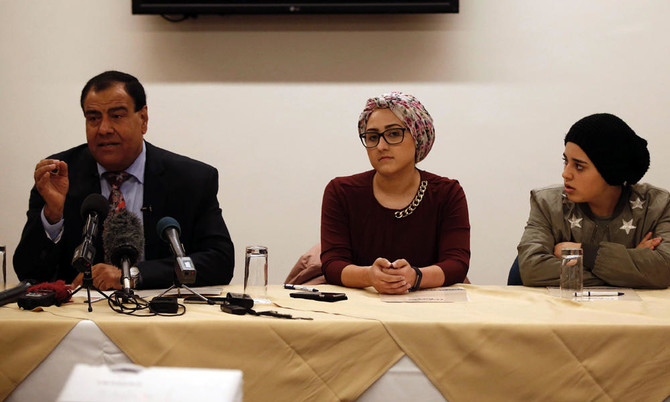
Dr. Izzeldin Abuelaish, struggling to compose himself at a news conference, urged “officials who live in denial to take responsibility.”
The grief of the Gaza infertility specialist has been seared into the memory of many Israelis. On Jan. 16, 2009, Abuelaish phoned an Israeli journalist friend live on the air, moments after the deadly strike on his home, to plead for help in evacuating the wounded, including a daughter and a niece.
In 2010, Abuelaish sued Israel, seeking an apology, acceptance of responsibility and compensation. A court hearing is set for Wednesday.
Israel has said it bears no liability because the incident occurred during wartime.
Israel’s Justice Ministry said Tuesday that the state does not dispute shells were fired at the building — a five-story home where Abuelaish and his brothers lived with their families.
The ministry said Israeli forces spotted people in the building at the time who they believed were directing sniper fire at the troops. The forces learned only later “that the plaintiffs were also in the building,” the statement said. The ministry alleged that “explosive materials of terrorist organizations” were in the building and that “it is quite possible” the girls were killed and wounded by an explosion of these materials.
The Israeli daily Haaretz reported earlier this week that the Defense Ministry filed a new court document with testimony from a weapons expert in the Israeli military who tested shrapnel taken from the wounded, including Abuelaish’s daughter, Shada. The tests concluded that the building contained weapons not used by the Israeli military, Haaretz reported.
Shada Abuelaish, sitting next to her father Tuesday, choked back tears when asked if she was angry about Israel’s position.
“I am angry because we have to fight for this,” said Shada, now 25. “The victim has to ask for justice.”
Abuelaish, 62, dismissed claims of a weapons cache. “Enough lies,” he said. “We need to move forward and take responsibility.”
The doctor was a well-known figure in Israel even before the first of what would be three wars between Israel and Gaza’s Hamas rulers over six years.
Abuelaish moved easily between two worlds, living in the Gaza town of Jebaliya but working in one of Israel’s biggest hospitals. During the first Gaza war, launched to end Hamas rocket fire on Israeli border towns, Israeli journalists often contacted him for updates, delivered in fluent Hebrew.
The doctor and his family spent the war in their apartment on the second floor of the family compound, close to the border with Israel. In early January 2009, Israeli ground forces moved into Gaza, including the doctor’s neighborhood, and over the next two weeks fired heavily, demolishing homes they said were thought to serve as Hamas positions.
On Jan. 16, tank shells hit the doctor’s home, killing daughters Aya, Mayar and Bissan, along with a niece, Noor.
Close to 1,400 Palestinians and 13 Israelis were killed during the three-week war, which ended Jan. 18, 2009.
Abuelaish, who has five surviving children, moved the family to Toronto, Canada, after the war.
He said Tuesday that any damages awarded by the Israeli court would be donated to the Daughters for Life Foundation, a charity established in the memory of his three daughters and niece. The foundation promotes education for women and girls of Middle Eastern background.


![]()
Gaza father seeks Israeli apology for killing of 3 daughters
Gaza father seeks Israeli apology for killing of 3 daughters
Latest updates


Recommended


© 2026 SAUDI RESEARCH & PUBLISHING COMPANY, All Rights Reserved And subject to Terms of Use Agreement.