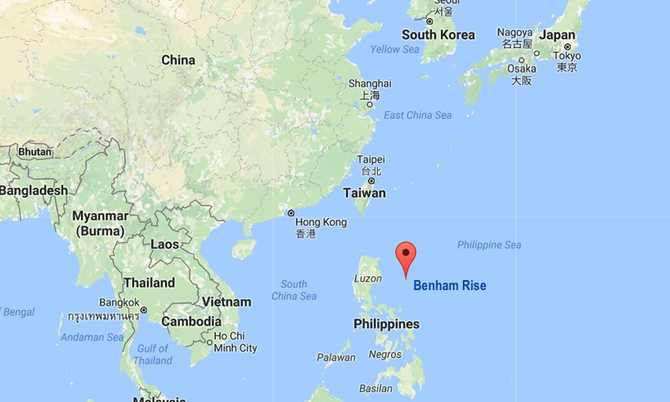
MANILA: Philippine President Rodrigo Duterte has ordered the navy to put up “structures” to assert sovereignty over a stretch of water east of the country where Manila has reported a Chinese survey ship was casing the area last year.
The Philippines has lodged a diplomatic protest with Beijing after the vessel was tracked moving back and forth over Benham Rise, a vast area east of the country declared by the United Nations in 2012 as part of the Philippines’ continental shelf.
According to the Philippines, Benham Rise is rich in biodiversity and fish stocks.
China’s foreign ministry on Friday said the ship was engaged in “normal freedom of navigation and right of innocent passage,” and nothing more.
Defense Secretary Delfin Lorenzana said Duterte’s instruction was to increase naval patrols in that area and put up structures “that says this is ours.” He did not specify what structures would be erected.
“We are concerned, they have no business going there,” Lorenzana told reporters late on Sunday.
Though he accepts China’s explanation, Lorenzana said it was clear that its vessel was not passing through the area because it stopped multiple times, for sustained periods.
Lorenzana last week said he was suspicious of China’s activities near Benham Rise and suggested they might be part of surveys to test water depths for submarine routes to the Pacific.
The issue was due to be discussed further at a national security council meeting on Monday evening, he said.
The issue risks disturbing ties with China at a time of rare cordiality between the two countries under Duterte, who has chosen to tap Beijing for business rather than confront it over its maritime activities and intentions in disputed waters.
Rows with China have usually been about the South China Sea, west of the Philippines, a conduit for about $5 trillion of shipped goods annually. China lays claim to almost the entire South China Sea.
While Duterte has been sanguine about ties with China, Lorenzana is more wary and has noted that Beijing’s fortification of manmade islands inside the Philippines’ 200 nautical mile exclusive economic zone has not abated.
(Reporting by Manuel Mogato)

Wary of China, Duterte tells navy to build ‘structures’ east of Philippines
Fraudsters flee Cambodia’s ‘scam city’ after accused boss taken down
SIHANOUKVILLE: Hundreds of people dragged away suitcases, computer monitors, pets and furniture as they fled a suspected Cambodian cyberfraud center, after the country’s most wanted alleged scam kingpin was arrested and deported.
Boarding tuk-tuks, Lexus SUVs and tourist coaches, an exodus departed Amber Casino in the coastal city of Sihanoukville, one of the illicit trade’s most notorious hubs.
“Cambodia is in upheaval,” one Chinese man told AFP. “Nowhere is safe to work anymore,” he said Thursday.
Similar scenes played out at alleged scam compounds across Cambodia this week as the government said it was cracking down on the multibillion-dollar industry.
But residents said many of the people working inside the tightly secured buildings moved out several days before the arrival of authorities, and an analyst dubbed it “anti-crime theater.”
From hubs across Southeast Asia, scammers lure Internet users globally into fake romantic relationships and cryptocurrency investments.
Initially largely targeting Chinese speakers, transnational crime groups have expanded operations into multiple languages to steal tens of billions annually from victims around the world.
Those conducting the scams are sometimes willing con artists, sometimes trafficked foreign nationals who have been trapped and forced to work under threat of violence.
AFP journalists visited several alleged Internet scam sites in Sihanoukville, in the wake of the high-profile arrest in Cambodia and extradition to China of internationally sanctioned accused scam boss Chen Zhi.
Few of those departing the casinos, hotels and other facilities were willing to speak with AFP, and none were willing to be identified due to concerns for their safety.
“Our Chinese company just told us to leave straight away,” said a Bangladeshi man outside Amber Casino.
“But we’ll be fine. There are plenty of other job offers,” he added.
Studded with casinos and unfinished high-rises, the glitzy resort of Sihanoukville has become a cyberscam hotbed, where thousands of people involved in the black market are believed to operate cons from fortified compounds.
Before Chen was indicted last year by US authorities who said his firm Prince Group was a front for a transnational cybercrime network, the Chinese-born businessman ran multiple gambling hotels in Sihanoukville.
A 2025 Amnesty International report identified 22 scam locations in the coastal resort, out of a total of 53 in the country.
The UN Office on Drugs and Crime estimates global losses to online scams reached up to $37 billion in 2023, and that at least 100,000 people work in the industry in Cambodia alone.
- Tipped off -
But the Cambodian government claims the lawless era has come to an end, with Prime Minister Hun Manet pledging on Facebook to “eliminate... all the problems related to the crime of cyber scams.”
Cambodia’s anti-scam commission says it has raided 118 scam locations and arrested around 5,000 people in the last six months.
Following Chen’s deportation to China, the Cambodian government has tightened the screws on some Prince Group affiliates, ordering Prince Bank into liquidation and freezing home sales at several of its luxury properties.
In recent months, China has stepped up its pursuit of the scam industry, sweeping up Chen and other key figures from across Southeast Asia to try them on its own soil.
But while Cambodia says it is “cracking down,” there are suspicions over the timing.
A tuk-tuk driver in Sihanoukville told AFP hundreds of Chinese people left one compound this week before police arrived.
“Looks like they were tipped off,” said the 42-year-old, declining to give his name.
Mark Taylor, former head of a Cambodia-based anti-trafficking NGO, said the “preemptive shifting of scam center resources,” including workers, equipment and managers, had been seen ahead of law enforcement sweeps.
It was “seemingly the product of collusion,” he added, in a strategy with “dual ends” of boosting the government’s anti-crime credentials while preserving the scamming industry’s ability to survive and adapt.
Amnesty has accused the Cambodian government of “deliberately ignoring” rights abuses by cybercrime gangs, which sometimes lure workers with offers of high-paying jobs before holding them against their will.
AFP journalists saw several coachloads of Mandarin speakers leaving Sihanoukville on the main highway to the capital Phnom Penh.
Multiple people said they “didn’t know” where they were going or what their plans were, but appeared anxious as they anticipated law enforcement closing in.
Outside the Amber Casino, holding a fake designer hold-all, the Bangladeshi man fell in with the crowd, saying: “This is about survival now.”
Boarding tuk-tuks, Lexus SUVs and tourist coaches, an exodus departed Amber Casino in the coastal city of Sihanoukville, one of the illicit trade’s most notorious hubs.
“Cambodia is in upheaval,” one Chinese man told AFP. “Nowhere is safe to work anymore,” he said Thursday.
Similar scenes played out at alleged scam compounds across Cambodia this week as the government said it was cracking down on the multibillion-dollar industry.
But residents said many of the people working inside the tightly secured buildings moved out several days before the arrival of authorities, and an analyst dubbed it “anti-crime theater.”
From hubs across Southeast Asia, scammers lure Internet users globally into fake romantic relationships and cryptocurrency investments.
Initially largely targeting Chinese speakers, transnational crime groups have expanded operations into multiple languages to steal tens of billions annually from victims around the world.
Those conducting the scams are sometimes willing con artists, sometimes trafficked foreign nationals who have been trapped and forced to work under threat of violence.
AFP journalists visited several alleged Internet scam sites in Sihanoukville, in the wake of the high-profile arrest in Cambodia and extradition to China of internationally sanctioned accused scam boss Chen Zhi.
Few of those departing the casinos, hotels and other facilities were willing to speak with AFP, and none were willing to be identified due to concerns for their safety.
“Our Chinese company just told us to leave straight away,” said a Bangladeshi man outside Amber Casino.
“But we’ll be fine. There are plenty of other job offers,” he added.
Studded with casinos and unfinished high-rises, the glitzy resort of Sihanoukville has become a cyberscam hotbed, where thousands of people involved in the black market are believed to operate cons from fortified compounds.
Before Chen was indicted last year by US authorities who said his firm Prince Group was a front for a transnational cybercrime network, the Chinese-born businessman ran multiple gambling hotels in Sihanoukville.
A 2025 Amnesty International report identified 22 scam locations in the coastal resort, out of a total of 53 in the country.
The UN Office on Drugs and Crime estimates global losses to online scams reached up to $37 billion in 2023, and that at least 100,000 people work in the industry in Cambodia alone.
- Tipped off -
But the Cambodian government claims the lawless era has come to an end, with Prime Minister Hun Manet pledging on Facebook to “eliminate... all the problems related to the crime of cyber scams.”
Cambodia’s anti-scam commission says it has raided 118 scam locations and arrested around 5,000 people in the last six months.
Following Chen’s deportation to China, the Cambodian government has tightened the screws on some Prince Group affiliates, ordering Prince Bank into liquidation and freezing home sales at several of its luxury properties.
In recent months, China has stepped up its pursuit of the scam industry, sweeping up Chen and other key figures from across Southeast Asia to try them on its own soil.
But while Cambodia says it is “cracking down,” there are suspicions over the timing.
A tuk-tuk driver in Sihanoukville told AFP hundreds of Chinese people left one compound this week before police arrived.
“Looks like they were tipped off,” said the 42-year-old, declining to give his name.
Mark Taylor, former head of a Cambodia-based anti-trafficking NGO, said the “preemptive shifting of scam center resources,” including workers, equipment and managers, had been seen ahead of law enforcement sweeps.
It was “seemingly the product of collusion,” he added, in a strategy with “dual ends” of boosting the government’s anti-crime credentials while preserving the scamming industry’s ability to survive and adapt.
Amnesty has accused the Cambodian government of “deliberately ignoring” rights abuses by cybercrime gangs, which sometimes lure workers with offers of high-paying jobs before holding them against their will.
AFP journalists saw several coachloads of Mandarin speakers leaving Sihanoukville on the main highway to the capital Phnom Penh.
Multiple people said they “didn’t know” where they were going or what their plans were, but appeared anxious as they anticipated law enforcement closing in.
Outside the Amber Casino, holding a fake designer hold-all, the Bangladeshi man fell in with the crowd, saying: “This is about survival now.”
© 2026 SAUDI RESEARCH & PUBLISHING COMPANY, All Rights Reserved And subject to Terms of Use Agreement.