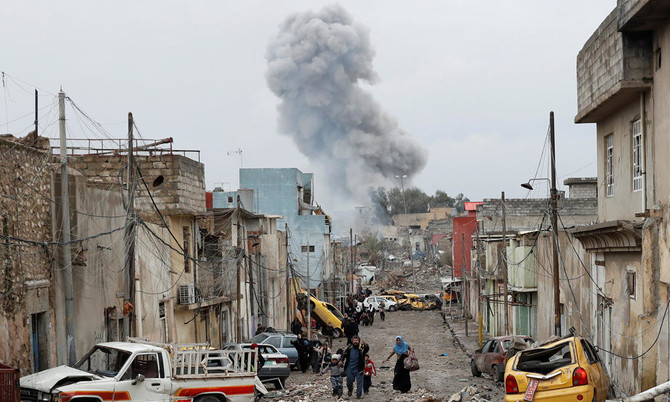
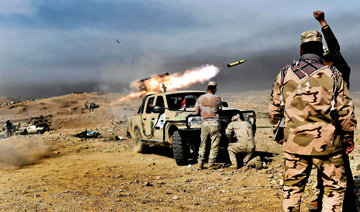
BAGHDAD: Iraqi troops encountered the “heaviest” clashes yet with Daesh group fighters Sunday in western Mosul since the start of the new push more than two weeks ago, according to a senior commander.
Maj. Gen. Haider Al-Maturi of the Federal Police Commandos Division told The Associated Press that Daesh militants dispatched at least six suicide car bombs, which were all destroyed before reaching the troops. The militants, he said, are moving from house to house and deploying snipers.
The wave of heavy resistance comes as Iraqi forces launched attacks against Daesh-held neighborhoods in western Mosul from three points Sunday morning. The Federal Police are closing in on the city’s main government complex in the Dawasa neighborhood and Iraq’s special forces are attempting to push into the Shuhada and Mansour neighborhoods.
Daesh fighters have “some mortar (teams) and snipers positioned inside homes,” said Iraqi special forces Maj. Ali Talib, explaining that US-led coalition airstrikes have helped destroy some of the Daesh defenses, but clashes are still ongoing.
Al-Maturi, of the federal police, said his troops are now some 500 meters away from the government complex.
The push on Mosul’s west was launched about two weeks ago after the eastern half of the city was declared “fully liberated” in January. The operation to retake Mosul officially began in October after more than two years of slowly clawing back territory from Daesh militants. Daesh overran nearly a third of Iraq — including Mosul the country’s second largest city — in the summer of 2014.

Wave of Daesh car bombs targets Iraqi troops in west Mosul
Drone strikes blamed on Iran hit Iranian Kurdish camp in Iraq: official, exiled group
IRBIL: Drone stikes blamed on Iran hit on Tuesday a camp hosting Iranian Kurdish fighters and family members in northern Iraq, a local official and an exiled opposition group said.
Iraq’s northern autonomous Kurdish region hosts camps and rear-bases operated by several Iranian Kurdish rebel groups, which have repeatedly faced cross-border strikes from Iran.
A local official in the Koysinjaq district, Tareq Al-Haidari, told AFP “three Iranian drones targeted the Azadi camp, which belongs to Iranian Kurdish opposition parties in the district.”
One drone directly hit the camp’s hospital, wounding one person, said Haidari and a commander from the Democratic Party of Iranian Kurdistan (PDKI).
PDKI commander Mohammed Nazif Kader told AFP “drones and missiles attacked the camp,” blaming the attack on Iran.
For decades, the Koysinjaq district, known as Koya to Kurds, has been home to the PDKI.
Iran has designated Kurdish opposition groups as terrorist organizations, and has accused them of serving Western or Israeli interests in the past.
These groups have previously fought Iranian security forces in Kurdish-majority areas along the border.
But in recent years, they have largely refrained from armed activity, although they continue to actively campaign from exile against the Islamic republic.
Last week, five groups, including the PDKI, announced a political coalition to seek the overthrow of Iran’s Islamic republic and ultimately to secure Kurdish self-determination.
Iraq’s northern autonomous Kurdish region hosts camps and rear-bases operated by several Iranian Kurdish rebel groups, which have repeatedly faced cross-border strikes from Iran.
A local official in the Koysinjaq district, Tareq Al-Haidari, told AFP “three Iranian drones targeted the Azadi camp, which belongs to Iranian Kurdish opposition parties in the district.”
One drone directly hit the camp’s hospital, wounding one person, said Haidari and a commander from the Democratic Party of Iranian Kurdistan (PDKI).
PDKI commander Mohammed Nazif Kader told AFP “drones and missiles attacked the camp,” blaming the attack on Iran.
For decades, the Koysinjaq district, known as Koya to Kurds, has been home to the PDKI.
Iran has designated Kurdish opposition groups as terrorist organizations, and has accused them of serving Western or Israeli interests in the past.
These groups have previously fought Iranian security forces in Kurdish-majority areas along the border.
But in recent years, they have largely refrained from armed activity, although they continue to actively campaign from exile against the Islamic republic.
Last week, five groups, including the PDKI, announced a political coalition to seek the overthrow of Iran’s Islamic republic and ultimately to secure Kurdish self-determination.
© 2026 SAUDI RESEARCH & PUBLISHING COMPANY, All Rights Reserved And subject to Terms of Use Agreement.