BEIRUT: At least 11 civilians were killed and dozens more wounded on Saturday in airstrikes on a central Syrian village that a monitor said were likely carried out by Russia.
“The raids targeted a livestock market in the village of Oqayrabat, held by the Daesh group in Hama province,” said Rami Abdel Rahman, head of the Syrian Observatory for Human Rights.
“They are probably Russian airstrikes,” he said, adding that 45 people were also wounded,
Oqayrabat lies northwest of Palmyra, the ancient desert city that was recaptured by Russian-backed regime forces from Daesh on Wednesday.
The road between the two had been often used by radical militants to travel between the provinces of Hama and Homs, where Palmyra lies.
Abdel Rahman said the raids on the village were part of “new military operations by the Syrian regime and its Russian ally targeting terrorist positions in Hama province.”
Syrian and Russian warplanes on Saturday were heavily bombing Daesh extremists north and east of Palmyra, which has changed hands several times in Syria’s nearly six-year war.
The Organization for the Prohibition of Chemical Weapons (OPCW) also raised fears at the time that chemical weapons may have been used in airstrikes on Oqayrabat.
The Observatory, which relies on a network of sources inside Syria for its information, says it determines whose planes carry out raids according to type, location, flight patterns and munitions used.
Tens of thousands of Syrian civilians have fled ferocious fighting between Russian-backed regime forces and Daesh militants over the past week in the country’s ravaged north.
Supported by Russian air power and artillery, regime forces have seized around 90 villages from the terrorists since mid-January.
Their aim is Daesh-held Khafsah, the main station pumping water into Aleppo.
Residents of Syria’s second city have been without water for 47 days after the terrorists cut the supply.
The fighting over the past week has sparked an exodus of “more than 30,000 civilians, most of them women and children,” Abdel Rahman said.
Most of the displaced went to areas around Manbij, under the control of the Syrian Democratic Forces (SDF), an alliance of Kurdish and Arab fighters backed by the US that is also fighting Daesh, the monitor said.
An AFP correspondent in Manbij saw dozens of displaced families speeding toward the relative safety of the town on motorcycles and in small buses and cars.
Many of them looked exhausted as they lined up at a checkpoint manned by the Manbij Military Council, the SDF unit that controls the town, to be searched and get permission to enter.
Ibrahim Al-Quftan, co-chair of Manbij’s civil administration, told AFP that as many as 40,000 displaced people had arrived in the town in recent days.
“The numbers of displaced people here are still rising because of the clashes between the Syrian regime and Daesh,” Al-Quftan said.
“These people are suffering very difficult circumstances.”
Manbij is already hosting “tens of thousands of displaced people that fled previous clashes in the area and are living in difficult circumstances,” according to Abdel Rahman.
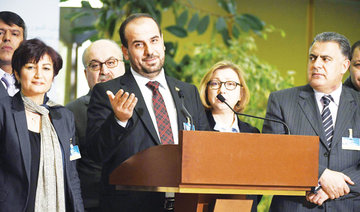
In another development, Syria’s chief negotiator in Geneva said that the “only thing” achieved at 10-day talks was an agreed agenda and that the regime wanted a unified opposition delegation as its negotiating partner.
In his first remarks since talks ended on Friday, Syria’s ambassador to the UN Bashar Al-Jaafari said the agenda agreed through UN mediator Staffan de Mistura gave equal weight to four subjects, including the regime’s own priority of fighting terrorism.
“Nothing has been adopted so far, there is nothing final at all except for the agreement on an agenda. This is the only final thing that we achieved in this round,” Al-Jaafari told reporters in Geneva.
Damascus sought a unified Syrian opposition, “not a Saudi partner nor a Qatari, Turkish or French partner.” “What is asked is to have a partner,” he said.
The main Syrian opposition at the talks is the High Negotiations Committee (HNC) but there are also two smaller dissident groups which have no military muscle but enjoy Moscow’s blessing as opposition voices.
Jaafari said a “first condition” was to have a Syrian national opposition that did not seek help from other parties.
The second condition was to have a unified opposition that agreed on a common agenda, he said.
Jaafari said the government was studying whether to return for the next round of Geneva talks later in March. De Mistura says he plans to continue separate talks with the two sides on substantive issues after reporting to the UN Security Council next week.
“The train is ready, is in the station, is warming up its engine, everything is ready and it just needs an accelerator,” de Mistura told reporters on Friday night. “And the accelerator is in the hands of those who were attending this round.”

Strikes kill 11 civilians in Syria as tens of thousands flee clashes with Daesh
Gazans long for reopening of ‘lifeline’ Rafah crossing
- The border crossing between Gaza and Egypt is the Palestinian territory’s only gateway to the outside world
- If Rafah opens in coming days, residents of the territory are hoping to reunite with family, or are looking to leave themselves
GAZA CITY: With Gaza’s vital Rafah border crossing expected to soon reopen, residents of the war-shattered territory are hoping to reunite with family members, or are looking to leave themselves.
The Rafah crossing between Gaza and Egypt is the Palestinian territory’s only gateway to the outside world that does not lead to Israel and is a key entry point for both people and goods.
It has been closed since Israeli forces took control of it in May 2024, except for a limited reopening in early 2025, and other bids to reopen failed to materialize.
Following a US-brokered ceasefire that took effect in October, Rafah is expected to reopen for pedestrians, after visiting US envoys reportedly pressed Israeli officials to reopen the crossing.
“Opening the Rafah crossing means opening the door to life for me. I haven’t seen my wife and children for two years since they left at the beginning of the war and I was prevented from traveling,” said 48-year-old Mahmud Al-Natour, who hails from Gaza City.
“My children are growing up far away from me, and the years are passing by as if we are cut off from the world and life itself,” he told AFP.
Randa Samih, 48, also called the crossing “the lifeline of Gaza,” but is worried about whether she would be able to leave.
She had applied for an exit permit to get treatment for her injured back, which she fears might not be serious enough to be allowed out.
“There are tens of thousands of injuries in Gaza, most of them more serious than mine,” she said.
“We’ll die or our health will decline before we get to travel.”
- ‘Limited reopening’ -
Gaza, a tiny territory surrounded by Israel, Egypt and the Mediterranean Sea, has been under Israeli blockade even before Hamas’s attack sparked the war.
Palestinian militants took 251 people hostage on October 7, 2023, in an attack that killed 1,221 others, most of them civilians.
Israel’s retaliatory offensive has killed at least 71,662 Palestinians, according to figures from the health ministry in Hamas-run Gaza that the United Nations considers reliable. The ministry does not say how many of the dead were fighters, though its data shows that more than half were women and children.
Ali Shaath heads the National Committee for the Administration of Gaza (NCAG), created as part of the ceasefire agreement. He announced last week that Rafah would reopen in both directions.
Israel said it would only allow pedestrians to travel through the crossing as part of its “limited reopening” once it had recovered the remains of the last hostage, Ran Gvili.
His remains were brought back to Israel later on Monday.
A Palestinian official told AFP on condition of anonymity that “estimates indicate that the Rafah crossing could be opened in both directions by the end of this week or early next week.”
A member of the NCAG told AFP that the technocratic committee would be responsible for sending lists of travelers’ names to the Israeli authorities for approval.
Outward travel will intially be limited to patients, the injured, students with university admission and visas, and holders of Egyptian citizenship or other nationalities and residency permits, the source said.
- ‘Burning with anticipation’ -
Gharam Al-Jamla, a displaced Palestinian living in a tent in southern Gaza, told AFP she counted on the crossing’s opening for her future.
“My dreams lie beyond the Rafah crossing. I applied for several scholarships to study journalism in English at universities in Turkiye. I received initial acceptance from two universities there,” the 18-year-old said.
She added she would then want to return to Gaza “to be one of its voices to convey the truth to the world.”
Gaza’s civil defense agency spokesman, Mahmud Bassal, appealed for the full reopening of Rafah to allow the entry of unlimited aid and equipment for reconstruction.
“There are thousands of bodies under the rubble, including children, women and people with disabilities, which have not been recovered since the beginning of the war,” he said.
The civil defense is a rescue force operating under Hamas authority.
Mohammed Khaled, 18, said he wanted to move on from the war.
“I’m burning with anticipation,” he told AFP.
“I haven’t seen my mother and sisters for two years. My mother traveled for medical treatment, and they only allowed my sisters to accompany her.”
Khaled said he also hoped to be able to travel to have surgery for a shrapnel injury sustained during the war.
The Rafah crossing between Gaza and Egypt is the Palestinian territory’s only gateway to the outside world that does not lead to Israel and is a key entry point for both people and goods.
It has been closed since Israeli forces took control of it in May 2024, except for a limited reopening in early 2025, and other bids to reopen failed to materialize.
Following a US-brokered ceasefire that took effect in October, Rafah is expected to reopen for pedestrians, after visiting US envoys reportedly pressed Israeli officials to reopen the crossing.
“Opening the Rafah crossing means opening the door to life for me. I haven’t seen my wife and children for two years since they left at the beginning of the war and I was prevented from traveling,” said 48-year-old Mahmud Al-Natour, who hails from Gaza City.
“My children are growing up far away from me, and the years are passing by as if we are cut off from the world and life itself,” he told AFP.
Randa Samih, 48, also called the crossing “the lifeline of Gaza,” but is worried about whether she would be able to leave.
She had applied for an exit permit to get treatment for her injured back, which she fears might not be serious enough to be allowed out.
“There are tens of thousands of injuries in Gaza, most of them more serious than mine,” she said.
“We’ll die or our health will decline before we get to travel.”
- ‘Limited reopening’ -
Gaza, a tiny territory surrounded by Israel, Egypt and the Mediterranean Sea, has been under Israeli blockade even before Hamas’s attack sparked the war.
Palestinian militants took 251 people hostage on October 7, 2023, in an attack that killed 1,221 others, most of them civilians.
Israel’s retaliatory offensive has killed at least 71,662 Palestinians, according to figures from the health ministry in Hamas-run Gaza that the United Nations considers reliable. The ministry does not say how many of the dead were fighters, though its data shows that more than half were women and children.
Ali Shaath heads the National Committee for the Administration of Gaza (NCAG), created as part of the ceasefire agreement. He announced last week that Rafah would reopen in both directions.
Israel said it would only allow pedestrians to travel through the crossing as part of its “limited reopening” once it had recovered the remains of the last hostage, Ran Gvili.
His remains were brought back to Israel later on Monday.
A Palestinian official told AFP on condition of anonymity that “estimates indicate that the Rafah crossing could be opened in both directions by the end of this week or early next week.”
A member of the NCAG told AFP that the technocratic committee would be responsible for sending lists of travelers’ names to the Israeli authorities for approval.
Outward travel will intially be limited to patients, the injured, students with university admission and visas, and holders of Egyptian citizenship or other nationalities and residency permits, the source said.
- ‘Burning with anticipation’ -
Gharam Al-Jamla, a displaced Palestinian living in a tent in southern Gaza, told AFP she counted on the crossing’s opening for her future.
“My dreams lie beyond the Rafah crossing. I applied for several scholarships to study journalism in English at universities in Turkiye. I received initial acceptance from two universities there,” the 18-year-old said.
She added she would then want to return to Gaza “to be one of its voices to convey the truth to the world.”
Gaza’s civil defense agency spokesman, Mahmud Bassal, appealed for the full reopening of Rafah to allow the entry of unlimited aid and equipment for reconstruction.
“There are thousands of bodies under the rubble, including children, women and people with disabilities, which have not been recovered since the beginning of the war,” he said.
The civil defense is a rescue force operating under Hamas authority.
Mohammed Khaled, 18, said he wanted to move on from the war.
“I’m burning with anticipation,” he told AFP.
“I haven’t seen my mother and sisters for two years. My mother traveled for medical treatment, and they only allowed my sisters to accompany her.”
Khaled said he also hoped to be able to travel to have surgery for a shrapnel injury sustained during the war.
© 2026 SAUDI RESEARCH & PUBLISHING COMPANY, All Rights Reserved And subject to Terms of Use Agreement.