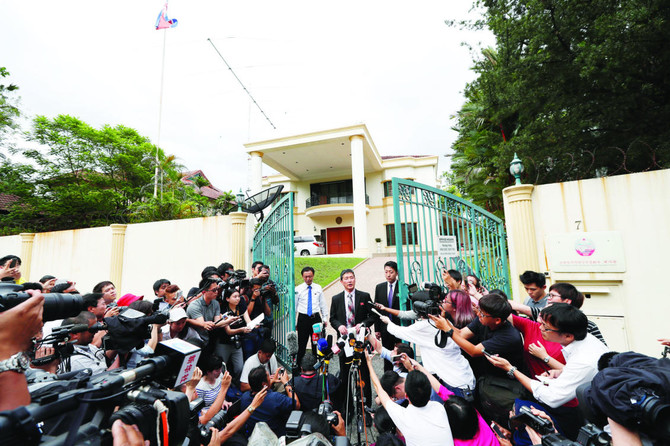
KUALA LUMPUR, Malaysia: A North Korean man will be released from custody because of lack of evidence connecting him to the fatal nerve agent attack on Kim Jong Nam, the estranged half brother of North Korea’s ruler, Malaysian officials said Thursday.
Ri Jong Chol, 45, was arrested on Feb. 17, four days after the attack at Kuala Lumpur’s bustling airport. Malaysia officials never said why he had been arrested.
On Thursday, Malaysian Attorney General Mohamad Apandi Ali said Ri will be released and deported because he does not have valid travel documents.
Also Thursday, Malaysia said it was scrapping visa-free travel for North Koreans entering the country, the latest fallout from an attack many believe was orchestrated by Pyongyang.
The attack was caught on grainy security camera footage that showed two women smearing something on Kim’s face as he waited for a flight in Kuala Lumpur on Feb. 13. Malaysian officials say the substance was VX nerve agent, a banned chemical weapon.
Kim was dead within an hour as the fast-acting poison coursed through his body, authorities say. No bystanders reported falling ill.
The poisoning has unleashed a serious diplomatic battle between Malaysia and North Korea. While it is not one of Pyongyang’s key diplomatic partners, Malaysia has been one of the few places in the world where North Koreans could travel without a visa. As a result, for years, it’s been a quiet destination for Northerners looking for jobs, schools and business deals.
That could all begin to change in the wake of Kim’s death. On Thursday, the Bernama news agency said North Koreans will have to apply for visas.
The two female suspects caught in the security footage were charged with murder in a Malaysian court Wednesday. Both say they were duped into thinking they were taking part in a harmless prank.
“I understand but I am not guilty,” Vietnamese suspect Doan Thi Huong told the court in English after the murder charge was read.
The other suspect, Indonesian Siti Aisyah, nodded as her translator told her, “You are accused of murdering a North Korean man at the departure hall” of Kuala Lumpur International Airport.
The women did not enter pleas because the magistrate court where they appeared has no jurisdiction over a murder case. Lead prosecutor Iskander Ahmad told the court he will ask for the case to be transferred to a higher court and for the women to be tried together.
Each faces a mandatory death sentence if convicted. Both women were wearing bulletproof vests as they were escorted from the court to Kajang Prison.
In the surveillance video, Huong was seen clearly in a T-shirt with “LOL” emblazoned across the front. Both women were originally from modest farming villages and had moved to their countries’ capitals seeking a better life.
Also Wednesday, the court approved a gag order to prevent police and potential witnesses from making public statements about the case.
North Korea is widely speculated to be behind the killing, particularly after Malaysia said that VX had killed Kim. Experts say the oily poison was almost certainly produced in a sophisticated state weapons laboratory.
North Korea’s official news agency called that finding the “height of absurdity” on Wednesday, saying the two women could not have used such a deadly toxin without killing or sickening themselves and anyone around them.
North Korea opposed Malaysian officials even conducting an autopsy on Kim, while Malaysia has resisted giving up the body without getting DNA samples and confirmation from next of kin.
Kim is believed to have two sons and a daughter with two women living in Beijing and Macau.
Authorities are seeking seven other North Korean suspects, four of whom fled the country the day of Kim’s death and are believed to be back in North Korea. Others sought include the second secretary of North Korea’s Embassy and an employee of North Korea’s state-owned airline, Air Koryo.
Kim Jong Nam was estranged from his half brother, North Korean leader Kim Jong Un. He reportedly fell out of favor with their father, the late Kim Jong Il, in 2001, when he was caught trying to enter Japan on a false passport to visit Tokyo Disneyland.
Isolated North Korea has a long history of ordering killings of people it views as threats to its regime. Kim Jong Nam was not known to be seeking political power, but his position as eldest son of the family that has ruled North Korea since it was founded could have made him appear to be a danger.

Malaysia to release, deport N. Korean in nerve agent probe
Cartel violence fuels doubts about FIFA World Cup games in Mexico
- Surge of bloodshed following the Mexican military’s killing of the country’s most powerful cartel boss
- Jalisco state, with Guadalajara as its capital, is the central hub for the Jalisco New Generation Cartel
GUADALAJARA, Mexico: Hugo Alejandro Perez was in his house a few miles from the Mexican stadium that is slated to host FIFA World Cup games when gunfire and explosions erupted just outside his door.
The 53-year-old restaurant owner was already skeptical about his city, Guadalajara, hosting the international sporting event.
He saw a government that failed to fix basic things, like water service to his home, along with cartel violence in the surrounding state of Jalisco and shook his head. The surge of bloodshed this week following the Mexican military’s killing of the country’s most powerful cartel boss offered more confirmation of his doubts.
“I don’t think they should host the World Cup here,” Perez said. “We have so many problems, and they want to invest in the World Cup? With all the violence, it’s not a good idea.”
Perez joined other people Tuesday in questioning Guadalajara’s capacity to be a host city for the summer football competition, even as the Mexican government vowed that the international event — hosted jointly by Mexico, the United States and Canada — will not be affected.
President offers ‘every guarantee’ for World Cup
President Claudia Sheinbaum was asked at her daily news briefing what guarantees there are that World Cup matches will be held in Jalisco. “Every guarantee,” she said, adding that there was “no risk” for fans coming to the tournament.
Jalisco Gov. Jesus Pablo Lemus said he had spoken with local FIFA officials, who have “absolutely no intention of removing any venues from Mexico. The three venues remain completely unchanged.”
The same day, the Portuguese football federation said it was “closely monitoring the delicate situation” in Mexico.” Its national team was scheduled to play Mexico’s team in a friendly on March 28 at the newly renovated Azteca Stadium in Mexico City, which is scheduled to host the opening World Cup match on June 11.
Jalisco, in western Mexico, was already facing scrutiny. The state has been plagued by some of the starkest examples of cartel violence in recent years, including the discovery of a cartel killing site at a ranch last March and a crisis of disappearances.
The state, with Guadalajara as its capital, is the central hub for the Jalisco New Generation Cartel, whose leader Nemesio Oseguera Cervantes, or “El Mencho,” was killed Sunday in a capture attempt by the military.
The operation and waves of violence killed 70 people. Cartel gunmen set fire to cars to block streets in states across the country, namely Jalisco, and fought with Mexican forces into Monday as the government said the conflict was under control.
The death of Oseguera Cervantes came as Mexico’s government has stepped up its offensive against cartels in an effort to meet demands by US President Donald Trump to crack down on criminal groups. The cartel, also known as CJNG, is one of the fastest-growing criminal networks in Mexico.
The White House confirmed that the US provided intelligence support to capture the cartel leader and applauded Mexico’s army for taking down a man who was one of the most wanted criminals in both countries. On Tuesday night, US President Donald Trump appeared to briefly reference the operation during his State of the Union address, saying “We’ve also taken down one of the most sinister cartel kingpins of all. You saw that yesterday.”
Drug lord’s death could lead to more violence
Perez, the restaurant owner, also commended Sheinbaum’s efforts to go after cartels, saying the government has taken cartel violence more seriously than her predecessors. At the same time, he said, local authorities in Jalisco have fallen short in protecting civilians.
The root concern for many is that the death of “El Mencho” could pave the way for more violence. Killing capos, in what’s become known as the “kingpin strategy,” has been criticized by Sheinbaum herself because it can often spark internal conflict between cartel factions and push rival cartels to make territorial grabs.
Vanda Felbab-Brown, an academic at the Brookings Institution, said she doesn’t see more acts of “revenge” by the cartel as likely, but the future remains uncertain, especially after leading figures in both CJNG and the Sinaloa Cartel have been knocked out in recent years.
“If there is no clear line of succession (in CJNG), we might see a lot of fighting within the cartel, its breakup, and there are a lot of scenarios,” she said.
On Sunday, when firefights broke out between the cartel and soldiers, and gunmen began to burn a car just feet in front of Perez’s house, he let people on the street scramble inside his home to seek cover. The fighting raged for an hour.
Now he says he doesn’t see the point of holding the games, adding that he doubts any of the money from the games will trickle down to businesses in working-class neighborhoods like his, even if they are just a 10-minute drive from the stadium. Similar tensions have simmered in Mexico City.
The World Cup is expected to be a $3 billion economic engine in Mexico, according to the Mexican Soccer Federation.
“It doesn’t help us residents at all, honestly. They should move it to Monterrey or Mexico City. But right now here, we’re not convinced,” he said. “Things aren’t in good enough shape for foreigners to be coming to Jalisco for an event like this.”
On Monday, some foreign tourists trapped in the violence in the city of Puerto Vallarta took to social media to warn of the violence, with a few remarking that they didn’t plan to return.
Hope of snapping back to normal
Despite that, Guadalajara was snapping back to its normal rhythm Tuesday. Many businesses opened their doors for the first time in two days, and streets were packed with traffic.
Workers were busy fixing up the exterior of the football stadium that will host World Cup matches. Cyclists zipped around outside the stadium, and parents played with children in parks.
Heavily armed police officers and National Guard members roamed the city, a sign for some that the government had the situation under control.
Juan Carlos Pila, a 55-year-old taxi driver, rolled his eyes at the reports of violence after spending two days waiting with his family for things to calm down. He said social media and local news outlets were overplaying the extent of the violence.
“People should come, man. Everyone is welcome,” he said.
Others, like Maria Dolores Aguirre, simply hoped for the best. Aguirre runs a small corner story in the cobblestoned tourist town of Tapalpa tucked away in Jalisco’s mountains, where Mexico’s military killed “El Mencho.”
Aguirre’s family business of over 50 years depends on the flow of tourists to the normally sleepy town. Now she worries bloodshed will deal a blow to her livelihood and change towns like hers.
“It’s going to affect us. It’s collateral damage,” Aguirre said. “The government is going to have to have a lot of security … The entire world just saw what happened and, of course, people are going to think twice about coming.”
The 53-year-old restaurant owner was already skeptical about his city, Guadalajara, hosting the international sporting event.
He saw a government that failed to fix basic things, like water service to his home, along with cartel violence in the surrounding state of Jalisco and shook his head. The surge of bloodshed this week following the Mexican military’s killing of the country’s most powerful cartel boss offered more confirmation of his doubts.
“I don’t think they should host the World Cup here,” Perez said. “We have so many problems, and they want to invest in the World Cup? With all the violence, it’s not a good idea.”
Perez joined other people Tuesday in questioning Guadalajara’s capacity to be a host city for the summer football competition, even as the Mexican government vowed that the international event — hosted jointly by Mexico, the United States and Canada — will not be affected.
President offers ‘every guarantee’ for World Cup
President Claudia Sheinbaum was asked at her daily news briefing what guarantees there are that World Cup matches will be held in Jalisco. “Every guarantee,” she said, adding that there was “no risk” for fans coming to the tournament.
Jalisco Gov. Jesus Pablo Lemus said he had spoken with local FIFA officials, who have “absolutely no intention of removing any venues from Mexico. The three venues remain completely unchanged.”
The same day, the Portuguese football federation said it was “closely monitoring the delicate situation” in Mexico.” Its national team was scheduled to play Mexico’s team in a friendly on March 28 at the newly renovated Azteca Stadium in Mexico City, which is scheduled to host the opening World Cup match on June 11.
Jalisco, in western Mexico, was already facing scrutiny. The state has been plagued by some of the starkest examples of cartel violence in recent years, including the discovery of a cartel killing site at a ranch last March and a crisis of disappearances.
The state, with Guadalajara as its capital, is the central hub for the Jalisco New Generation Cartel, whose leader Nemesio Oseguera Cervantes, or “El Mencho,” was killed Sunday in a capture attempt by the military.
The operation and waves of violence killed 70 people. Cartel gunmen set fire to cars to block streets in states across the country, namely Jalisco, and fought with Mexican forces into Monday as the government said the conflict was under control.
The death of Oseguera Cervantes came as Mexico’s government has stepped up its offensive against cartels in an effort to meet demands by US President Donald Trump to crack down on criminal groups. The cartel, also known as CJNG, is one of the fastest-growing criminal networks in Mexico.
The White House confirmed that the US provided intelligence support to capture the cartel leader and applauded Mexico’s army for taking down a man who was one of the most wanted criminals in both countries. On Tuesday night, US President Donald Trump appeared to briefly reference the operation during his State of the Union address, saying “We’ve also taken down one of the most sinister cartel kingpins of all. You saw that yesterday.”
Drug lord’s death could lead to more violence
Perez, the restaurant owner, also commended Sheinbaum’s efforts to go after cartels, saying the government has taken cartel violence more seriously than her predecessors. At the same time, he said, local authorities in Jalisco have fallen short in protecting civilians.
The root concern for many is that the death of “El Mencho” could pave the way for more violence. Killing capos, in what’s become known as the “kingpin strategy,” has been criticized by Sheinbaum herself because it can often spark internal conflict between cartel factions and push rival cartels to make territorial grabs.
Vanda Felbab-Brown, an academic at the Brookings Institution, said she doesn’t see more acts of “revenge” by the cartel as likely, but the future remains uncertain, especially after leading figures in both CJNG and the Sinaloa Cartel have been knocked out in recent years.
“If there is no clear line of succession (in CJNG), we might see a lot of fighting within the cartel, its breakup, and there are a lot of scenarios,” she said.
On Sunday, when firefights broke out between the cartel and soldiers, and gunmen began to burn a car just feet in front of Perez’s house, he let people on the street scramble inside his home to seek cover. The fighting raged for an hour.
Now he says he doesn’t see the point of holding the games, adding that he doubts any of the money from the games will trickle down to businesses in working-class neighborhoods like his, even if they are just a 10-minute drive from the stadium. Similar tensions have simmered in Mexico City.
The World Cup is expected to be a $3 billion economic engine in Mexico, according to the Mexican Soccer Federation.
“It doesn’t help us residents at all, honestly. They should move it to Monterrey or Mexico City. But right now here, we’re not convinced,” he said. “Things aren’t in good enough shape for foreigners to be coming to Jalisco for an event like this.”
On Monday, some foreign tourists trapped in the violence in the city of Puerto Vallarta took to social media to warn of the violence, with a few remarking that they didn’t plan to return.
Hope of snapping back to normal
Despite that, Guadalajara was snapping back to its normal rhythm Tuesday. Many businesses opened their doors for the first time in two days, and streets were packed with traffic.
Workers were busy fixing up the exterior of the football stadium that will host World Cup matches. Cyclists zipped around outside the stadium, and parents played with children in parks.
Heavily armed police officers and National Guard members roamed the city, a sign for some that the government had the situation under control.
Juan Carlos Pila, a 55-year-old taxi driver, rolled his eyes at the reports of violence after spending two days waiting with his family for things to calm down. He said social media and local news outlets were overplaying the extent of the violence.
“People should come, man. Everyone is welcome,” he said.
Others, like Maria Dolores Aguirre, simply hoped for the best. Aguirre runs a small corner story in the cobblestoned tourist town of Tapalpa tucked away in Jalisco’s mountains, where Mexico’s military killed “El Mencho.”
Aguirre’s family business of over 50 years depends on the flow of tourists to the normally sleepy town. Now she worries bloodshed will deal a blow to her livelihood and change towns like hers.
“It’s going to affect us. It’s collateral damage,” Aguirre said. “The government is going to have to have a lot of security … The entire world just saw what happened and, of course, people are going to think twice about coming.”
© 2026 SAUDI RESEARCH & PUBLISHING COMPANY, All Rights Reserved And subject to Terms of Use Agreement.