BRUSSELS: EU member states should be ready to detain more migrants who have no case for asylum to prevent them from running away before they are deported, the chief migration official with the bloc’s executive arm in Brussels said.
The EU is pushing to reduce immigration after some 1.6 million refugees and migrants reached its shores via the Mediterranean in 2014-2016. It wants to prevent people from coming and deport more.
“Return rates have to be improved,” Migration Commissioner Dimitris Avramopoulos said on Thursday in presenting new, non-binding, proposals by the executive European Commission.
“Member states should also use the possibility to place migrants in detention if there is a risk of absconding and for a sufficient period to be able to complete the return and readmission procedure.”
Brussels estimates there may be around 1 million people in the EU who should be sent back but that only about a third of those with pending return are actually being returned.
While EU law sets out the minimum common standards for returns, some member states had stricter domestic rules that could be eased to streamline the process, the Commission said.
It recommended shorter appeals deadlines, issuing return decision with no expiry date and considering more detentions, including for minors, which is barred now by some member states.
It said EU states should be less coy about detaining people for the maximum allowed pre-deportation time-limit of 18 months if that was needed to ensure an effective deportation.
“It should never be considered something like a concentration camp,” Avramopoulos said, fending off criticism by rights groups that detaining asylum seekers or migrants was inadvisable.
“The ones who are not entitled to refugee status, they have to be returned. But in meantime they have to stay somewhere — in very dignified conditions — in order to avoid absconding.”
It said detention should not be ruled out for minors, which is currently a red line in some EU states.
Beyond deportation, the Commission also proposed setting up by mid-year a program for assisted voluntary returns from Europe. It is already stepping up funding for the UN migration agency IOM to increase returns from Libya, now the main embarkation point for Europe.
That is part of a broader plan to work with the internationally recognized government in Tripoli to cut the number of people getting on smugglers’ boats to head to Europe, even though the EU recognizes any cooperation with the lawless Libya can only bring limited results.
The bloc remains bitterly divided over what to do with those who are already in.
The Commission said only 13,546 people had been moved from Greece and Italy — the two biggest arrival countries in the EU — to other member states under a two-year plan that was supposed to cover 160,000 people and expires in September.
It is a major point of contention among the frontline Greece and Italy, Germany and Sweden — the eventual hosts for most refugees — and Poland and Hungary, which refuse to take in any.
Brussels has long threatened sanctions and, although the Commission’s head Jean-Claude Juncker said on Thursday he would use “all the tools ... to ensure that the commitments made are honored,” Avramopoulos also said that “we are not there yet.”


![]()
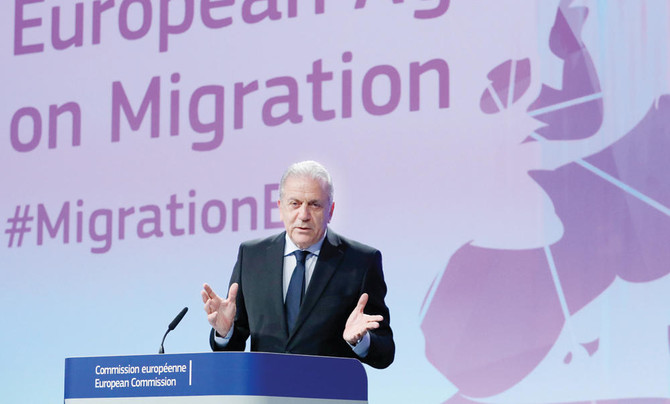

Brussels tells EU states to detain more freely migrants awaiting deportation
Brussels tells EU states to detain more freely migrants awaiting deportation
Nepal’s rapper-turned-mayor challenges ousted PM
Katmandu: Nepal’s rapper-turned-politician Balendra Shah will go into a head-to-head election battle with the veteran prime minister he helped unseat, as he champions youth demands that toppled last year’s government.
The 35-year-old resigned last week as mayor of Katmandu to contest general elections, announcing Tuesday that he will directly challenge ousted prime minister KP Sharma Oli by running in the same constituency.
Nepal will hold general elections on March 5, the first since mass anti-corruption protests in September 2025 overthrew Oli, a 73-year-old Marxist leader and four-term prime minister.
“Contesting against a major figure... signals that I am not taking the easy way out,” Shah told AFP, ahead of his formal confirmation of candidacy.
“It demonstrates that, despite the problems or betrayals that have affected the country, we are moving toward addressing them,” he added.
Better known as Balen, the former mayor arrived for the interview at a Katmandu hotel dressed in black and wearing a traditional Nepali hat or “topi,” though he was without his trademark dark square sunglasses.
His hip-hop songs tackling corruption and inequality have drawn millions of views.
A civil engineer and rapper before joining politics, Shah stunned the political establishment in 2022 when he became the first independent candidate to be elected as Katmandu mayor.
He built a reputation as a sharp-tongued reformer, launching campaigns targeting tax evasion, traffic congestion, education and city waste.
Shah’s approach, however, drew criticism for heavy-handed enforcement and for communicating directly with his millions of social media followers rather than engaging with journalists.
“We made many processes that operated through informal arrangements transparent, through open procurement,” he said.
- ‘Ripple effect’ -
In December, Shah joined the centrist Rastriya Swatantra Party (RSP), led by television host Rabi Lamichhane, 50.
RSP, which became parliament’s fourth-largest force in the last elections in 2022, challenged parties that had dominated Nepal since the end of its civil war in 2006.
If the RSP secures a parliamentary majority, Shah would become prime minister.
“We share the same ideology,” Shah said, describing a vision of “a liberal economic system with social justice,” including free education and health care for the poor.
Rather than contesting from his Katmandu base, Shah will challenge Oli in his stronghold of Jhapa-5, a largely rural district 300 kilometers (185 miles) southeast of Katmandu.
“This should not be perceived as an egoistic decision,” Shah said. “The ripple effect would simply be greater if I contest from Jhapa.”
The September 8-9 demonstrations were initially triggered by anger over a brief government ban on major social media platforms, with protesters gathered under a loose “Gen Z” banner.
But deeper grievances — economic stagnation and entrenched corruption — fueled the unrest in the country of 30 million, in which at least 77 people were killed.
- ‘Grow our economy’ -
Shah backed the protests while urging restraint, emerging as a central figure in the movement.
“Gen Z’s number one demand is good governance, because there is a high level of corruption in the country,” he said, adding that his party had drawn on protesters for support.
“The Gen Z protest has opened a door — 40 percent of our central committee members and proportional representatives are new faces who emerged from the September protest,” he said.
Young Nepalis are looking for leaders promising economic reform. The World Bank estimates 82 percent of Nepal’s workforce is in informal employment, with GDP per capita at $1,447 in 2024.
“We need to grow our economy,” Shah said, citing tourism, trade and skilled jobs as ways to stem the mass outflow of workers.
Landlocked Nepal, wedged between regional giants India and China, faces geopolitical pressures, but Shah sees an opportunity to make Nepal a trade hub.
“My approach is to maintain a natural relationship with both neighboring nations,” he said.
And while focused on politics, he said that music remains central to his identity.
“Music is a medium to express oneself,” he said. “I will continue it, even if I am elected as prime minister.”
The 35-year-old resigned last week as mayor of Katmandu to contest general elections, announcing Tuesday that he will directly challenge ousted prime minister KP Sharma Oli by running in the same constituency.
Nepal will hold general elections on March 5, the first since mass anti-corruption protests in September 2025 overthrew Oli, a 73-year-old Marxist leader and four-term prime minister.
“Contesting against a major figure... signals that I am not taking the easy way out,” Shah told AFP, ahead of his formal confirmation of candidacy.
“It demonstrates that, despite the problems or betrayals that have affected the country, we are moving toward addressing them,” he added.
Better known as Balen, the former mayor arrived for the interview at a Katmandu hotel dressed in black and wearing a traditional Nepali hat or “topi,” though he was without his trademark dark square sunglasses.
His hip-hop songs tackling corruption and inequality have drawn millions of views.
A civil engineer and rapper before joining politics, Shah stunned the political establishment in 2022 when he became the first independent candidate to be elected as Katmandu mayor.
He built a reputation as a sharp-tongued reformer, launching campaigns targeting tax evasion, traffic congestion, education and city waste.
Shah’s approach, however, drew criticism for heavy-handed enforcement and for communicating directly with his millions of social media followers rather than engaging with journalists.
“We made many processes that operated through informal arrangements transparent, through open procurement,” he said.
- ‘Ripple effect’ -
In December, Shah joined the centrist Rastriya Swatantra Party (RSP), led by television host Rabi Lamichhane, 50.
RSP, which became parliament’s fourth-largest force in the last elections in 2022, challenged parties that had dominated Nepal since the end of its civil war in 2006.
If the RSP secures a parliamentary majority, Shah would become prime minister.
“We share the same ideology,” Shah said, describing a vision of “a liberal economic system with social justice,” including free education and health care for the poor.
Rather than contesting from his Katmandu base, Shah will challenge Oli in his stronghold of Jhapa-5, a largely rural district 300 kilometers (185 miles) southeast of Katmandu.
“This should not be perceived as an egoistic decision,” Shah said. “The ripple effect would simply be greater if I contest from Jhapa.”
The September 8-9 demonstrations were initially triggered by anger over a brief government ban on major social media platforms, with protesters gathered under a loose “Gen Z” banner.
But deeper grievances — economic stagnation and entrenched corruption — fueled the unrest in the country of 30 million, in which at least 77 people were killed.
- ‘Grow our economy’ -
Shah backed the protests while urging restraint, emerging as a central figure in the movement.
“Gen Z’s number one demand is good governance, because there is a high level of corruption in the country,” he said, adding that his party had drawn on protesters for support.
“The Gen Z protest has opened a door — 40 percent of our central committee members and proportional representatives are new faces who emerged from the September protest,” he said.
Young Nepalis are looking for leaders promising economic reform. The World Bank estimates 82 percent of Nepal’s workforce is in informal employment, with GDP per capita at $1,447 in 2024.
“We need to grow our economy,” Shah said, citing tourism, trade and skilled jobs as ways to stem the mass outflow of workers.
Landlocked Nepal, wedged between regional giants India and China, faces geopolitical pressures, but Shah sees an opportunity to make Nepal a trade hub.
“My approach is to maintain a natural relationship with both neighboring nations,” he said.
And while focused on politics, he said that music remains central to his identity.
“Music is a medium to express oneself,” he said. “I will continue it, even if I am elected as prime minister.”
Latest updates


© 2026 SAUDI RESEARCH & PUBLISHING COMPANY, All Rights Reserved And subject to Terms of Use Agreement.