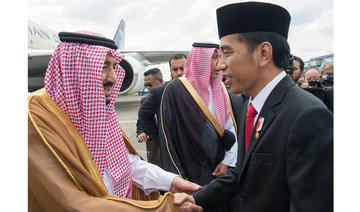
JAKARTA: Saudi Arabia's King Salman called Thursday for a united fight against terrorism in a speech to Indonesia’s parliament during a landmark state visit to the world’s most populous Muslim-majority country.
In a speech to hundreds of people at the legislature in the capital Jakarta, he called for an intensified fight against terrorism.
“The challenge we, especially Muslims, face now is terrorism,” he said. “We should close ranks in combating terrorism, radicalism and strive to bring world peace for the benefit of all of us.”
Saudi Arabia is part of a US-led coalition that has carried out air strikes against the Daesh group and other jihadists in Syria.
Daesh is under pressure in Iraq and Syria, as government forces make a drive to retake areas held by the jihadists.
Saudi Arabia has witnessed a series of deadly attacks claimed by Daesh since late 2014, mostly targeting the Shiite minority and security forces, killing dozens of people.
Indonesia, which has long struggled with Islamic militancy, is also facing a renewed threat due to the appeal of Daesh, with hundreds of its citizens heading to the Middle East to fight with the jihadists.
A gun and suicide attack in Jakarta in January last year that killed four civilians and four attackers was the first assault claimed by Daesh in Southeast Asia.
On Thursday, King Salman also visited Jakarta’s Istiqlal mosque, the biggest in Southeast Asia, accompanied by President Joko Widodo, and the leaders prayed together.
The king and his delegation will be in Jakarta until Friday, after which they will head to the island of Bali for a holiday.
Salman’s three-week Asian tour is seeking investment opportunities as the world’s top oil exporter looks to diversify its economy. He began the trip in Malaysia earlier this week and is also set to visit Brunei, Japan, China, the Maldives and Jordan.

King Salman urges united front against terrorism on Indonesia trip
Arab region on recovery path with 3.7% growth in 2026, but geopolitical risks persist: ESCWA
RIYADH: The Arab region is on a path of gradual economic recovery this year, according to a UN report that forecast growth reaching 3.7 percent and a gradual decline in inflation.
The UN Economic and Social Commission for Western Asia warned in its Macroeconomic Outlook for the Arab region that the persistence of geopolitical fog and risks to global trade remains a pressure factor on the region’s growth prospects.
ESCWA projected regional gross domestic product to have grown by 2.9 percent in 2025 before accelerating to 3.7 percent in 2026, supported by diversification efforts, fiscal reforms, and investment in non-hydrocarbon sectors.
Inflation across the region is expected to decline from 8.2 percent in 2025 to 5.4 percent by 2027, driven by easing commodity prices and the normalization of supply chains, the report said.
In its latest economic update, the World Bank said that regional GDP in the Middle East, North Africa, Afghanistan, and Pakistan is projected to grow by 3.3 percent in 2026, driven by stronger-than-expected performance in Gulf Cooperation Council countries and developing oil importers.
However, ESCWA warned that “ongoing conflicts, trade disruptions and elevated global tariff uncertainties continue to steer the economic outlook,” citing the spillover effects from the war on Gaza, tensions between Iran and Israel, and the volatile situation in several Arab countries, including Sudan, Yemen, and Syria.
The report highlighted a widening divergence in growth prospects among Arab economies. High-income Gulf countries are driving the regional recovery through diversification into manufacturing, tourism, and digital sectors.
For investors eyeing this shift, a key question is which specific non-oil industries offer the most resilient returns despite the persistent geopolitical risks. Ahmed Moummi, economic affairs officer at ESCWA, told Arab News that beyond the headline sectors, the most sustainable opportunities lie in the real economy.
“In general, real sectors have sustainable returns, particularly industry and agriculture. Investing in the latest technologies in the industrial or the agricultural sectors are likely to enhance returns and ensure sustainability of the business, like agri-business, food processing, fisheries, and tourism,” he said in an interview.
Saudi Arabia’s real GDP is projected to grow by an average of 3.3 percent during 2025-2027, supported by increased investment in manufacturing, real estate, and tourism, while the UAE is expected to achieve 4.5 percent average growth over the same period.
Middle-income countries face more significant challenges, including high debt burdens, inflation, and external shocks.
According to the ESCWA, the situation remains dire for conflict-affected low-income countries, including Somalia, Sudan, Syria, and Yemen. These economies are projected to contract by 0.9 percent in 2025 before modestly recovering to 1.7 percent growth in 2026, assuming conflicts de-escalate and reconstruction efforts begin.
With growth so uneven across high-income, middle-income, and conflict-affected economies, the question arises as to what business models or sectors are best positioned to succeed across this fragmented regional landscape. The answer, according to Moummi, lies in resilience through diversification.
“Diversified economies with diversified sources of income are the best models given the overall geopolitical and global landscape,” he said. “Investing in real sectors generates employment and realizes sustainable and inclusive economic growth. Also investing in knowledge economy and in skills’ development would ensure also that labor force would be agile and would fit for future jobs.”
The analysis warned that elevated tariffs announced by the US in April 2025 have increased trade uncertainty globally. While energy products are currently exempt, textiles, fertilizers, chemicals, aluminum, and electronics now face high US tariffs, affecting several Arab countries.
Jordan stands to be most impacted, with around 25 percent of its total exports directed to the US.
Bahrain, and Egypt, as well as Lebanon, Morocco, and Tunisia will be affected to a lesser extent, as their US exports average around 5 percent.
An indirect impact may emanate from potential slowdowns in the region’s main trading partners, particularly China and the EU, which together account for nearly one-third of Arab exports.
ESCWA has developed machine-learning-based “nowcasting” models piloted for Egypt and Saudi Arabia that integrate conventional and alternative data sources, including Google Trends and satellite imagery, to enable near-real-time GDP estimation.
“Nowcasting integrates conventional and alternative data sources and enables near-real-time GDP estimation, enhances policy responsiveness, and provides a scalable framework for evidence-based economic assessment in the region,” the report stated.
For Egypt, the models point to a 4 percent annual real GDP growth rate for 2025, while Saudi Arabia’s growth is nowcast at 4.3 percent for the same year.
The release concluded that achieving lasting peace and stability is fundamental for recovery and long-term development. It called for sustained aid and concessional financing to support reconstruction and human capital investment in conflict-affected countries.
“Diversification, fiscal consolidation and improved debt management are needed to preserve macroeconomic stability, decrease dependence on hydrocarbon revenues, generate employment, and create fiscal space for productive investment and social spending,” ESCWA said.