BEIJING: China’s factory activity expanded faster than expected in February as domestic and export demand picked up, adding to signs that the global economy is regaining momentum even as fears grow of a surge in trade protectionism.
Growth in both output and orders accelerated last month, according to official and private factory surveys on Wednesday, giving the government more room to focus on tackling financial risks to the economy as debt continues to rise.
“This is the 7th consecutive month that China’s official manufacturing PMI stayed within expansionary territory, suggesting that industrial activity remains buoyant,” said Zhou Hao, emerging markets economist at Commerzbank AG in Singapore.
Zhou said it was “very likely” that China’s central bank would raise short-term interest rates by a another 10 basis points in March — which would mark the third such move in as many months — as authorities grow more confident that the economy is on a steadier footing.
Facing growing risks from explosive growth in debt, China’s central bank has cautiously shifted its stance in recent months to a tightening bias after years of super-loose policy to stave off the risk of a hard landing for the world’s second-largest economy.
Policy sources have told Reuters that China’s leaders will accept a lower economic growth target of around 6.5 percent in 2017 and target a less aggressive expansion of money supply, as the focus slowly shifts from growth to pushing reforms to contain debt and housing risks.
China’s industrial sector has benefited from a construction boom since the middle of last year that has spurred demand and prices for building materials from cement to steel, boosting sales and profits.
The official Purchasing Managers’ Index (PMI) released on Wednesday rose to a three-month high of 51.6 in February, compared with the previous month’s 51.3, and above the 50-point mark that separates growth from contraction on a monthly basis.
Analysts had expected a reading of 51.1.
Output rose at a faster pace of 53.7, compared to 53.1 in January, while overall new order growth also picked up.
A private survey, which focuses more on small and mid-sized firms offered similarly encouraging findings.
The Caixin/Markit Manufacturing Purchasing Managers’ index (Caixin/Markit Manufacturing PMI) rose to 51.7, up from 51 in January and beating analysts’ forecasts of 50.8.
New export orders grew at the fastest pace since September 2014.
While the industrial sector continued to shed jobs in February, the pace eased to its slowest since March 2013.
Inflationary pressures also continued to rise sharply thanks largely to higher prices for building materials such as steel reinforcing bars and copper pipes, but producers were able to pass some of the increased input costs on to consumers.
For now, China’s consumer inflation remains well within the central bank’s comfort zone, but expectations of upward pressure could keep the central bank on a gradual tightening path.
Stronger readings on export orders would build on China’s better-than-expected trade numbers in January, but worries of a rise in US trade protectionism are clouding the longer-term outlook for Asia’s exporters.
Still, China’s domestic demand appears solid for now, and is becoming more broad-based.
A separate reading on the services sector showed growth remained robust in February, though the pace of expansion has been slowing modestly for four consecutive months.
The official non-manufacturing Purchasing Managers’ Index (PMI) stood at 54.2 in February, down from 54.6 in January, and well above the 50-point mark.
Capital Economics said persistently softer service sector activity may suggest domestic demand growth has peaked, increasing the risk of a reversal in the central bank’s new tightening bias and a return to stimulus if authorities fear economic growth is faltering.


![]()
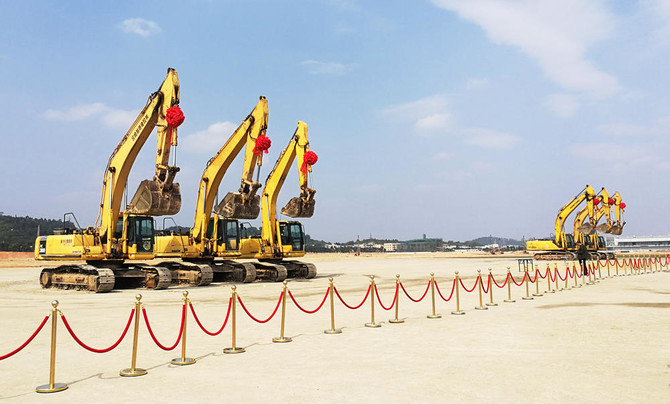
China factory growth beats expectations
China factory growth beats expectations
Latest updates


© 2026 SAUDI RESEARCH & PUBLISHING COMPANY, All Rights Reserved And subject to Terms of Use Agreement.