NEW YORK/GENEVA: Russia on Tuesday cast its seventh veto to protect the Syrian regime from UN Security Council action, blocking a bid by Western powers to impose sanctions over accusations of chemical weapons attacks during the six-year Syrian conflict.
China backed Russia and cast its sixth veto on Syria. Russia had said the vote on the resolution, drafted by France, Britain and the US, would harm UN-led peace talks between the warring Syrian parties in Geneva, which began last week.
Nine council members voted in favor, Bolivia voted against, while Egypt, Ethiopia and Kazakhstan abstained. A resolution needs nine votes in favor and no vetoes by the US, France, Russia, Britain or China to be adopted.
Russian President Vladimir Putin described the draft resolution on Tuesday as “totally inappropriate.”
“For my friends in Russia, this resolution is very appropriate,” US Ambassador to the UN Nikki Haley told the council after the vote.
“It is a sad day on the Security Council when members start making excuses for other member states killing their own people. The world is definitely a more dangerous place,” she said.
Russia’s Deputy UN Ambassador Vladimir Safronkov described the statements made against Moscow in the Security Council as “outrageous” and declared that “God will judge you.”
“Today’s clash or confrontation is not a result of our negative vote. It is a result of the fact that you decided on provocation while you knew well ahead of time our position,” said Safronkov.
Western powers put forward the resolution in response to the results of an investigation by the UN and the Organization for the Prohibition of Chemical Weapons (OPCW).
The international inquiry found that the Syrian regime, led by President Bashar Assad, was responsible for three chlorine gas attacks and that Daesh militants had used mustard gas.
British UN Ambassador Matthew Rycroft told the council before the vote: “This is about taking a stand when children are poisoned. It is that simple. It is about taking a stand when civilians are maimed and murdered with toxic weapons.”
French UN Ambassador Francois Delattre said the failure by the council to act would “send a message of impunity.”
China’s UN Ambassador Liu Jieyi said it was too early to act because the international investigation was still ongoing. “We oppose the use of chemical weapons,” he said.
Meanwhile, Russia called for terrorism to be included on the agenda of UN-sponsored peace talks on Syria in Geneva. Moscow wants the issue added to the agenda, which for the moment focuses on three “baskets” or areas: Governance, the constitution and elections.
“Definitely yes,” Gennady Gatilov, deputy foreign minister, told reporters when asked if terrorism should be included.
In another development, pro-regime forces have reached the outskirts of Palmyra in their push to drive Daesh from the ancient town. It is the regime’s second such offensive this year.
The activist-run Palmyra Coordination Committee says Syrian forces and their allies from the Lebanese militant Hezbollah group and Iranian advisers are at the town’s western gateway, located about 5 km from the famed Roman ruins.


![]()
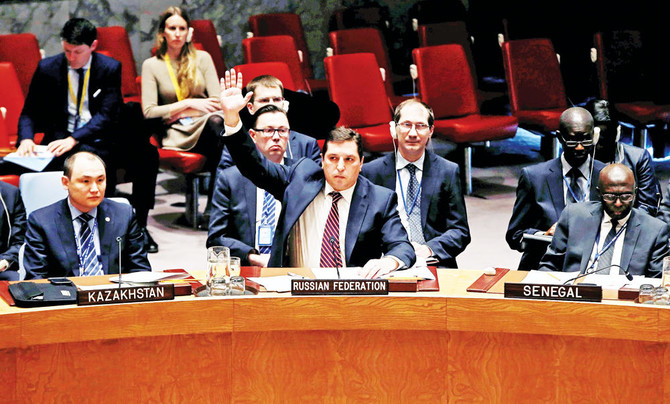
Russian veto gets Assad off the hook for 7th time
Russian veto gets Assad off the hook for 7th time
Latest updates



© 2026 SAUDI RESEARCH & PUBLISHING COMPANY, All Rights Reserved And subject to Terms of Use Agreement.