

Turkey puts 47 on trial for ‘coup plot to kill Erdogan’

1 / 2
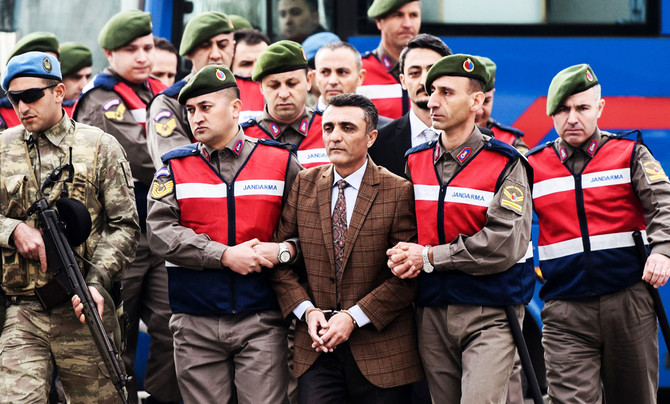
People, mainly Turkish soldiers, accused of trying to assassinate Turkish President during the July coup attempt, are escorted by security forces towards the courthouse in Mugla, western Turkey, on Monday. (AFP)
2 / 2
Turkish President Tayyip Erdogan makes a speech during an opening ceremony in the southeastern city of Gaziantep. (Yasin Bulbul/Presidential Palace/Handout via Reuters)
Updated 20 February 2017
Follow

Turkey puts 47 on trial for ‘coup plot to kill Erdogan’

MUGLA: Almost 50 suspects went on trial on Monday accused of plotting to assassinate Turkish President Recep Tayyip Erdogan at a luxury Aegean hotel on the night of the botched July 15 coup.
Forty-four suspects, mainly soldiers, are under arrest, while three others still on the run are being tried in absentia at the court in the southern city of Mugla.
The suspects, several smartly dressed in suits and ties, were led into the court by security forces in front of television cameras, AFP correspondents said.
Onlookers heckled the accused as they stepped out of the buses that took them from prison, shouting “we want the death penalty!”  
The trial was taking place under the highest security with snipers posted on rooftops and helicopters circling overhead.
Erdogan, who was holidaying at a hotel in the Aegean resort of Marmaris with his family on the night of the coup, has said the plot left him 15 minutes from death.
Prosecutors have sought multiple life sentences for each of the 47 suspects, who include an alleged “hit squad” of 37 soldiers.
Many were detained hiding in the mountains above Marmaris, even in caves, in the days after the coup bid that left 248 dead not including the plotters. Turkish officials say the plot to kill Erdogan was a key part of the plan to depose the elected government they allege was masterminded by the US-based cleric Fethullah Gulen and his so-called Fethullah Terror Organization (FETO).
Onlookers waving Turkish flags chanted slogans against the accused and Gulen, including “Execution!” and “Game Over, FETO.”
After the coup, there have been calls to reimpose the death penalty in Turkey, which was abolished in 2004. 
Erdogan has repeatedly told crowds at rallies he would approve legislation reimposing the death penalty if it was approved by Parliament.

Syrian army chief, SDF delegation discuss integration measures

The meeting addressed military deployment and administrative arrangements. (SANA)
Updated 9 sec ago
Follow

Syrian army chief, SDF delegation discuss integration measures

  • Iraqi and Syrian security officials told The Associated Press that the US military had begun moving its forces and equipment from the Qasrak base in Syria to Iraq’s semi-autonomous Kurdish region

DAMASCUS: Syrian Chief of Staff Maj. Gen. Ali Al-Naasan on Sunday met a delegation from the Syrian Democratic Forces to discuss steps for integrating SDF units into several brigades of the Syrian Arab Army.
The Defense Ministry said that the meeting also addressed military deployment and administrative arrangements.
Syria announced on Jan. 29 a comprehensive agreement with the SDF that includes a ceasefire, a phased integration of forces, and the return of state institutions and border crossings to government control.

BACKGROUND

Syria announced on Jan. 29 a comprehensive agreement with the SDF that includes a ceasefire and a phased integration of forces.

The media directorate of the presidency earlier announced that Brig. Gen. Ziad Al-Ayesh has been appointed as a presidential envoy to implement the Jan. 29 agreement.
The directorate said in a statement to SANA that the agreement enhances the state’s presence, removes obstacles and activates government services for citizens.
The deal includes a phased integration of military and administrative bodies, the deployment of security forces into Hasaka and Qamishli, and the state’s administration of civil institutions and border crossings.
The UN Security Council has welcomed the agreement. The council also praised the start of implementation and reaffirmed its commitment to Syria’s sovereignty and territorial integrity.
In a recent press statement, council members said the agreement must be upheld to ensure civilian protection, unhindered humanitarian access and Syria’s continued recovery.
Meanwhile, US forces were withdrawing from Qasrak base in northeastern Syria, in what appears to be part of a larger drawdown of US forces in the country.
Iraqi and Syrian security officials told The Associated Press that the US military had begun moving its forces and equipment from the Qasrak base in Syria to Iraq’s semi-autonomous Kurdish region.
AP journalists in the city of Qamishli in northeast Syria saw a convoy of dozens of trucks carrying military vehicles and equipment on Monday, with military helicopters circling overhead, moving toward the Iraqi border.
A senior Iraqi security official said evacuation of the base had begun Sunday and that on Monday, US forces and military equipment coming from the base crossed into Iraq’s semi-autonomous northern Kurdish region.
A Syrian security official said about 200 soldiers remained at the base on Monday and that work was underway to dismantle military jamming and air defense systems, and the engineering section at the base.
Earlier this month, CENTCOM and Syria’s Defense Ministry announced that US troops had left another base, Al-Tanf, located in eastern Syria near the border with Jordan.
Meanwhile, Syrian authorities are repairing key infrastructure at Deir Ezzor Civil Airport ahead of flights being resumed. 
Syria’s General Authority of Civil Aviation and Air Transport announced on Monday that technical and engineering teams were repairing the runway, essential facilities, and rebuilding the airport’s perimeter fence to meet international safety and security standards.