Intimidation, death threats stalk gang-raped Muslim women after India’s religious riots

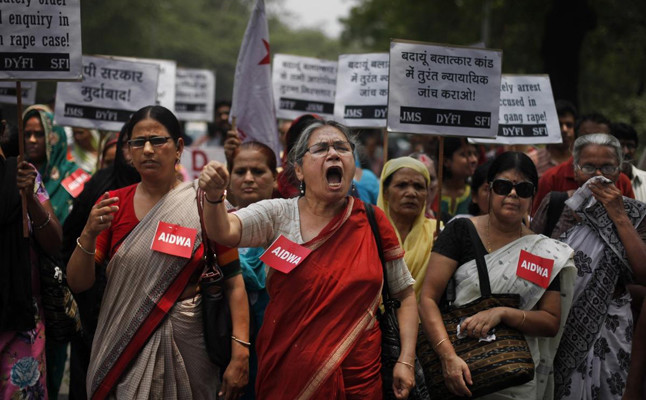
Members of the All India Democratic Women's Association shout slogans during a protest against the gang rape of two teenage girls, in New Delhi, India, in this May 2014 file photo. (AP)
Updated 10 October 2017
Follow

Intimidation, death threats stalk gang-raped Muslim women after India’s religious riots

NEW DELHI: Three years after religious riots in India, Muslim women who reported being gang raped during the violence are still waiting for their cases to be investigated while facing death threats and harassment for speaking out, Amnesty International said.
More than 60 people were killed and over 50,000 forced to flee from their villages when clashes between majority Hindus and minority Muslims erupted in the state of Uttar Pradesh in September 2013.
Seven Muslim women came forward to report complaints of rape during the riots in Muzaffarnagar and Shamli districts, but to date there has not been a single conviction, the Indian branch of the rights group said on Thursday.
Over the last three years, two of the women changed their statements following threats. One victim died during child birth in 2016. One case resulted in an acquittal, one trial is currently underway and in two cases, trials have not begun.
“The Uttar Pradesh government has failed to expeditiously investigate and prosecute the cases and deliver justice,” said Amnesty International India (AII) in a report.
“Their failures continue to keep the survivors in a state of fear and insecurity, skeptical that they will ever get justice.”
Government and police officials from Uttar Pradesh were not immediately available to comment on the reports findings.
The violence was triggered on Aug. 27, 2013, when a Muslim youth was stabbed to death by two Hindu youths after being accused of harassing their sister. A Muslim mob then stoned the two Hindus to death, government officials say.
Neighbours — Hindu and Muslim — turned on one another with machetes and set alight homes and places of worship.
“All three of them threatened me, saying that if I did not do what they asked, they would kill my son. They took turns to rape me,” said one of the victims, named as Ghazala in report, who was raped in a sugarcane field in Shamli on Sept. 8, 2013.
Violence between Muslims and Hindus has been a defining feature of Indian politics since the separation of Pakistan in 1947, when hundreds of thousands of people were killed and millions displaced.
AII’s research — based on police and court documents and interviews with victims, police and government officials — found that the police refused initially to register the complaints and then failed to investigate allegations.
The slow pace of the justice has meant victims and their families have been threatened and intimidated by the accused, AII said.
Due to India’s under-resourced, archaic judicial system long delays in trials are common, but lawyers say delays in this case are due to discrimination against Muslim women who are accusing men from the dominant Hindu Jat majority.
“This is not because the system is inefficient. And it is not because the police and courts do not know how to work,” said human rights lawyer Vrinda Grover at the launch of the report.
“This is a matter of institutional bias within the police.”
The report comes at a sensitive time as Uttar Pradesh, India’s most populous region, begins state elections on Feb. 11.
Religion and caste violence play a central role in politics in Uttar Pradesh and fanning communal tension often brings political gains to parties that claim to protect different religious and caste groups, analysts say.


House votes to slap back Trump’s tariffs on Canada in rare bipartisan rebuke

Updated 6 sec ago
Follow

House votes to slap back Trump’s tariffs on Canada in rare bipartisan rebuke

WASHINGTON: The House voted Wednesday to slap back President Donald Trump’s tariffs on Canada, a rare if largely symbolic rebuke of the White House agenda as Republicans joined Democrats over the objections of GOP leadership.
The tally, 219-211, was among the first times the House, controlled by Republicans, has confronted the president over a signature policy, and drew instant recrimination from Trump himself. The resolution seeks to end the national emergency Trump declared to impose the tariffs, though actually undoing the policy would require support from the president, which is highly unlikely. It next goes to the Senate.
Trump believes in the power of tariffs to force US trade partners to the negotiating table. But lawmakers are facing unrest back home from businesses caught in the trade wars and constituents navigating pocketbook issues and high prices.
“Today’s vote is simple, very simple: Will you vote to lower the cost of living for the American family or will you keep prices high out of loyalty to one person — Donald J. Trump?” said Rep. Gregory Meeks of New York, the top Democrat on the House Foreign Affairs Committee, who authored the resolution.
Within minutes, as the gavel struck, Trump fired off a stern warning to those in the Republican Party who would dare to cross him.
“Any Republican, in the House or the Senate, that votes against TARIFFS will seriously suffer the consequences come Election time, and that includes Primaries!” the president posted on social media.
The high-stakes moment provides a snapshot of the House’s unease with the president’s direction, especially ahead of the midterm elections as economic issues resonate among voters. The Senate has already voted to reject Trump’s tariffs on Canada and other countries in a show of displeasure. But both chambers would have to approve the tariff rollbacks, and send the resolution to Trump for the president’s signature — or veto.
Six House Republicans voted for the resolution, and one Democrat voted against it.
From Canada, Ontario, Premier Doug Ford on social media called the vote “an important victory with more work ahead.” He thanked lawmakers from both parties “who stood up in support of free trade and economic growth between our two great countries. Let’s end the tariffs and together build a more prosperous and secure future.”
Trump recently threatened to impose a 100 percent tariff on goods imported from Canada over that country’s proposed China trade deal, intensifying a feud with the longtime US ally and Prime Minister Mark Carney.
GOP defections forced the vote
House Speaker Mike Johnson tried to prevent this showdown.
Johnson insisted lawmakers wait for a pending Supreme Court ruling in a lawsuit about the tariffs. He engineered a complicated rules change to prevent floor action. But Johnson’s strategy collapsed late Tuesday, as Republicans peeled off during a procedural vote to ensure the Democratic measure was able to advance.
“The president’s trade policies have been of great benefit,” Johnson, R-Louisiana, had said. “And I think the sentiment is that we allow a little more runway for this to be worked out between the executive branch and the judicial branch.”
Late Tuesday evening, Johnson could be seen speaking to holdout Republican lawmakers as the GOP leadership team struggled to shore up support during a lengthy procedural vote, but the numbers lined up against him.
“We’re disappointed,” Kevin Hassett, the director of the White House’s National Economic Council, told reporters at the White House on Wednesday morning. “The president will make sure they don’t repeal his tariffs.”
Terminating Trump’s emergency
The resolution put forward by Meeks would terminate the national emergency that Trump declared a year ago as one of his executive orders.
The administration claimed illicit drug flow from Canada constitutes an unusual and extraordinary threat that allows the president to slap tariffs on imported goods outside the terms of the US-Mexico-Canada trade agreement.
The Republican chairman of the House Foreign Affairs Committee, Rep. Brian Mast of Florida, said the flow of fentanyl into the US is a dire national emergency and the policy must be left in place.
“Let’s be clear again about what this resolution is and what it’s not. It’s not a debate about tariffs. You can talk about those, but that’s not really what it is,” Mast said. “This is Democrats trying to ignore that there is a fentanyl crisis.”
Experts say fentanyl produced by cartels in Mexico is largely smuggled into the US from land crossings in California and Arizona. Fentanyl is also made in Canada and smuggled into the US, but to a much lesser extent.
Torn between Trump and tariffs
Ahead of voting, some rank-and-file Republican lawmakers expressed unease over the choices ahead as Democrats — and a few renegade Republicans — impressed on their colleagues the need to flex their power as the legislative branch rather than ceding so much power to the president to take authority over trade and tariff policy.
Rep. Don Bacon, R-Nebraska, said he was unpersuaded by Johnson’s call to wait until the Supreme Court makes its decision about the legality of Trump’s tariffs. He voted for passage.
“Why doesn’t the Congress stand on its own two feet and say that we’re an independent branch?” Bacon said. “We should defend our authorities. I hope the Supreme Court does, but if we don’t do it, shame on us.”
Bacon, who is retiring rather than facing reelection, also argued that tariffs are bad economic policy.
Other Republicans had to swiftly make up their minds after Johnson’s gambit — which would have paused the calendar days to prevent the measure from coming forward — was turned back.
“At the end of the day, we’re going to have to support our president,” said Rep. Keith Self, R-Texas.
Rep. Darrell Issa, R-Calif., said he doesn’t want to tie the president’s hands on trade and would support the tariffs on Canada “at this time.”