MANILA: The Philippines’ Catholic Church assailed President Rodrigo Duterte’s war on drugs for creating a “reign of terror” among the poor, in sermons read out at Saturday services that will be repeated to congregations across the country on Sunday.
In its most strongly worded attack on the crackdown on drug pushers and users, the Catholic Bishops’ Conference of the Philippines said killing people was not the answer to trafficking of illegal drugs, and it was disturbing that many didn’t care about the bloodshed, or even approved of it.
“An even greater cause of concern is the indifference of many to this kind of wrong. It is considered as normal, and, even worse, something that (according to them) needs to be done,” the bishops said in a pastoral letter, a copy of which was obtained by Reuters.
“An additional cause of concern is the reign of terror in many places of the poor. Many are killed not because of drugs. Those who kill them are not brought to account,” they said.
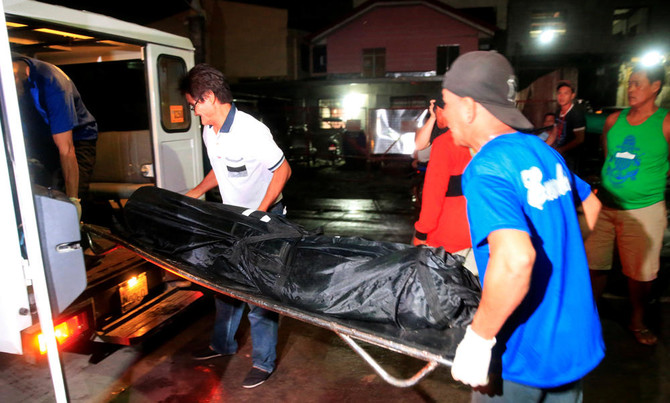
More than 7,600 people have been killed since Duterte launched his anti-drugs campaign seven months ago, more than 2,500 in what police say were shootouts during raids and sting operations.
Both the government and police have strenuously denied that extrajudicial killings have taken place. The president’s office had no immediate comment on the bishops’ letter.
Beginning with Mass services on Saturday evening, priests read out the letter signed by the bishops of Asia’s biggest Catholic nation. Their address did not mention Duterte by name, but urged “elected politicians to serve the common good of the people and not their own interests” and called for steps to tackle “rogue policemen and corrupt judges.”
Nearly 80 percent of the Philippines’ 100 million people are Catholic and, unlike in many other countries where the faith has waned, the majority still practice with enthusiasm. While that support has historically given the Church significant political and social clout, it has been hesitant to criticize the blunt-spoken president’s war on drugs.
In interviews with Reuters last year, more than a dozen clergymen said they were uncertain how to take a stand against the killings given the popular support for Duterte’s campaign. Some said challenging him could be fraught with danger.
Duterte has routinely attacked the Church. He cursed the Pope for causing traffic snarl-ups during his 2015 visit, and as recently as this week called for a “showdown” with priests whom he has accused of having wives, engaging in homosexual acts, misusing state funds and molesting children.
'Rogue cops'
In apparent reference to accusations that many drug pushers and users have been victims of extra-judicial killings, the bishops said “every person has a right to be presumed innocent until proven guilty,” and the law should be followed.
“We must also give priority to reforming rogue policemen and corrupt judges,” they said.
The pastoral letter was read out during Mass on Saturday evening to a congregation of about 50 — mostly women — at the domed Church of St. Joseph inside the sprawling grounds of Camp Crame, the national police headquarters in Manila.
Father Jojo Borja, a chaplain at Camp Crame, said the situation was difficult for clergymen, particularly those employed by the government.
“We have to be in the middle always,” he told Reuters. “When we talk against the government we will be kicked out from the service. Sometimes we will be called for questioning, to ask about our loyalty.”
The bishops’ letter comes less than a week after Duterte suspended all police operations in the drug crackdown due to what he said was deep-rooted corruption in the force. He has put an anti-drugs agency in charge of the campaign and says he wants the military to play a supportive role.
In a series of reports last year, Reuters showed that the police had a 97-percent kill rate in their drug operations, the strongest proof yet that police were summarily shooting drug suspects.
The Reuters reports also found that low-level officials in poor neighborhoods helped police assemble “watch lists” of alleged drug users and pushers that were effectively hit-lists, with many of the people named ending up dead.
Duterte used exaggerated and flawed data, including the number of drug users in the Philippines, to justify his anti-narcotics crackdown, according to a Reuters investigation.
In a report this week, Amnesty International said police prosecuting the war on drugs behaved like the criminal underworld they were supposed to be suppressing, taking payments for killings and the delivery of bodies to funeral homes.
It said the wave of drugs-related killings appeared to be “systematic, planned and organized” by authorities, and could constitute crimes against humanity.


![]()
Philippine Catholic Church slams ‘reign of terror’ behind war on drugs
Philippine Catholic Church slams ‘reign of terror’ behind war on drugs
Latest updates


© 2026 SAUDI RESEARCH & PUBLISHING COMPANY, All Rights Reserved And subject to Terms of Use Agreement.