MUMBAI, India: Veteran Indian actor Om Puri, who successfully straddled movie careers in Bollywood and the West, died on Friday in Mumbai.
Puri, 66, suffered cardiac arrest, his friend and actor Anupam Kher told Reuters.
Puri cut his teeth in the 1980s with alternative art cinema that found a niche audience in India, playing several memorable characters that depicted the angst of the times.
He also worked in several Hollywood and British films, including "The Reluctant Fundamentalist", "East is East", and most recently in "The Hundred-Foot Journey", opposite Britain's Helen Mirren.
"He showed that you didn't have to be 'fair' and 'good-looking' to be a protagonist," Saeed Akhtar Mirza, who directed Puri in one of his earliest films, "Albert Pinto Ko Gussa Kyon Aata Hai" (Why does Albert Pinto get Angry?), told Reuters.
"It was just the force of his personality and his performance."
Several Bollywood stars, fans and Prime Minister Narendra Modi took to Twitter to pay their respects.
"Who dare say Om Puri is no more? He lives through his work," actor Kamal Hassan tweeted.
An alumnus of the Film and Television Institute of India and later, the National School of Drama, the actor's work in Govind Nihalani's "Ardh Satya" (Half-Truth) and later "Aakrosh" (Rage) won him several accolades.
Along with Naseeruddin Shah, Shabana Azmi and Smita Patil, Puri was seen as one of the stars of the alternative cinema movement that contrasted sharply with Bollywood's often crass content.
His distinctive baritone, and ability to switch seamlessly between art house, Bollywood, Hollywood and British film, made him an international star, one of the few Indian actors to cross over to the West before the likes Irrfan Khan and Priyanka Chopra made the jump. (Reporting by Shilpa Jamkhandikar)


Indian actor Om Puri, star in Bollywood and the West, dies at 66

Indian actor Om Puri, star in Bollywood and the West, dies at 66
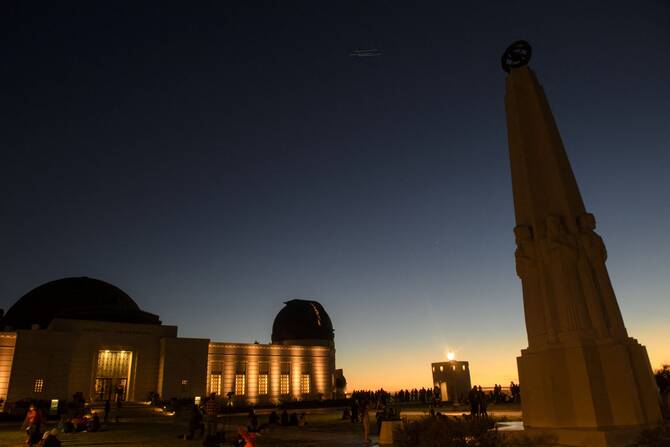
6 planets will parade across the night sky at the end of February
NEW YORK: Six planets are linking up in the sky at the end of February, and most will be visible to the naked eye.
It’s what’s known as a planetary parade, which happens when multiple planets appear to line up in the sky at once. The planets aren’t in a straight line, but are close together on one side of the sun.
Skygazers can usually spot two or three planets after sunset, according to NASA. Hangouts of four or five that can be glimpsed with the naked eye are less common and occur every few years. Last year featured lineups of six and all seven planets.
When will they be visible?
On Saturday, Mercury, Venus, Jupiter and Saturn will be visible to the naked eye if clear skies allow. Uranus and Neptune can only be spotted with binoculars and telescopes.
What time is optimal for viewing?
Go outside about an hour after sunset and venture away from tall buildings and trees that will block the view. Look to the western sky and spot Mercury, Venus and Saturn close to the horizon. Jupiter will be higher up, along with Uranus and Neptune.
How to know if you’ve spied a member of the parade?
“If it’s twinkling, it’s a star. If it is not twinkling, it’s a planet,” said planetary scientist Sara Mazrouei with Humber Polytechnic in Canada.
The parade should be visible over the weekend and in the days after. Eventually, Mercury will bow out and dip below the horizon.
At least one bright planet is visible on most nights, according to NASA.
Glimpsing many in the sky at once is a fun way to connect with astronomers of centuries’ past, said planetary scientist Emily Elizondo with Michigan State University.
Ancient astronomers used to make sense of the universe “just by looking up at the stars and the planets,” Elizondo said, “which is something that we can do today.”