THE HAGUE: Bosnian Serb forces acted in self defense during the bloody siege of Sarajevo, the Yugoslav war crimes court heard as the first defense witness took the stand in the trial of ex-army chief Ratko Mladic on Monday.
One of Mladic’s officers, Mile Sladoje, told the three-judge panel at the International Criminal Tribunal for the former Yugoslavia (ICTY), where Mladic faces charges of genocide and crimes against humanity, that his troops “never were snipers” during the notorious 1990s siege in which 10,000 people died.
“All our activities (in Sarajevo) were defense activities,” Sladoje said in a statement read by Mladic’s lawyer Miodrag Stojanovic before questioning began.
“There were standing orders, fire could only be returned in response to enemy fire,” said Sladoje, an assistant logistics commander in the Bosnian Serb Army, who was saluted by Mladic as he walked into the courtroom.
Dubbed the “Butcher of Bosnia,” Mladic, 72, faces 11 charges ranging from hostage-taking to genocide for his role in Bosnia’s brutal 1992-95 war following the break-up of the former Yugoslavia.
Around 100,000 people were killed and 2.2 million others left homeless in a conflict which included some of the worst atrocities committed on European soil since World War II.
Mladic is charged with involvement in the slaughter of almost 8,000 Muslim men and boys at Srebrenica in July 1995 and the 44-month siege of the Bosnian capital Sarajevo.
He is accused of waging a “campaign of terror” against Sarajevo’s civilians through indiscriminate shelling and deploying snipers during the siege.
But Sladoje, referring to the sniper killing in Sarajevo of a teenage girl, denied there were snipers among his troops or that they had sniper weapons.
“We had normal infantry weapons, we never had snipers or such rifles,” the officer told the judges.
Mladic, dressed in a black suit, black tie and white shirt listened attentively as Sladoje spoke.
Judge Alphons Orie admonished Mladic for talking loudly to the officer during a break in proceedings.
“There’s no standing, no greeting of witnesses,” Orie said when the session resumed. “No loud talking. He (Sladoje) is here as a witness, not an acquaintance of the accused,” the judge said.
At Srebrenica, Mladic’s forces are accused of overrunning lightly armed Dutch UN troops protecting the supposedly safe enclave, before murdering thousands of men and boys and dumping their bodies into mass graves.
He has also been charged for taking hostage a group of over 200 United Nations peacekeepers during the conflict, keeping them in strategic locations as “human shields” against NATO air strikes.
Judge Orie has given Mladic’s lawyers 207 hours to question witnesses — the same amount of time given to the prosecution, who finished their case earlier this year, the ICTY said in a statement.
There was no restriction on the number of witnesses defense lawyers could call, it added.
Mladic was arrested in Serbia and transferred to the ICTY in 2011.
Known for his outbursts in court, he has denied the charges. He faces life in prison if convicted.
In January, he refused to testify at the trial of Radovan Karadzic, his political counterpart at the time, repeatedly dismissing the UN Yugoslav war crimes tribunal as “satanic.” The two men could have been tried together had they been arrested around the same time. But Karadzic was arrested in July 2008 and Mladic in May 2011.
Last month, the ICTY upheld the charges after reviewing the evidence against Mladic, with judge Orie ruling that he “had a case to answer on all counts of the indictment.”


‘Serbs fought in self-defense’, Mladic witness tells UN court
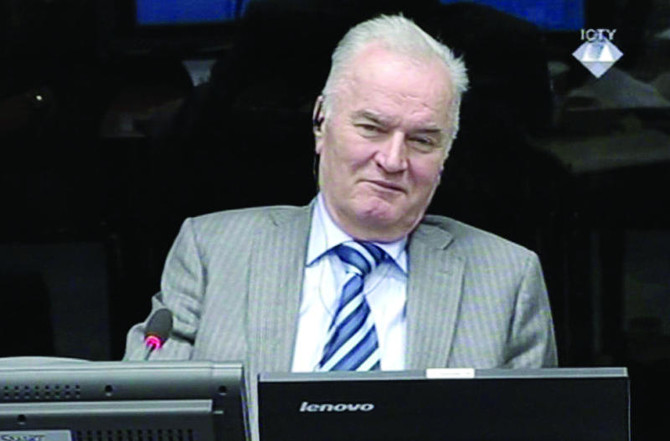
‘Serbs fought in self-defense’, Mladic witness tells UN court

Heavy shelling, explosions spark fear along Pakistan-Afghanistan border
- Residents fear for their safety amid border clashes
- 1,500 Afghan families displaced due to heavy shelling and explosions
- Pakistan denies targeting civilians, says its strikes focus on militants
LAL PUR, Afghanistan/PESHAWAR, Pakistan: People living along Pakistan’s border with Afghanistan said they were considering fleeing their homes because of heavy shelling and explosions as fighting between troops from both sides entered a seventh day on Wednesday.
The South Asian allies-turned-foes have engaged in their worst fighting in years following Pakistani airstrikes on major Afghan cities last week, increasing volatility in a region also on edge over US and Israeli strikes on Iran.
Islamabad has said its airstrikes, which have at times directly targeted the Taliban government, are aimed at ending Afghan support for militants carrying out attacks on Pakistan. The Taliban has denied aiding militant groups.
SHELLING STARTS AS VILLAGERS ARE BREAKING RAMADAN FAST
Residents of towns and villages in Pakistan’s northwest said fighting between border forces starts in the evenings, placing their homes in the line of fire, often at sunset when families are breaking their fast in the holy month of Ramadan.
“There is complete silence in the day, but the moment we sit for iftar dinner, the two sides start shelling,” Farid Khan Shinwari from Landi Kotal, a town near the Torkham border crossing, told Reuters.
“We open our fast in extremely difficult situations, as you never know when a shell can hit your house.”
Residents in the town and nearby villages said there had been heavy shelling and some explosions heard in the past few days, prompting many to flee their homes.
On the other side of the border, Afghans shared similar stories of skirmishes and families fleeing their homes.
Hundreds had been displaced to an open dirt field under makeshift tents, while others had no shelter at all. Officials say around 1,500 families have fled their homes.
Fighting along the 2,600-km (1,615-mile) border has ebbed and flowed over the week-long conflict, with both sides saying they have inflicted heavy losses on the other country and gained ground in the fighting.
Reuters has been unable to verify these accounts.
TURKEY HAS OFFERED TO MEDIATE
Turkish President Recep Tayyip Erdogan told Pakistani Prime Minister Shehbaz Sharif that Ankara would help reinstate a ceasefire, the Turkish Presidency said on Tuesday, as other countries that had offered to mediate have since been hit by the conflict in the Gulf.
On Wednesday, both countries reported exchanges of heavy fire, with Afghanistan’s defense ministry saying Taliban forces shot down a Pakistani drone and captured seven border posts.
A spokesperson for the ministry said 110 civilians, including 65 women and children, had been killed since the fighting began and another 123 were wounded. The United Nations mission for Afghanistan has listed 42 deaths so far.
Pakistan’s Information Minister Attaullah Tarar disputed both figures, saying: “Pakistan exercises great care in only targeting terrorists and support infrastructure. No civilian structures have been targeted.”
On Saturday, Pakistan struck “ammunition and critical equipment” at the Bagram air base north of Kabul, Tarar said, a key American command center through the 20-year Afghan war.


