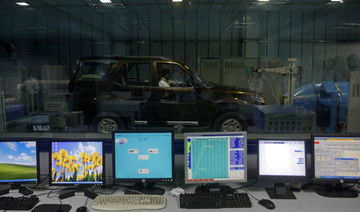
NEW DELHI: Several of India's most popular car models, including the famously small Tata Nano, crumpled in independent crash tests in ways that would likely lead to fatality or serious injury, a global car safety watchdog said Friday.
The results are an indictment of the auto industry in India, which lacks adequate safety standards, said David Ward, head of the London car-safety watchdog Global NCAP, which performed the crash tests. India has some of the deadliest roads in the world.
Drivers should be "educated and protected by regulation, but that's not happening in India," said Ward.
India's growing middle class, anxious to buy new cars, has helped fuel a booming auto industry while demanding little in terms of safety. Last year India produced 3.2 million cars, nearly twice the 1.7 million manufactured in the 2008 fiscal year. For the bulk of those sold within India, air bags and rear passenger seat belts were optional, and none was required to be tested for its ability to withstand a collision.
The lack of safety features, combined with reckless driving and shoddy roads, has helped give India a road death rate that is more than six times as high as that of the US and nearly three times China's rate, according to the World Health Organization's 2013 road safety report on the number of deaths compared with the size of a country's car fleet.
Seen another way, one in 10 people killed in a road accident worldwide is Indian.
Four of five small cars popular on the Indian market last year — including the Tata Nano, the best-selling Maruti Suzuki Alto 800 and the Hyundai i10 — failed independent crash tests recently performed by Global NCAP. The findings were not unlike what safety assessors found in Brazil and Mexico last year.
Automakers said the issue of car safety is complex, involving not just passenger safety, but also the safety of those outside the car. They said that means cars need to handle well, with good steering and brake systems while drivers must be educated about the rules of the road, and roads should be in good condition.
These are all challenges in India, where roads are often unpaved and pockmarked by ditches. City streets frequently crumble under heavy traffic, monsoon rains and hot sun. The minimal fines imposed for speeding mean limits are often flouted, with drivers peeling around corners and honking at cows, bullock carts, cyclists or anything else in their way.
Tim Leverton, head of Research and Development for Tata Motors, said Tata is looking again at the Nano's structure for ways to improve its strength, after already adding power steering and improving the car's dynamics.
In the Indian tests, only the Volkswagon Polo's 2014 model had air bags, which were added after the earlier model failed the crash test. Volkswagon said the air bags, as well as anti-lock brakes, would become standard from Feb. 1 along with a 2.7 percent price increase to offset the costs.
"We are proud to be leading the cause of driver safety," Arvind Saxena, the managing director of Volkswagen's Indian passenger car business, said in a statement.
India's biggest carmaker, Maruti Suzuki, did not respond to calls for comment.
The Polo and the Ford Figo were the only two cars to maintain their structures in a 64-kph collision, while the other three crumpled at a slower speed of 56 kph in ways that would likely lead to fatality or serious injury even with air bags.
All five cars chosen were standard, entry-level models, the sort a working class family might choose as their first car, rather than more expensive versions with additional features. About 80 percent of the cars sold in India have price tags of under $8,000.


Indian cars fail safety test, says global watchdog

Indian cars fail safety test, says global watchdog


Oman targets clean energy, EVs in China talks
JEDDAH: Oman is intensifying efforts to attract investment into its industrial sector and advance toward high-value, technology-led activities through an official visit to China.
The delegation was headed by Saleh Said Masan, undersecretary for commerce and industry at the Ministry of Commerce, Industry and Investment Promotion, who visited a number of major Chinese manufacturing facilities, according to the Oman News Agency.
Industrial development is a central pillar of Oman Vision 2040 and the Industrial Strategy 2040, which target a tripling of manufacturing output, the attraction of approximately 40 billion Omani rials ($104 billion) in investment, and the expansion of advanced and green industries.
“These visits fall within ongoing efforts to strengthen investment in the industrial sector, in line with Oman’s strategy to develop integrated industrial clusters and shift toward high value-added industries driven by innovation and advanced technologies,” ONA reported.
As part of the visit, the delegation toured global solar energy firm JA Solar, where discussions with senior management focused on the latest smart solar cell and panel manufacturing technologies.
Both sides reviewed progress on the establishment of JA Solar’s facility in the Sohar Freezone, following a previously signed memorandum of understanding with the ministry to develop an integrated solar cell and module plant with an estimated investment of $564 million.
Officials confirmed that construction is proceeding according to plan, underscoring Oman’s goal of positioning itself as a regional hub for clean energy technologies and supporting its net-zero emissions target by 2050.
The delegation also visited the headquarters of BAIC Motor Corp., where recent advancements in electric and smart vehicles, along with next-generation transportation systems, were presented.
During the visit, Masan highlighted the incentives and support mechanisms offered by Oman to attract investment in the electromechanical and transport industries, reaffirming the ministry’s commitment to facilitating high-quality industrial projects.
“This direction aims to establish joint ventures in automotive assembly and manufacturing, helping diversify the industrial base and create specialized employment opportunities for Omani professionals in engineering and digital technologies, in line with Industrial Strategy 2040 objectives,” ONA stated.
Concluding the visit, the undersecretary said the engagements reflect the ministry’s focus on a qualitative shift toward capital-intensive and technology-driven industries.
He added that integrating renewable energy projects with JA Solar and localizing vehicle technologies with BAIC would enhance manufacturing’s contribution to gross domestic product and strengthen the competitiveness of national products under the Made in Oman brand.
Masan emphasized the ministry’s commitment to fostering an attractive investment climate that encourages foreign direct investment and supports the integration of small and medium-sized enterprises into the global supply chains of leading international companies.


