They are the traditional markers in Nigeria of both ethnic and social identity — and even royalty — but for Raphael Akindele and young men like him, hats are sometimes quite literally a pain.
“I just don’t feel smart and comfortable wearing a hat on a ‘buba and sokoto’,” said the 21-year-old, referring to the traditional long robe and trousers worn by many Nigerian men.
“Such dressing belongs to the old school,” the computer technician told AFP at a recent Lagos wedding, where his t-shirt and jeans set him apart from other guests in colorful traditional attire.
From Trilbies, Homburgs and Panamas to Bowlers and Fedoras, hats were once an essential part of any appropriately dressed Western gentleman’s wardrobe until fashions changed.
But in Nigeria, hats of all colors, shapes, sizes and designs are still a regular sight.
Internationally, the country’s current most famous hat wearer is President Goodluck Jonathan, who is rarely seen without his black Fedora, which is widely worn by men in Nigeria’s oil-rich southeast.
Elsewhere, the Trilby or Bowler, sometimes adorned with a white feather, is in vogue with men in the Niger Delta, while men from the Hausa ethnic group favor the “habar kada,” which is likened to a crocodile’s mouth.
Many Yoruba men plump for the “gobi,” an embroidered soft cap that can be worn either fully raised or tilted to one side, or the “abeti aja,” whose triangular flaps are folded either side like dog ears.
For Igbo males, only traditional chiefs and monarchs wear the red fez-like hats popular in northern Africa, while others sport headgear similar to the “gobi.”
With such a wide variety, it might be thought that any image-conscious young man would be able to find one to suit his own style.
But Ismail Aminu, a 24-year-old student in the northeastern city of Maiduguri, said simply: “I get headaches whenever I put on caps for long.
“I use them occasionally or during religious or traditional ceremonies because I see them as a burden on my head.
“Caps in this part of Nigeria are heavy because they are mostly knitted and starched. Using caps among the youths is gradually becoming a thing of the past.”
Many older men, for whom hat-wearing is second nature, admit they are baffled and even outraged at the vogue for a bare head.
Maiduguri trader Abdulahhi Abubakar, 43, said the phenomenon was “an aberration of the culture of the Hausa” while lecturer Lere Adeyemi said it “violates the ethos of Nigerian culture.”
Former teacher Benjamin Ofomadu, 76, said for his generation, not to wear a hat with traditional dress was considered “a cultural sacrilege of sort and... irresponsible.”
In some cultures, hats are seen as a “mark of respect for your head... your destiny or inner god,” said Adeyemi, who teaches African and Asian cultural studies at the University of Lagos.
“If you do not wear a cap on a traditional dress, your dressing is incomplete,” he added.
“It simply shows that there is a disconnect between such a person and culture, which is part of our life. And this is sad.”
Critics blamed television and the creeping influence of foreign or Western culture for the trend, while Adeyemi claimed the dress codes in some jobs were a lingering form of colonialism.
Nigeria’s banking sector, for example, requires men to wear a Western-style suit and tie. Horsehair wigs and gowns introduced by the British former rulers are still seen in the legal profession.
Young men in jeans, t-shirts — and even baseball caps — are meanwhile increasingly seen in places such as Lagos, indicating that outside trends were taking hold.
“They see people in suits and they admire them. They no longer appreciate caps,” said Ibrahim Musa Babagana, a 52-year-old sociology teacher.


Hats off for young Nigerians as fashions change

Hats off for young Nigerians as fashions change
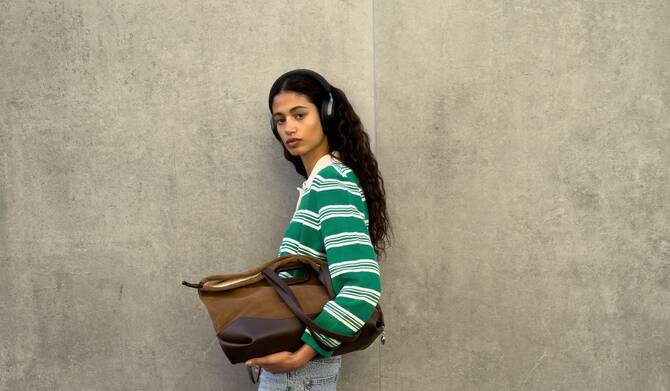
Malika El-Maslouhi ushers in spring in Maje
DUBAI: Moroccan Italian model Malika El-Maslouhi is the embodiment of relaxed in Parisian label Maje’s Spring-Summer 2026 campaign.
The model took to Instagram to share shots from the campaign. Set against a minimalist concrete backdrop, El-Maslouhi is seen wearing a green and white striped knit cardigan paired with wide-leg, speckled denim and chunky black boots, creating a chic contrast between casual comfort and fashion-forward styling. The oversized brown leather bag slung under her arm adds a touch of understated luxury.
She captioned the post, “Spring renaissance.”
Meanwhile, El-Maslouhi ended 2025 on a strong note with a holiday campaign for the French luxury label Guerlain.
In a photo shared on the brand’s Instagram page, the 27-year-old model, who has become a favorite on international runways, wore the limited-edition Rouge G lipstick from Guerlain’s Tale of Wonders Holiday Collection in shade G 877. She was also pictured holding the lipstick alongside the matching limited-edition Rouge G Stellar case.
In August 2025, she was the face of Anthropologie’s 2026 resort-wear campaign. The line blended breezy elegance with playful details, including jewel-toned maxi dresses, sleek black knitted dresses, and form-fitting satin gowns that would be perfect for date night.
El-Maslouhi has previously starred in Anthropologie’s summer campaigns. The catwalk star was photographed posing pool and beachside in pieces from Anthropologie’s summer offering, which included ready-to-wear, swimwear and accessories.
Earlier in the year, El-Maslouhi starred in Saint Levant’s music video for the song “Exile,” directed by Algerian-French filmmaker Lyna Zerrouki. The video, which explores themes of longing, loss and hope, features El-Maslouhi against a striking blue backdrop, seemingly falling through the air.
El-Maslouhi, born in Milan to a Moroccan father and an Italian mother, began her modeling career at the age of 18. She has since appeared on runways for international fashion houses including Dior, Chanel, Valentino and Jacquemus, gracing the catwalks of New York, London, Milan and Paris fashion weeks. Over the years, she has walked for brands such as Ulla Johnson, Prabal Gurung, David Koma, Boss, Missoni, Messika and more.
She has also featured in campaigns for brands such as Calvin Klein, Off-White and Lanvin, expanding her portfolio across both luxury and contemporary fashion.
In 2022, she was awarded the Model of the Year in Italy title.


