



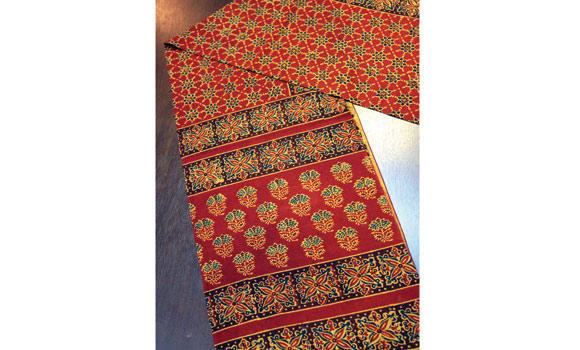

The best gifts come from the heart, not the store. This is what Arab and Pakistani traditions are all about; we show our respect to our esteemed guests by presenting gifts that represent our culture.
Ajrak — from the Indus Valley tradition of Sindh, Pakistan, is one such item that has rich cultural value.
Ajrak is a block printed cloth with deep crimson red and indigo blue background, bearing symmetrical patterns with interspersed unprinted sparkling white motifs, mostly stars. Made of cotton, its suppleness reminds us of smooth silk. More than a fabric, ajrak is a Sindhi tradition, traceable from the earliest archaeological finds of the old Indus civilization of Moen Jo-Dero. It has been equally popular since time immemorial till today among its urban, rural and nomad users.
Ajrak is literally used in Sindh (Pakistan) from the cradle to the grave. It is used as a hammock for infants, headgear for girls, bridal accessory, a turban and a shawl, a bed cover, a tablecloth, a gift item and a token of respect to honor a guest. Most of the heads of state and dignitaries of Pakistan have used ajrak in their public meetings to show respect and as a token of solidarity for Sindh Province.
To get a first-hand idea of how it is made we visited the small towns of Mityari, Bhit Shah and Hala located in and near Mityari District of Sindh Province in Pakistan. Bhit Shah is famous because of the great Sindhi mystic poet “Shah Abdul Latif Bhitai” whose famous poetic masterpiece “Shah Jo Risalo” occupies a very prominent place in Sindhi literature. A visit to Bhit Shah opens the door to “Sindhology,” the specialization of the Indus (Sindh) valley civilization, as “Egyptology’ is to the ancient Egyptian civilization.
Mitiari is known for ajrak craftsmanship, whereas Hala town is the marketplace of all the handicrafts including ajrak, Sindhi embroidery, and lacquered woodwork, typical glazed tiles in blue and white “Kashi” artwork, terracotta and some typical woven fabrics like “Soosi’.
The urge to mention the stunning beauty of the scenic panorama along the highway during a drive from Karachi to these places is simply irresistible. The misty twilight, the wide stretches of green and yellow mustard fields in full bloom, attractive banana and mango plantations, and widespread lush green fields interspersed with working village girls dressed in luminescent yellow, green, crimson and orange colors with occasional colorful floral nurseries in full bloom are only a few glimpses of the tour.
The legendary Pakistani folk singer “Allan Faqir” with his down-to-earth personality was an inspiring artist with his stylish ajrak attire including his dancing peacock like turban made of ajrak.
Color is the continuous phase of the “music in the color emulsion” of Sindhi society.
The Muslim rulers used to award “Khilat” (an expensive gown) in recognition of the services of their courtiers. Similarly, Muslim Sindhi rulers also continued the tradition and awarded ajrak in recognition of outstanding performances or the valuable services rendered by individuals. It is customarily conferred even today on respectable guests.
Considering the different processes involved, particularly printing, which is the main element of the craft, ajrak-making seems to be a scientific art. The technique of printing allows exclusive absorption of a dye in the desired areas only and prevents absorption on the areas intended to be left uncolored. It seems to be like differential staining used in microscopy wherein different microbes are stained and fixed selectively.
The famous German orientalist Marry Anne Schimmel and Elsa Qazi, a well-known scholar translated Shah Jo-Risalo selectively in verse. Both scholars highlighted in their work the fact that ajrak was very much in use at least in Shah Latif Bhittai’s times. It is a pure spiritual delight to know how beautifully and finely Elsa Qazi captured its essence. Symbolic use of ajrak, camel, saltbush and washing etc. few of Elsa Qazi’s narrations are:
“Like fresh pan-leaves are ajrak (shawls) they
Wear of shimmering emerald silk’
“Beautiful like roses sweet
Are robes of damsels fair?“
(Elsa Qazi from Mumal and Rano)
There was a time when princely Hoat
My clothes to wash did choose;
Now even camel men refuse
To take me with themselves
My gown is at my shoulders torn;
Yet my head is covered with Ajrak
O sisters in Bhambore (Place in Pakistan) fair
What have I now to do?
Email: [email protected]


