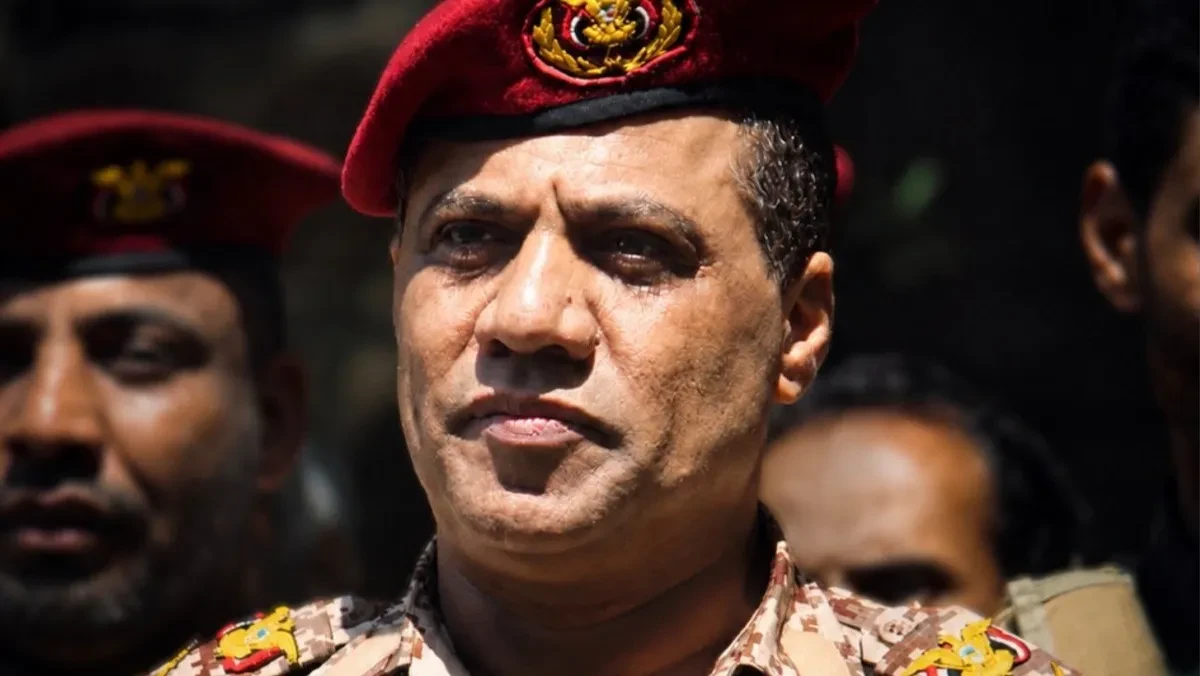
- Yemen’s Deputy Minister of Defense, Major General Samir Al-Sabri, reports military advancements across multiple fronts in the ongoing Battle of Marib, with Sanaa identified as the main battleground
- Significant military progress is noted in various regions, including the West Coast, Taiz, and the Kahbub mountains, despite some losses in Taiz Governorate
DUBAI: Yemeni Deputy Minister of Defense, Major General Samir Al-Sabri, told Al-Sharq the Battle of Marib is witnessing military progress and that forces are advancing on more than one front.
He noted that supply lines in Al-Waziyah remain open, while emphasizing that Sanaa is the main battle, though the Bab al-Mandab Strait represents the most critical location at this stage.
Al-Sabri explained that “all fronts across Yemen are now inflamed—in the West Coast, Dhubab, and the Kahbub mountains; in the east in regions of Marib Governorate; and in the center in Taiz and Al Bayda Governorates,” noting that “there is significant progress on many fronts.”
He added that there are “some losses of certain villages in Taiz Governorate and the Taiz countryside, but overall, battles remain fierce and ongoing,” confirming that “battles are proceeding as planned, according to the battle sequence, and aligned with the current phase we are in.”
The first phase and Bab Al-Mandab
Al-Sabri considered that “the first phase is breaking the Houthi offensive in all governorates, especially along the West Coast and Taiz Governorate,” while pointing out that the strategic Bab al-Mandab area is the most critical in the current stage.
He said that “taking control of the Kahbub mountain range, which stretches between Lahj and Taiz Governorates, is considered a major step toward cutting off Houthi fire and supply lines.”
The battle of Taiz
In response to a question regarding Taiz and reports indicating Houthi attempts to advance at the governorate’s entrances, Al-Sabri said that Taiz city was previously besieged for more than 4 years, and that its siege was broken in 2018 and 2019.
He added that “the Houthis treat this governorate differently from the rest of the governorates, as it was perhaps the first to shatter the Houthi bid to control Yemen in 2014.”
He stated that “battles in Taiz are taking place in almost every village,” adding: “We believe the Houthis have entered a lion’s den, and their exit will be far more difficult, despite some gains and taking control of a few districts.”
He pointed out that “the other matter is that this battle in western Taiz, in general, has as a main Houthi objective the securing and controlling of Bab al-Mandab, in execution of directives from the Iranian Islamic Revolutionary Guard Corps (IRGC).”
Al-Waziyah and prominent challenges
He added that “Al-Waziyah is one of the most critical hubs, possessing open supply lines connecting to Taiz, Al-Mukha, and other lines toward the Al-Hudaydah route.”
He stated that “the area holds paramount importance and is home to the fiercest fighters in the region, who absolutely do not serve as an incubator for the Houthis—just as Taiz itself does not serve as a Houthi incubator.”
He pointed out that “this area serves as a primary link in the battle, controlling the lines of troop movements and supplies for both the Houthis and the legitimate forces.”
The battle of Sanaa
He explained that “the distance between Marib and Sanaa is 120 kilometers, and it is now a corridor of active fronts,” noting that “the battle of Sanaa is the main battle.”
He also referenced the statement issued by the Chairman of the Presidential Leadership Council, which affirmed that reclaiming Sanaa will remain the primary goal for restoring state institutions to the capital, alongside taking control of all routes leading to Saada and Amran governorates.
Countering aerial threats
Al-Sabri stated that they “are countering the Houthis’ use of drones in kind,” noting that “there will be further developments in the upcoming phase.”
He clarified that “the air force is performing well—both the legitimate Yemeni air forces and the Coalition air forces, which have a major and pivotal impact across many fronts.”
“As for missile capabilities, Iran exports weapons to the Houthis, particularly in the weapons sector and spare parts for missiles. Missiles are sent in pieces and assembled in Sanaa using Iranian, Iraqi, and Lebanese expertise,” said Al- Sabri.
He added: “Ultimately, when the Houthis strike civilian facilities like Aden Airport or the city of Taiz, killing children, or hit civilian infrastructure in Saudi Arabia, it is an indicator that they are entering a state of hysteria that will soon lead to their complete downfall.”
Al-Sabri explained that “the air force is striking all supply lines, particularly those associated with drones, ballistic missiles, and weapons depots,” pointing out the “necessity of disrupting these lines and preventing their movement, after which the National Army will be capable of eliminating the remaining Houthi forces on the ground.”
The west coast and field coordination
Regarding the role of the Yemeni Armed Forces and field coordination to protect the West Coast, Al-Sabri stated that “there is high-level coordination between the Coast Guard and Naval Forces, even though their capabilities are not yet at the required scale,” emphasizing that “nations around the world, particularly Britain, are beginning to understand the importance of the Coast Guard and protecting the strait.”
Al-Sabri added that regional and international nations share a responsibility in confronting the Houthi movement, noting that an unchecked Houthi control over Bab al-Mandab would impact the global economy, not just the Yemeni economy.
Al-Sabri said that major efforts are underway to clear mines in areas from which the Houthis withdrew and government forces secured, noting that “hundreds of landmines were removed by the Giants Brigades (*Al-Amaliqah*) along the West Coast.”
He explained that “the Houthis plant landmines without even maintaining maps of their locations,” noting that “the Houthis plant mines and leave without knowing where they were placed, leading to the deaths of civilians and children who unknowingly walk over them. Ultimately, when they retreat, they mine these areas to block Yemeni forces from advancing.”
He emphasized that “the Yemeni Army possesses an excellent engineering unit working precisely, systematically, and in an organized manner to clear these mines, supported by international efforts and regional organizations.”