- ‘People have nowhere else to go; it’s either torn and worn-out tents that offer little protection or privacy, or damaged buildings at risk of collapse,” says head of Civil Defence in Gaza City
- ‘We are not approaching a natural catastrophe; it is a man-made crisis produced by 3 years of destruction, displacement and restrictions, and winter is about to expose it,’ he adds
GAZA: Gaza’s Civil Defence has warned of a looming humanitarian crisis this winter as worsening weather threatens to bring down war-damaged buildings on top of displaced families already struggling to survive in deteriorating shelters.
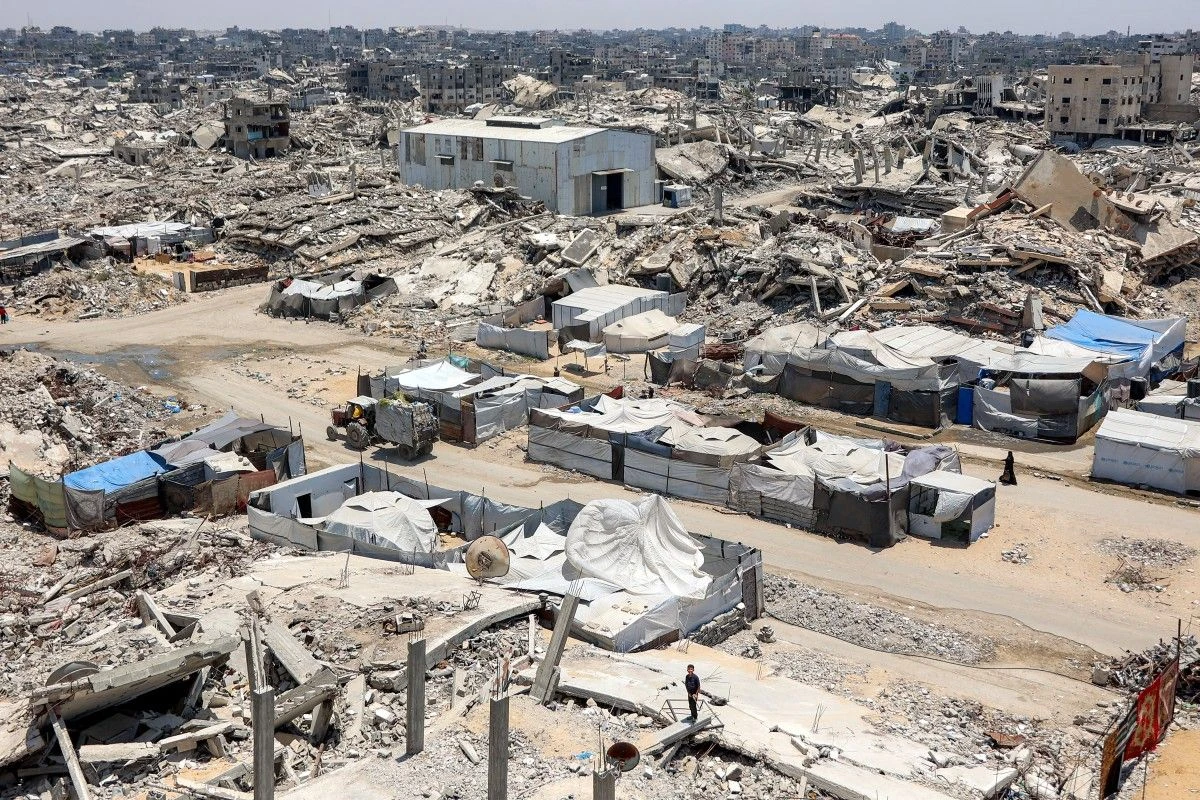
About 1.2 million Palestinians, 58 percent of Gaza’s population, displaced by the war that began in October 2023 are living in crowded tents and other makeshift shelters that are worn out and fragile after years of rain, wind and harsh weather.
Now facing yet another winter with few alternatives, families living with little protection from the elements are seeking shelter in partially damaged or bombed-out buildings, despite warnings from Palestinian authorities that structures weakened by Israeli strikes could collapse under heavy rain and strong winds.
Raed Al-Dahshan, the director of Civil Defence in Gaza City, said rescue teams were facing “a major humanitarian catastrophe” this winter, and amid Israeli restrictions they lack the heavy machinery, equipment and reconstruction materials they need to alleviate the crisis.
“People have nowhere else to go,” he told Arab News. “It’s either torn and worn-out tents that offer little protection or privacy, or damaged buildings at the risk of collapse.”
About 82 percent of structures across Gaza have been damaged by the war, according to the UN, with more than 200,000 affected to varying degrees. More than 2,000 are believed to be at risk of collapse, including about 700 in central Gaza, according to Palestinian authorities.
Civil Defence crews were deployed at four separate building collapses in the space of just 72 hours during the season’s first major rains last week, Al-Dahshan said. He warned that additional heavy rainfall would further weaken damaged buildings and cause them to collapse, threatening those sheltering inside as well as displaced families living nearby in tents.
“Rain can seep through cracked concrete and weaken partly destroyed homes, further accelerating structural collapse,” he said.
The unfolding humanitarian crisis was laid bare on Sept. 16 when the six-story Al-Saada building in Gaza City’s Tal Al-Hawa neighborhood collapsed, killing at least 21 people, including 12 children. About 100 displaced Palestinians were sheltering in the building, which was previously damaged by Israeli airstrikes, when it collapsed onto nearby homes and tents.
In the absence of heavy machinery, Civil Defence crews and residents dug through the rubble by hand as they searched for survivors, eventually pulling 45 people from the debris with the help of UN agencies and Egyptian relief teams.
On Sept. 18, Civil Defence crews rescued seven children and two women trapped on the second floor of their home in the Sabra neighborhood, south of Gaza City, after its staircase collapsed. A day later, rescuers pulled a young man from rubble after a roof and staircase collapsed on him in the Zeitoun neighborhood in southeastern Gaza City.
Al-Dahshan said Civil Defence officials had also warned of the possible collapse of a five-story building in the Nasser neighborhood of western Gaza City, where about 120 people from 10 families were sheltering. Despite repeated warnings to evacuate, the families refused to leave.
“When we urge people to leave because the building is unsafe, they tell us, ‘We would rather die here. Where else can we go? Where can we shelter our women and children?’” Al-Dahshan said.
“They ask us to provide them with somewhere safe to go but Civil Defence is already stretched beyond its capacity.”
More than 1.9 million Palestinians, about 90 percent of Gaza’s population, have been displaced by the war, many of them several times, and thousands are sleeping outdoors or sheltering in or around the remains of bombed buildings and other unsafe, damaged structures, according to the UN.
Nearly a year after a US-brokered ceasefire came into effect on Oct. 10, 2025, large-scale reconstruction work has yet to begin in Gaza as negotiations remain stalled over the disarmament of Hamas and the withdrawal of Israeli troops.
Meanwhile, Israeli airstrikes and other attacks continue to hit populated areas, despite the truce, causing more casualties, property damage and displacement, the UN warns. Hundreds of thousands of Palestinians remain unable to return to their homes beyond the so-called “Yellow Line” that separates areas under Israeli military control from western zones where the Palestinian population is largely confined.
The Israeli prime minister, Benjamin Netanyahu, instructed the military in May to expand its control to 70 percent of Gaza, further squeezing much of the population into an ever-shrinking area. This has left the vast majority of Palestinians living in tents within packed, sprawling camps, some built upon urban ruins, that lack basic sanitation and are surrounded by garbage and sewage.
Destroyed buildings, accumulated waste and damaged water and sanitation infrastructure have turned tents into breeding grounds for rodents, parasites and disease.
Dr. Taghreed Bassam, a psychologist in Gaza, said families desperate to escape the summer heat, overcrowding and rat-infested displacement camps had cleared spaces amid the rubble or moved into partially destroyed homes and abandoned buildings, despite the danger they posed.
“Rodents and parasites have become a major problem for families in tents, as they bite their children and spread disease,” she told Arab News.
“For families with children and the elderly, it has become difficult for them to withstand the summer in makeshift nylon and plastic tents that trap heat and lack electricity and clean water.”
As winter approaches, people at the displacement sites face a different threat. Humanitarian organizations have warned that makeshift tents provide inadequate protection from harsh winter conditions and are vulnerable to flooding during heavy rain, while damaged sewage systems increase the risk that floodwater will become contaminated.
Al-Dahshan said storms routinely damaged or blew away tents, while rain seeps through torn shelters, leaving families exposed to the cold and wet.
“Tents are not fit for living anymore and will affect the most vulnerable, including those with war injuries, the elderly and children,” he said, adding that with much of Gaza inaccessible or destroyed, there was little suitable space left to erect new tents.
“Hundreds of thousands of tents in Gaza urgently need to be replaced,” Al-Dahshan said, and he called for shelter materials and rescue equipment to be allowed into the territory. The tents also offer little protection from continuing Israeli attacks, he added.
“We have seen bullets tear through several tents in a single incident, passing from one tent into another, putting multiple families at risk,” Al-Dahshan said.
The UN Office for the Coordination of Humanitarian Affairs recorded collapses at five buildings in which people were sheltering during the first week of September alone, a category that can include standalone homes or housing units in larger buildings.
The growing seasonal danger comes as Civil Defence and UN officials continue to warn that rescue operations in Gaza were hampered by shortages of heavy machinery, cranes, specialized rescue equipment and other essential supplies.
Israeli authorities have maintained tight restrictions on the entry into Gaza of equipment and construction materials they say could potentially have military uses. The UN and humanitarian organizations said the restrictions prevent repairs to damaged homes and the reinforcement of shelters, and deprive emergency crews of the equipment they need to save lives.
Many ambulances, fire engines and other rescue vehicles have been destroyed or damaged by Israeli attacks during the war, further reducing the capacity of the emergency response.
In August, the UN said Israeli authorities had twice rejected requests for delivery of nearly 37,000 pieces of timber and 660 emergency shelter kits on security grounds. The OCHA warned that this would severely restrict efforts to improve makeshift shelters and carry out emergency repairs to damaged homes ahead of winter.
Al-Dahshan said this paralysis was visible when rescuers were sent to dig people out from the rubble of the building in Al-Saada last week with only hammers.
“Search and rescue crews are being deployed without protective vests, helmets or gloves,” he added, as he called for the urgent deliveries of the equipment “that would allow Civil Defence teams to do their work and rescue people if a crisis occurs.”
Civil Defense teams are now mapping the areas considered most at risk from flooding so that already stretched rescue teams can be stationed in these places when heavy rain is expected. But without adequate drainage, better shelter materials and safer accommodation, entire displacement camps could be inundated this winter, Al-Dahshan warned.
He called on the international community to urgently provide heavy machinery for rescue operations, as well as construction equipment, ambulances, rescue vehicles, tents, tarpaulins and other non-food items for displaced people ahead of the winter rains.
“We are not approaching a natural catastrophe; it is a man-made crisis produced by three years of destruction, displacement and restrictions, and winter is about to expose it in a new way,” Al-Dahshan said.
“We cannot deal with this crisis alone; it is everyone’s responsibility to aid the people of Gaza.”