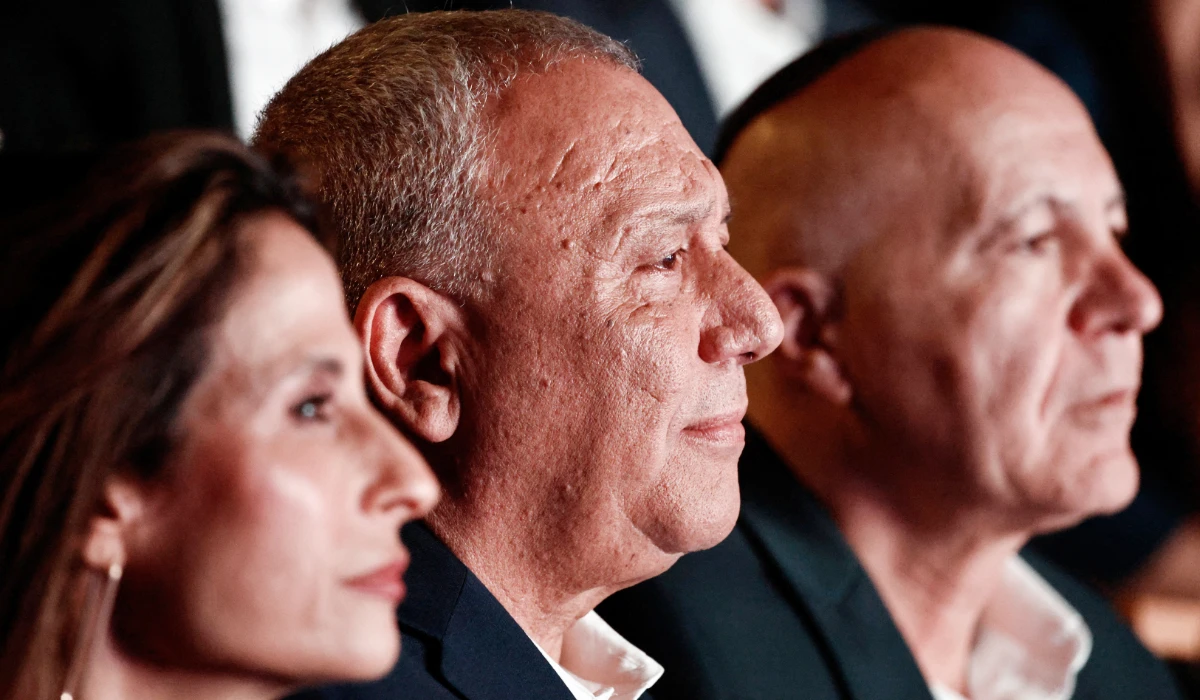
ROSH HAAYIN, Israel: Gadi Eisenkot, the main challenger to Israeli Prime Minister Benjamin Netanyahu, accused the sitting premier of looking merely after his own political survival and not the country’s security, at a rally in central Israel on Monday.
Unveiling the candidates of the Yashar party for the October 27 election, the former military commander said nothing about how he would handle the Palestinian question or the wars against Iran and Lebanon launched by Netanyahu, but accused him of ducking responsibility in the nearly three years since the massive Hamas attack.
A relative newcomer to politics, his party Yashar (Hebrew for “Upright“), founded a year ago, has surged in the polls in recent months, with many voters seeing him as a viable candidate to replace Netanyahu, thanks to his military background.
At Monday’s rally in a hall in the central Israeli city of Rosh Haayin, Eisenkot vowed to put an end to the divisions that have plagued the country since October 7, 2023 over Netanyahu’s conduct of the war in Gaza, where dozens of Israeli hostages were held, and on other fronts.
“In the face of the great rift that opened on October 7, and in the face of the immense challenges before the State of Israel, I believe we need a leadership that knows how to rise to the magnitude of the hour, that knows how to unite and bring unity around what we share, and to fundamentally restore the principles of stateliness and Zionism,” Eisenkot said.
Eisenkot also touched on other hot-button issue in the upcoming election, such as the exemptions and benefits granted to ultra-Orthodox Jewish men.
“Will we go on for more years under a government that promotes evasion of duty without shame? A government that hands out billions of shekels to those who neither serve nor work?” he said.
According to a poll by Israel’s public broadcaster Kan published Sunday, Yashar is expected to win 23 Knesset seats out of 120, slightly ahead of Netanyahu’s Likud at 20.
The anti-Netanyahu bloc is projected to win 51 seats, while Netanyahu’s Likud and its coalition partners are polling at 52 in total.
That means that neither bloc would have the 61-seat majority needed to govern, unless it secures support from unaligned parties, including two Arab-majority lists that together account for 13 seats.
Eisenkot appeared confident that his party would be able to draw away votes from Likud, the historic political home of the Israeli right.
“I meet many people who have been voting for the same party for decades. They tell me how hard it is to vote differently,” he said. “I reply: just as you trust me, I trust you to make the courageous and right choice for Israel.”