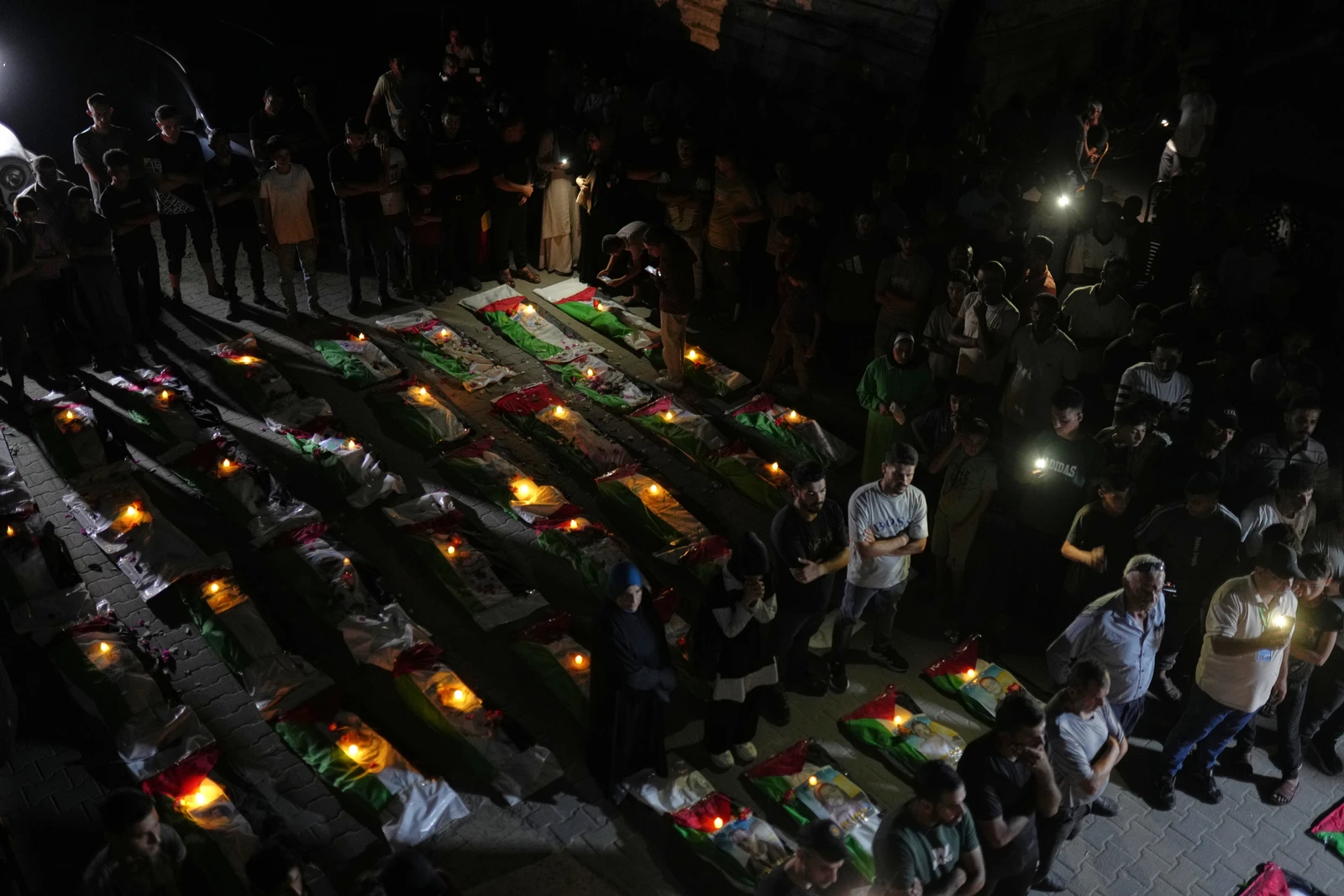
LONDON: Funerals were held in Gaza City on Sunday for about 100 people whose remains were recovered from the ruins of properties destroyed in the early months of Israel’s war. Most of the victims were women and children, the official Palestinian news agency reported.
Their remains were pulled from the rubble of homes belonging to the Malka, Irheim, Al-Balaawi and Salmi families in the city’s Zeitoun neighborhood. Hundreds of relatives, friends and neighbors joined a funeral procession outside the Imam Al-Shafi’i Mosque in Zeitoun.
The remains, wrapped in Palestinian flags, were carried to the nearby Martyrs Cemetery near Al-Ahli Arab Hospital, where they were buried in collective graves.
Recovery teams working with the International Committee of the Red Cross retrieved the bodies after heavy equipment became available to clear debris. Excavators, trucks, bulldozers and other machinery were used in the operation.
A similar mass funeral was held in Gaza last month, involving 112 people whose remains had been trapped beneath the ruins of a residential block for more than two and a half years. Officials said at the time that the remains of a further 157 people were believed to be still buried at the site.
Palestinian authorities estimate that more than 10,000 bodies remain hidden under Gaza’s rubble, underscoring the scale of the challenge facing recovery crews as access and equipment gradually become available.
The recovery effort comes amid concerns about preserving possible evidence of violations of international law.
Francesca Albanese, the UN special rapporteur on human rights in the Palestinian territories, said on Monday that large-scale rubble removal in Israeli-controlled parts of Gaza could erase evidence of international crimes, including genocide, and further entrench Israel’s occupation.
“The debris covering much of the enclave is not simply construction waste,” she said. She described it as a “crime scene, a graveyard and the material record” of a two-year bombing campaign.
The process of rubble removal, crushing and relocation must not destroy evidence or prevent the recovery and identification of human remains, Albanese said, adding that nearly 70 percent of Gaza remained subject to Israeli military access restrictions or control.
She called for human remains to be recovered and identified, sites to be systematically documented, evidence to be preserved and an unbroken chain of custody to be maintained under independent oversight before debris is moved or crushed.
Citing an earlier report by the UN special rapporteur on the right to adequate housing, Albanese said that at least 92 percent of Gaza’s housing units, along with extensive civilian infrastructure, were destroyed or damaged between October 2023 and October 2025.
The report characterized the scale of destruction and displacement as unprecedented in modern warfare.
Mass funeral held for 100 people found beneath Gaza rubble