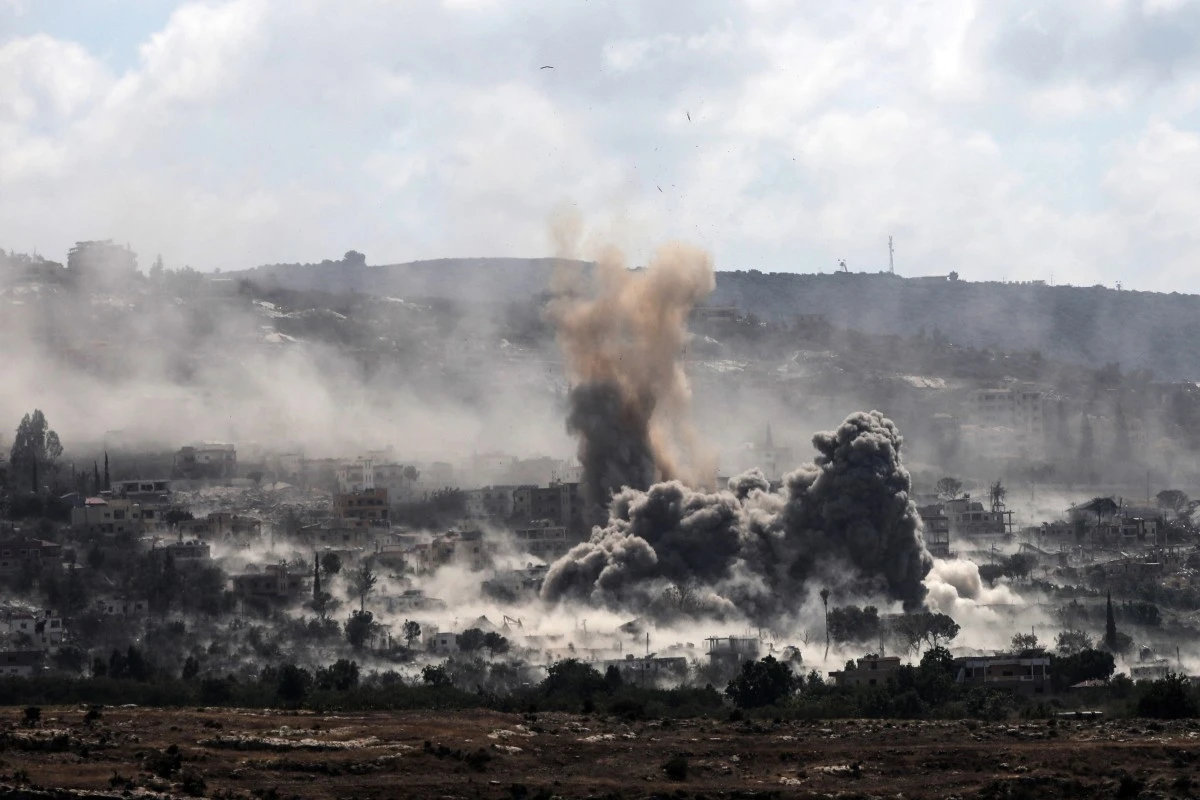
BEIRUT: A three-day Israeli escalation against civilians in southern Lebanon has left 27 people dead, mostly women, children and paramedics, and wounded 69 others, as airstrikes created what locals described as a “ring of fire” around the Nabatieh area, particularly near the Ali Al-Taher heights.
According to Lebanon’s Ministry of Health, 12 people were killed and 10 others wounded in Israeli airstrikes on a residential home in Kafr Rumman, a densely populated town near Ali Al-Taher heights, north of the Litani River. The dead included two children and four women. Eight people were wounded, among them three children and a paramedic who was later killed in a separate Israeli strike on a car in the same town.
Israeli attacks over the weekend targeted Arab Salim, Kafr Rumman, Nabatieh and its outskirts, Mayfadoun, Al-Kfour and Al-Ramadiyah, leaving 11 dead and 26 wounded. These strikes followed another round of attacks from Friday night into Saturday that killed four people and injured 32 others, including women and children.
Lebanon’s Labor Minister Mohamad Haidar mourned a ministry employee, Hiba Ali Sabah, who was killed with her husband and daughter at dawn on Monday when a residential building in Kafr Rumman was hit.
Haidar said: “The massacre also claimed the lives of her husband’s brother, his family, and her father-in-law, in yet another crime added to the record of Israeli crimes against Lebanese civilians, emphasizing the scale of attacks targeting families and safe residential neighborhoods.”
Massive explosions rocked southern Lebanon on Monday as Israeli strikes hit the coastal town of Al-Mansouri near Tyre and the border town of Hula, leveling homes. Overnight on Sunday into Monday, the Israeli army issued an evacuation warning for a building in Deir Al-Zahrani, deep in southern Lebanon, and then destroyed it about 22 minutes later.
The latest wave of Israeli violations of the fragile ceasefire has prompted renewed displacement from villages in the Nabatieh district and surrounding areas.
Israeli army spokeswoman Ella Waweya said the operations were carried out in response to “a flagrant violation of the ceasefire agreement by the terrorist organization Hezbollah, following the launch of an explosive-laden drone toward IDF forces, compelling the IDF to take forceful action against the group.”
Less than 24 hours earlier, the Israeli army had targeted the Finance Ministry building in Nabatieh, and Ghandour Hospital, in what Haidar described as “a flagrant violation of all international rules and conventions.” He called on “the international community and concerned international organizations to take immediate and serious action to put an end to these Israeli crimes and attacks.”
Activists from Nabatieh and southern Lebanon issued a statement warning of “the danger approaching Nabatieh and its surrounding areas,” saying the district and its villages now risked “the same fate as the villages, towns and cities: destruction and displacement.”
The activists said: “The people of the south are meanwhile caught between displacement, fear and uncertainty, while entire villages have lost their character. No one can ask people to wait until destruction reaches their city before raising their voices.”
While affirming the “clear responsibility of the enemy” for what is happening, the statement stressed that this “does not erase the responsibilities of those at home; rather, it makes them all the more urgent” — a clear rebuke of Iran-backed Hezbollah.
“Responsibility for the crime lies with the perpetrator, while responsibility for the choices, decisions and positions lies with those who made them, shielded them or remained silent about them,” the activists said. “Those who have held the decision over war and security in their hands for years, and told southerners that they were best equipped to protect them, must answer today for the consequences of their choice: Where is the land now? What has happened to the villages? And how much capacity do people still have to endure and return?”
The Israeli army announced at the end of last week that it had taken control of the Ali Al-Taher hills and the areas around them, prompting widespread questions inside Lebanon about how the area had fallen. Hezbollah had turned the area into a fortified stronghold with military installations and a command center.
Before Israel moved to occupy the hills, Hezbollah rejected a proposal by Lebanese authorities to hand the area over to the Lebanese army, justifying its refusal by saying it “does not surrender its weapons north of the Litani River.”
The activists said: “What happened at the Ali Al-Taher hills cannot be brushed aside. These hills are the gateway to Nabatieh and one of the key positions protecting it. When it became possible to place them under the authority of the state and the Lebanese army, that option was rejected, and they subsequently fell into the hands of the occupation.
“Repeating the same rhetoric is no longer acceptable. Protecting people and land must take precedence over any partisan or regional consideration.”
The activists called on “the Lebanese state, represented jointly by the Presidency and the Council of Ministers, and the Lebanese army, to fulfill their constitutional and national duty to protect Nabatieh, the villages of its district and their residents, without waiting for negotiations or an agreement with any party, and without treating the protection of people and land as an issue subject to political bargaining.”
They called on the state to use all its resources to stop the occupation from expanding, protect remaining towns and villages, and eliminate the pretexts Israel used to justify further destruction and displacement.
In an unprecedented position that underscores the growing frustration toward Hezbollah, the activists affirmed their commitment to “placing the decision on war and peace exclusively in the hands of the legitimate institutions of the state.”
They added: “Nabatieh is not a bulwark for any axis, nor does it belong to any political group. It is a city that belongs to its people, and the historic capital and center of Jabal Amel. Protecting it begins with restoring the state’s role and ending the duality of decision-making that has exhausted the south and weakened its ability to protect itself.”
Lebanese Prime Minister Nawaf Salam spoke with Nabatieh Mayor Abbas Fakhr El-Din and, according to his press office, affirmed that “these attacks will not deter the government from remaining committed to supporting the return of residents and their resilience, and from providing everything necessary to ensure the continued operation of public facilities and meeting the needs of citizens.”
Parliament Speaker Nabih Berri said: “Israel’s crimes amount to acts of state terrorism, and demonstrate that it has honored none of the formulas or arrangements for a ceasefire. It is acting outside all rules, agreements and understandings, and is proceeding with turning the south, its people and their property into a ballot box stained with blood in the run-up to the next elections, in a contest in which everyone is competing over who can kill and destroy more.”
Israel’s public broadcaster reported on Sunday that the Israeli army was “awaiting political-level approval” to destroy the tunnels at Ali Al-Taher. After destroying them, the Israeli army is expected to withdraw from the Yellow Line and position itself along the Gray Line, a strip extending 2 km to 4 km from the border with Israel.
Israeli attacks on civilians in Lebanon leave 27 dead, 69 wounded