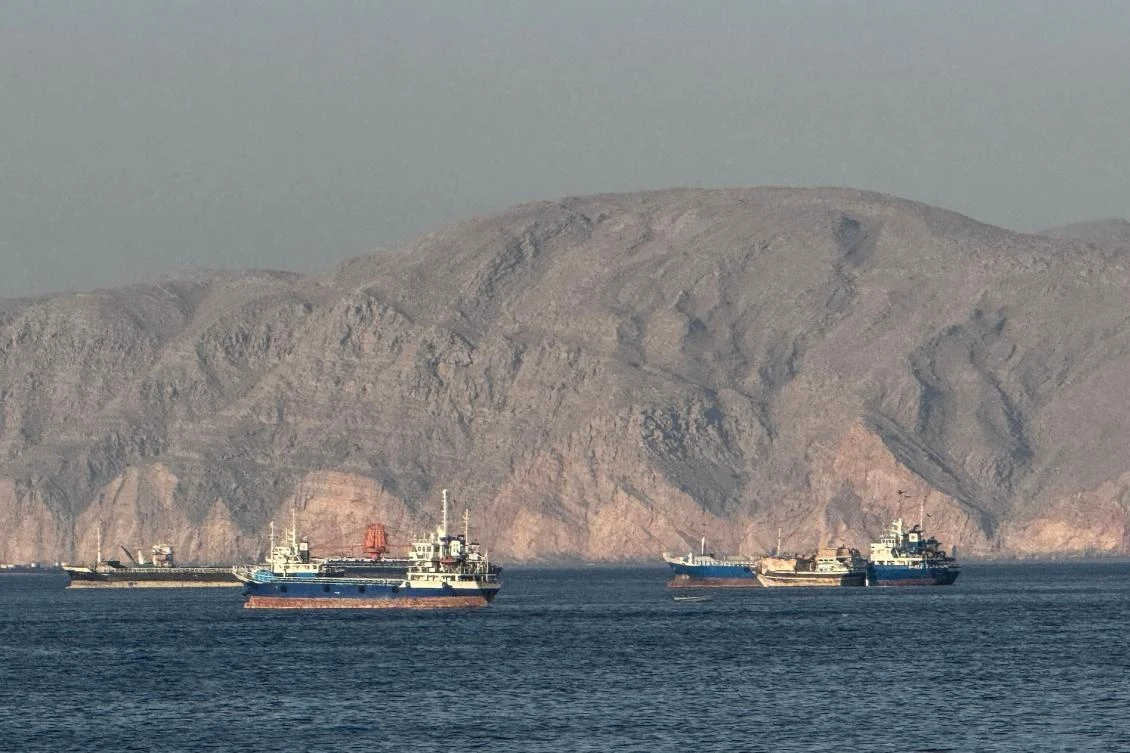
LONDON: In the past few days, US President Donald Trump and Scott Bessent, his treasury secretary, have both suggested that within as little as two years it will no longer be necessary to ship oil through the Strait of Hormuz chokepoint.
“The oil will be going on pipelines across the land,” Bessent told the G20 meeting in North Carolina last week. “In two years, the Straits of Hormuz will be a worthless piece of water.”
On Friday, Trump echoed Bessent’s optimism. “Many oil pipelines are being built in the Middle East,” he told reporters at the White House.
He also welcomed reports that convoys of thousands of trucks are daily carrying oil by road over 1,500 km from southern Iraq to Syria’s Mediterranean port of Baniyas.
It is certainly true that some pipelines that were in place before the current war are up and running at capacity, and that plans are being laid for the construction of several more in the region.
But analysts are expressing doubts about whether such networks can come online in time to have any impact on the current crisis, whether the capacity of such pipelines could ever match that of the tanker fleet, and even whether the oil companies currently considering investing in them will pull out if Hormuz is freed up again before work begins.
“I think the idea that the strait will stop mattering or become worthless is pure rhetoric,” energy analyst Richard Bronze, co-founder and executive director of market intelligence analysts Energy Aspects, told Arab News.
“There are pipeline projects that can provide more capacity that avoids the Strait of Hormuz, particularly for crude oil. Many of these are still at the planning stage.
“But even if all of these projects go through, it’s just not realistic from a purely energy flows point of view to think the strait won’t matter, let alone all the other types of goods that move through that waterway.”
Trucking oil by road is also no long-term solution, said Bronze.
“We have started to see pretty large-scale use of trucks, mostly for Iraqi fuel oil and some crude through Syria.
“But this is a very expensive alternative to pipelines. It’s much less efficient, it’s slower, it costs a lot more for every barrel that you move, and you’re constrained by the capacity and number of trucks you have.
“So this is a way to work in a crisis, but it’s not a desirable long-term option. You can also see rail as an option — I think Iran is exploring this at the moment because of the US blockade — but these are workarounds when a producer is facing real difficulties.
“They’re not the desirable or the preferred, which is always going to be seaborne tankers or pipelines.”
To say the Strait of Hormuz could soon become irrelevant “is way too strong and overstated,” analyst Robert McNally told NPR recently.
McNally, who was senior director for international energy on President George W. Bush’s National Security Council, added: “When we talk about energy flows, the Strait of Hormuz is the most relevant chokepoint on the planet.
“Even if regional producers are able to build pipelines and options to direct flows around Hormuz, the benefit, and there will be a benefit to that, will not make Hormuz irrelevant.”
There are currently two major established and operational pipelines, but both were operating at or near capacity before the start of the war in February.
Petroline, Saudi Arabia’s East-West pipeline, which runs from the Gulf coast to the Red Sea terminal of Yanbu, was built in the 1980s as a hedge against the Iraq-Iran war. It is capable of handling up to 7 million barrels per day of crude oil, of which a maximum of 5 million are earmarked for export.
In July, it was reported that the Kingdom was considering boosting the capacity of Petroline by another 2 million bpd.
Abu Dhabi’s 360 km Crude Oil Pipeline, which was built in 2012 and runs between its onshore Habshan oil field and the port of Fujairah on the Gulf of Oman, can carry only 1.5 million bpd. In May, the Abu Dhabi National Oil Company (ADNOC) announced it was speeding up efforts to double the capacity of the pipeline by 2027.
A network of other pipelines is being considered by Iraq, which is in talks with countries, including Syria and Jordan.
During a visit to Washington in July by Iraqi Prime Minister Ali Al-Zaidi, US oil companies including Chevron signed a series of memoranda of understanding linked to plans to revive a 74-year-old, 850 km-long oil pipeline that was built in 1952 and runs from Kirkuk in northern Iraq to the Syrian port of Baniyas.
Capable of carrying about 300,000 bpd, tensions between Syria and Iraq shut it down in 1982. It was reopened briefly in 2000, but in 2003 it fell victim to another war, when it was damaged by US airstrikes during the US-led invasion of Iraq.
The success of the Kirkuk-Baniyas pipeline project also hangs in large part on improving relations between Baghdad and the Kurdistan Regional Government in Irbil.
Since 1976, Iraq has exported some of its oil 970 km overland to the Mediterranean through Turkiye. The twin Kirkuk-Ceyhan pipelines have a capacity of about 1.5 million bpd, but again the line has been frequently compromised by conflicts in the region.
The decades-old operating agreement between the two countries was due to lapse at the end of this month, but on August 1, Ankara and Baghdad signed a one-year extension, announcing work was underway on a new long-term agreement for the use of the pipeline.
Currently, the Kirkuk-Ceyhan pipeline is operating at about 50 percent of its capacity, but Ankara is in talks with Baghdad to extend it to Iraq’s southern oil fields.
Last year, work began on a new 1,700 km pipeline from Iraq’s southern oil fields around Basra to the Jordanian Red Sea port of Aqaba. When complete, the Basra-Aqaba Oil Pipeline Project will carry up to 2.5 million bpd of crude.
There has also been talk of reopening a historic Iraqi oil pipeline. The Kirkuk-Tripoli pipeline, which carried oil over 928 km to the Lebanese port via Syria, was built in the early 1930s. It has been mothballed since 1984.
Other countries are exploring the possibilities.
Exports of oil from Kuwait have virtually dried up, and last month it emerged that it was in talks with neighboring countries to explore the possibility of building a crude oil pipeline to bypass the Strait of Hormuz.
“We are currently looking for the best and most cost-effective option,” Kuwait’s oil minister Tariq Sulaiman Al-Roumi said last month. Any such project, he added, would be “huge” — and vastly expensive.
Two possible routes have been discussed, but both would be very long and challenging to construct within a timeframe to play any part in countering the current crisis.
One proposed route would connect Kuwait to the Red Sea through Saudi Arabia.
A pipeline from Kuwait to the Saudi port of Yanbu, a straight-line distance of more than 1,000 km, would need to go over or through the Sarawat mountain range, which runs from the Jordanian border in the north to Yemen in the south.
Requiring either massive tunneling operations or a series of pumping stations to carry the oil up and over the mountains, this would be far more expensive than a project covering a similar distance over flat desert terrain.
Another possible pipeline could run all the way to the UAE’s port of Fujairah on the Gulf of Oman.
The overland distance from Kuwait to Fujairah is over 1,200 km and, as this would have to pass through both Saudi and UAE territory, this would require a three-way agreement.
Even when complete, tankers loading at Fujairah would still be potentially exposed to Iranian drone and missile attacks.
But even if all these new and expanded pipelines came on stream, said energy analyst Bronze, they would still not match the capacity of seaborne routes to markets.
In 2025, more than 20 million bpd of crude and petroleum liquids passed through the Strait of Hormuz.
And there are, he said, other issues.
“That doesn’t take account of refined products, which are really critical. Much of the crisis for energy markets at the moment is in diesel, in refined products rather than crude supply. It also doesn’t provide any assistance for moving liquified natural gas.”
Qatar is one of the biggest exporters of LNG in the world, shipping about one-fifth of global supplies on specialist tankers via its Ras Laffan industrial complex, and “there’s no pipeline proposals that are going to solve the problem for getting Qatari LNG out without relying on the strait.”
Some of Qatar’s LNG does currently go via undersea pipeline to Abu Dhabi for distribution to customers in the UAE and Oman.
The 364 km pipeline carries just 20 billion cubic meters (bcm) of natural gas a year, a fraction of Qatar’s usual exports of 110 bcm.
But building pipelines with sufficient capacity to replace the specialist LNG tankers would be a daunting task.
Before natural gas can be loaded onto tankers, it has to be extensively treated and converted into liquid form.
If LNG was to be transported via newly built pipelines for transfer to tankers and wider distribution, doing so would require the construction throughout the supply chain of cryogenic storage infrastructure and dedicated “regasification” terminals.
But even if all the oil and gas produced in the Gulf found routes to market that bypassed the Strait of Hormuz, energy is not the only commodity that flows in and out of the Gulf.
According to a 2025 review of maritime transport carried out by UN Trade and Development, more than 30 million TEU (20-foot equivalent unit) containers passed in and out of the Strait of Hormuz, bound for ports such as Dubai’s Jebel Ali.
In June 2025, for example, of the average of 144 ships per day passing through the strait, 48 were oil tankers, but 24 were container ships carrying everything from iPhones, clothing and manufacturing equipment to white goods, furniture and cars.
Meanwhile, 18 were bulk carriers carrying non-packaged cargoes, such as grain, aluminum, methanol and fertilizer — an important export from the oil-producing Gulf states.
How realistic are plans to bypass the Strait of Hormuz with new oil pipelines?