The Qur’an repeatedly exhorts its readers to seek advice from men of knowledge.
It informs about different facts and then gives the advice: “If you want to know more about this or that, or if you doubt what is said, then you should ask those who have knowledge.”
This too is a surprising attitude. It is not usual to have a book that comes from someone without training in geography, botany, biology, etc., who discusses these subjects and then advises the reader to ask men of knowledge if he doubts anything.
Yet in every age there have been Muslims who have followed the advice of the Qur'an and made surprising discoveries. If one looks to the works of Muslim scientists of many centuries ago, one will find them full of quotations from the Qur’an. These works state that they did research in such a place, looking for something. And they affirm that the reason they looked in such and such a place was that the Qur’an pointed them in that direction.
For example, the Qur’an mentions man’s origin and then tells the reader: “Research it!” It gives the reader a hint where to look and then states that one should find out more about it. This is the kind of thing that Muslims today largely seem to overlook, but not always, as illustrated in the following example.
Embryology
A few years ago, a group of men in Riyadh, Saudi Arabia, collected all of the verses in the Qur’an, which discuss embryology, the growth of the human being in the womb. They said, “Here is what the Qur’an says. Is it the truth?” In essence, they took the advice of the Qur’an: “Ask the men who know.” They chose, as it happened, a non-Muslim who is a professor of embryology at the University of Toronto. His name is Keith Moore, and he is the author of textbooks on embryology, a world expert on the subject. They invited him to Riyadh and said, “This is what the Qur’an says about your subject. Is it true? What can you tell us?”
While he was in Riyadh, they gave him all the help that he needed in translation and all of the cooperation for which he asked. And he was so surprised at what he found that he changed his textbooks. In fact, in the second edition of one of his books, called Before We Are Born... in the section about the history of embryology, he included some material that was not in the first edition because of what he found in the Qur’an was ahead of its time and that those who believe in the Qur’an know what other people do not know.
I had the pleasure of interviewing Dr. Keith Moore for a television presentation, and we talked a great deal about this; it was illustrated by slides and so on. He mentioned that some of the things that the Qur’an states about the growth of the human being were not known until 30 years ago. In fact, he said that one item in particular — the Qur’an’s description of the human being as a “leech-like clot” (Qur'an, 40:67) — was new to him; but when he checked on it, he found that it was true, and so he added it to his book. He said, “I never thought of that before,” and he went to the zoology department and asked for a picture of a leech. When he found that it looked just like the human embryo, he decided to include both pictures in one of his textbooks.
Although the aforementioned example of man researching information contained in the Qur’an deals with a non-Muslim, it is still valid because he is one of those who is knowledgeable in the subject being researched.
Had some layman claimed that what the Qur’an says about embryology is true, then one would not necessarily have to accept his word. However, because of the high position, respect, and esteem man gives to scholars, one naturally assumes that if they research a subject and arrive at a conclusion based on that research, then the conclusion is valid.
Skeptic’s reaction
Dr. Moore also wrote a book on clinical embryology, and when he presented this information in Toronto, it caused quite a stir throughout Canada. It was on the front pages of some of the newspapers across Canada, and some of the headlines were quite funny. For instance, one headline read: “Surprising thing found in ancient prayer book!” It seems obvious from this example that people do not clearly understand what it is all about. As a matter of fact, one newspaper reporter asked Professor Moore: “Don’t you think that maybe the Arabs might have known about these things — the description of the embryo, its appearance and how it changes and grows? Maybe they were not scientists, maybe they did some crude dissections on their own — carved up people and examined these things.”
The professor immediately pointed out to him that he (the reporter) had missed a very important point — all of the slides of the embryo that had been shown and that had been projected in the film had come from pictures taken through a microscope. He said, “It does not matter if someone had tried to discover embryology 14 centuries ago. They could not have seen it!”
All of the descriptions in the Qur’an of the appearance of the embryo are of the item when it is still too small to see with the eye; therefore, one needs a microscope to see it. Since such a device had only been around for little more than 200 years, Dr. Moore taunted, “Maybe 14 centuries ago someone secretly had a microscope and did this research, making no mistakes anywhere. Then he somehow taught Muhammad, may the mercy and blessings of God be upon him, and convinced him to put this information in his book. Then he destroyed his equipment and kept it a secret forever. Do you believe that? You really should not unless you bring some proof because it is such a ridiculous theory.” In fact, when he was asked, “How do you explain this information in the Qur'an?” Dr. Moore’s reply was, “It could only have been divinely revealed!”
Geology
One of Professor Moore’s colleagues, Marshall Johnson, deals extensively with geology at the University of Toronto. He became very interested in the fact that the Qur'an’s statements about embryology are accurate, and so he asked Muslims to collect everything contained in the Qur’an, which deals with his specialty.
Again people were very surprised at the accuracy of the findings. Since there are a vast number of subjects discussed in the Qur'an, it would certainly require a large amount of time to exhaust each subject.
It suffices for the purpose of this discussion to state that the Qur’an makes very clear and concise and correct statements about various subjects while simultaneously advising the reader to verify the authenticity of these statements with research by scholars in those subjects. And as illustrated by the previous examples of embryology and geology, the Qur’an has clearly emerged authentic.
—
Courtesy: islamhouse.com


![]()
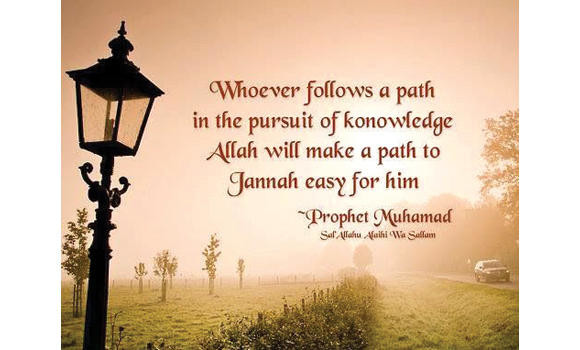

Seek knowledge from learned men
Seek knowledge from learned men
The beauty of prayer in Islam
GOING deeper into our spiritual state during prayers (salah) requires that we have a presence of heart and are mindful of the words being said during the prayers.
Our prayer will feel shorter, yet when we look at how much time we actually spent, we will think, “Did I just spend 10 minutes?” or even 15 and 20 minutes.
A person who began applying this said he wished the prayer would never end.
A feeling that Ibn Al-Qayyim describes as “what the competitors compete for… it is nourishment for the soul and the delight of the eyes,” and he also said, “If this feeling leaves the heart, it is as though it is a body with no soul.”
The love of Allah
Some people’s relationship with Allah is limited to following orders and leaving prohibitions, so that one does not enter hell. Of course, we must follow orders and leave prohibitions, but it needs to be done out of more than fear and hope; it should also be done out of love for Allah. Allah says in the Qur’an: “… Allah will bring forth [in place of them] a people He will love and who will love Him.” (Qur’an, 5:54)
We often find that when a lover meets the beloved, hearts are stirred and there is warmth in that meeting. Yet when we meet Allah, there is not even an ounce of this same feeling. Allah says in the Qur’an: “And (yet) among the people are those who take other than Allah as equals (to Him). They love them as they (should) love Allah. But those who believe are stronger in love for Allah.” (Qur’an, 2:165)
And those who believe are stronger in love for Allah. There should be a feeling of longing, and when we raise our hands to start the prayer, warmth and love should fill our hearts because we are now meeting with Allah. A dua of the Prophet (peace be upon him): “O Allah, I ask You for the longing to meet You” (An-Nisa’i, Al-Hakim)
Ibn Al-Qayyim says in his book Tareeq Al-Hijratain that Allah loves His Messengers and His believing servants, and they love Him and nothing is more beloved to them than Him. The love of one’s parents has a certain type of sweetness, as does the love of one’s children, but the love of Allah far supersedes any of that. The Prophet, peace be upon him, said: “Any person who combines these three qualities will experience the sweetness of faith: 1) that God and His messenger are dearer to him than anything else; 2) that his love of others is purely for God’s sake; and 3) that he hates to relapse into disbelief as much as he hates to be thrown in the fire.” (Bukhari)
Thus, the first thing he mentioned was: “… that God and His messenger are more beloved to him than anything else…”
Ibn Al-Qayyim says: “Since ‘there is nothing like unto Him’ (Qur’an, 42:11), there is nothing like experiencing love for Him.”
If you feel this love for Him, it will be a feeling so intense, so sweet, that you would wish the prayer would never ever end.
Do you truly want to feel this love? Then ask yourself: ‘why do you or should you love Allah?’
Know that you love people for one (or all, in varying degrees) of three reasons: For their beauty, because of their exalted character or/and because they have done good to you. And know that Allah combines all of these three to the utmost degree.
All-embracing beauty
We’ve all been touched by beauty. It is almost fitrah (natural disposition) to love what is beautiful. Ali ibn Abi Talib, may Allah be pleased with him, said about the Prophet, peace be upon him, that it was “as if the sun is shining from his face.” Jabir (may God be pleased with him) said: “The Messenger of Allah was more handsome, beautiful, and radiant than the full moon” (Tirmidhi)
Allah made all His Prophets have a certain beauty so that people would have a natural inclination toward them.
And beauty is more than what is in the face, because beauty is in all of creation and somehow has the ability to take our breath away and give us peace simultaneously. The glimmer of the crescent moon on a calm night, the intensity of a waterfall as the water drops for thousands of feet, the sunset by the sea … certain scenes of natural unspoiled beauty stirs something in us. As Allah is the One Who made it beautiful, so what of Allah’s beauty?
Ibn Al-Qayyim said: “And it is enough to realize Allah’s Beauty when we know that every internal and external beauty in this life and the next are created by Him, so what of the beauty of their Creator?”
This fitrah for loving what is beautiful is because Allah is beautiful. One of His Names is Al-Jameel (the Most Beautiful). Ibn Al-Qayyim states that the beauty of Allah is something that a person cannot imagine and only He knows it. There is nothing of it in creation save for glimpses.
Ibn Al-Qayyim says if all of creation were the most beautiful they could be (so let’s imagine, ever single human being looked as beautiful as Yusuf, peace be upon him, and the whole world was like Paradise), and all of them combined from the beginning of time until the Day of Judgment, they would not even be like a ray in comparison to the sun when compared to Allah. Allah’s beauty is so intense that we will not even be able to take it in this life. In the Qur’an, Allah describes Musa’s (peace be upon him) request: “And when Moses arrived at Our appointed time and his Lord spoke to him, he said, ‘My Lord, show me (Yourself) that I may look at You.’ (Allah) said: ‘You will not see Me but look at the mountain; if it should remain in place, then you will see Me.’ But when his Lord appeared to the mountain He rendered it level, and Moses fell unconscious.” (Qur’an, 7:143)
Even the mountain could not bear the beauty of Allah and crumbled, and when Musa, peace be upon him, saw this (he did not even see Allah), he fell unconscious. This is why on the Day of Judgment it is Allah’s light that will shine on everything. We talk about breathtaking beauty, but we have yet to experience Allah’s beauty. While things in this world can be beautiful or majestic or if they combine both they are finite, true majesty and beauty are for Allah: “And there will remain the Face of your Lord, Owner of Majesty and Honor.” (Qur’an, 55:27)
Keeping all of this in mind, the Prophet, peace be upon him, said: “Allah directs His Face toward the face of His servant who is praying, as long as he does not turn away” (Tirmidhi).
Remember this in your prayer, and ask Allah to allow you the joy of seeing Him in Paradise.
Our prayer will feel shorter, yet when we look at how much time we actually spent, we will think, “Did I just spend 10 minutes?” or even 15 and 20 minutes.
A person who began applying this said he wished the prayer would never end.
A feeling that Ibn Al-Qayyim describes as “what the competitors compete for… it is nourishment for the soul and the delight of the eyes,” and he also said, “If this feeling leaves the heart, it is as though it is a body with no soul.”
The love of Allah
Some people’s relationship with Allah is limited to following orders and leaving prohibitions, so that one does not enter hell. Of course, we must follow orders and leave prohibitions, but it needs to be done out of more than fear and hope; it should also be done out of love for Allah. Allah says in the Qur’an: “… Allah will bring forth [in place of them] a people He will love and who will love Him.” (Qur’an, 5:54)
We often find that when a lover meets the beloved, hearts are stirred and there is warmth in that meeting. Yet when we meet Allah, there is not even an ounce of this same feeling. Allah says in the Qur’an: “And (yet) among the people are those who take other than Allah as equals (to Him). They love them as they (should) love Allah. But those who believe are stronger in love for Allah.” (Qur’an, 2:165)
And those who believe are stronger in love for Allah. There should be a feeling of longing, and when we raise our hands to start the prayer, warmth and love should fill our hearts because we are now meeting with Allah. A dua of the Prophet (peace be upon him): “O Allah, I ask You for the longing to meet You” (An-Nisa’i, Al-Hakim)
Ibn Al-Qayyim says in his book Tareeq Al-Hijratain that Allah loves His Messengers and His believing servants, and they love Him and nothing is more beloved to them than Him. The love of one’s parents has a certain type of sweetness, as does the love of one’s children, but the love of Allah far supersedes any of that. The Prophet, peace be upon him, said: “Any person who combines these three qualities will experience the sweetness of faith: 1) that God and His messenger are dearer to him than anything else; 2) that his love of others is purely for God’s sake; and 3) that he hates to relapse into disbelief as much as he hates to be thrown in the fire.” (Bukhari)
Thus, the first thing he mentioned was: “… that God and His messenger are more beloved to him than anything else…”
Ibn Al-Qayyim says: “Since ‘there is nothing like unto Him’ (Qur’an, 42:11), there is nothing like experiencing love for Him.”
If you feel this love for Him, it will be a feeling so intense, so sweet, that you would wish the prayer would never ever end.
Do you truly want to feel this love? Then ask yourself: ‘why do you or should you love Allah?’
Know that you love people for one (or all, in varying degrees) of three reasons: For their beauty, because of their exalted character or/and because they have done good to you. And know that Allah combines all of these three to the utmost degree.
All-embracing beauty
We’ve all been touched by beauty. It is almost fitrah (natural disposition) to love what is beautiful. Ali ibn Abi Talib, may Allah be pleased with him, said about the Prophet, peace be upon him, that it was “as if the sun is shining from his face.” Jabir (may God be pleased with him) said: “The Messenger of Allah was more handsome, beautiful, and radiant than the full moon” (Tirmidhi)
Allah made all His Prophets have a certain beauty so that people would have a natural inclination toward them.
And beauty is more than what is in the face, because beauty is in all of creation and somehow has the ability to take our breath away and give us peace simultaneously. The glimmer of the crescent moon on a calm night, the intensity of a waterfall as the water drops for thousands of feet, the sunset by the sea … certain scenes of natural unspoiled beauty stirs something in us. As Allah is the One Who made it beautiful, so what of Allah’s beauty?
Ibn Al-Qayyim said: “And it is enough to realize Allah’s Beauty when we know that every internal and external beauty in this life and the next are created by Him, so what of the beauty of their Creator?”
This fitrah for loving what is beautiful is because Allah is beautiful. One of His Names is Al-Jameel (the Most Beautiful). Ibn Al-Qayyim states that the beauty of Allah is something that a person cannot imagine and only He knows it. There is nothing of it in creation save for glimpses.
Ibn Al-Qayyim says if all of creation were the most beautiful they could be (so let’s imagine, ever single human being looked as beautiful as Yusuf, peace be upon him, and the whole world was like Paradise), and all of them combined from the beginning of time until the Day of Judgment, they would not even be like a ray in comparison to the sun when compared to Allah. Allah’s beauty is so intense that we will not even be able to take it in this life. In the Qur’an, Allah describes Musa’s (peace be upon him) request: “And when Moses arrived at Our appointed time and his Lord spoke to him, he said, ‘My Lord, show me (Yourself) that I may look at You.’ (Allah) said: ‘You will not see Me but look at the mountain; if it should remain in place, then you will see Me.’ But when his Lord appeared to the mountain He rendered it level, and Moses fell unconscious.” (Qur’an, 7:143)
Even the mountain could not bear the beauty of Allah and crumbled, and when Musa, peace be upon him, saw this (he did not even see Allah), he fell unconscious. This is why on the Day of Judgment it is Allah’s light that will shine on everything. We talk about breathtaking beauty, but we have yet to experience Allah’s beauty. While things in this world can be beautiful or majestic or if they combine both they are finite, true majesty and beauty are for Allah: “And there will remain the Face of your Lord, Owner of Majesty and Honor.” (Qur’an, 55:27)
Keeping all of this in mind, the Prophet, peace be upon him, said: “Allah directs His Face toward the face of His servant who is praying, as long as he does not turn away” (Tirmidhi).
Remember this in your prayer, and ask Allah to allow you the joy of seeing Him in Paradise.
Latest updates


© 2026 SAUDI RESEARCH & PUBLISHING COMPANY, All Rights Reserved And subject to Terms of Use Agreement.