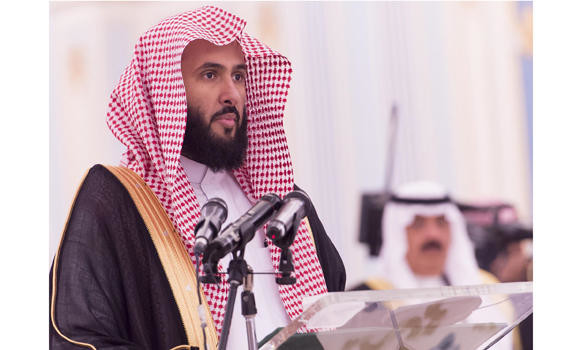
JEDDAH: Justice Minister Walid Al-Samaani on Tuesday reiterated that trials in the Saudi courts, including terror-related cases, have to follow rigorous procedures in terms of providing evidence.
He explained that at the first stage of litigation, three judges preside over the Criminal Court. When the case is sent to Appeals Court, five judges look into it. After this, the case goes to the Higher Court, where it is studied by another set of five judges. At this stage, the final verdict is issued.
Before a final verdict is delivered, it goes through no less than 13 judges, making the judgment absolutely indisputable.
“The trials are completely transparent and in line with Islamic law,” said Al-Samaani.
Lawyer Ahmed Al-Jamaan Al-Malki, a member of the Arab Lawyers Union, said the Saudi judiciary is based on Islamic law derived from the Holy Qur’an, Sunnah, consensus (Ijma’), and analogy (Qiyas).
Saudi Arabia is the only country in the world that relies fully on Islamic laws for verdicts of all kinds, which are enshrined in the country’s Basic Law of Governance.
He said the judiciary is independent. Even evidence submitted by the king must conform to Islamic law, he said. Some cases are overseen by one judge whereas criminal cases involving execution, amputation or stoning involve three judges. There are five judges sitting at the Appeals Court and five at the Supreme Court.
Abdullah Al-Falaj, a legal consultant, said that Saudi law provided that the judiciary be an independent authority.
“There shall be no power over judges in their judicial function other than the power of the Shariah. These are guarantees for the independence of the judicial authorities and systems, so that everyone is equal before the law without discrimination by one person against another,” Al-Falaj said.
He said that the law provided that an accused person shall have the right to seek the assistance of a lawyer or a representative to defend him or her during the investigation and trial.
Al-Falaj said the Kingdom had ratified a number of international conventions and treaties on human rights, such as the Arab Charter on Human Rights, Convention on the Rights of the Child, International Convention on the Elimination of All Forms of Racial Discrimination and the Convention on the Prevention and Punishment of the Crime of Genocide.
RELATED STORY: Saudi judicial system gives accused full rights to defend